

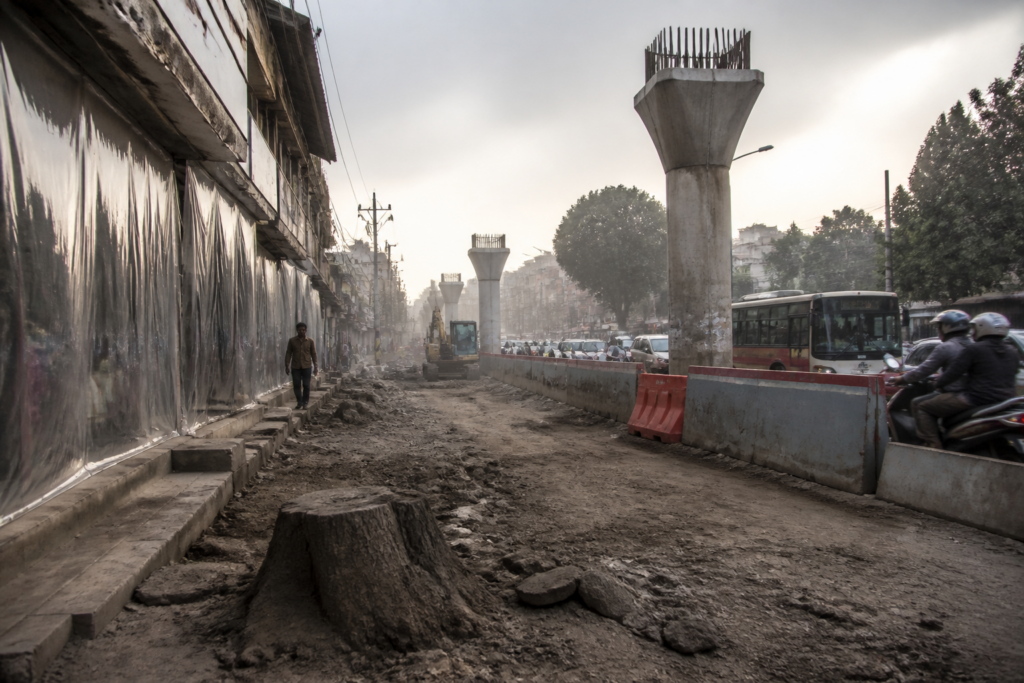
PVC curtains have become an improvised line of defence for shopkeepers along Bhopal’s road from Prabhat Chouraha to Ratnagiri, where Metro and Public Works Department flyover construction has left businesses dealing with dust, cement-laden debris, damaged surfaces and slower traffic. The change is small but revealing: a product that was once uncommon is now being used by traders as basic protection for merchandise and shop interiors.
The Times of India report from Bhopal describes a construction corridor where the immediate disruption is not limited to inconvenience. Loose soil, unfinished road surfaces and continuing vehicle movement are combining to push dust into shops and onto the road. For citizens, the corridor has become a daily test of how infrastructure works are managed while construction is still under way.
The central issue is not that a Metro line or flyover is being built. Urban infrastructure projects routinely require excavation, diversions, tree removal and changes to road space. The more important question raised by the BHEL experience is whether the temporary conditions created by construction are being controlled adequately for the people who continue to live, work and travel beside the project.
In BHEL, shopkeepers say fine dust repeatedly settles on counters, merchandise and interiors. Installing transparent PVC curtains allows them to retain visibility from the road while reducing the amount of grime entering their premises. The measure also illustrates how the cost of construction disruption can shift quietly from project agencies to individual businesses. Each shopkeeper must find a private remedy for a public-space problem.
The report identifies the main road from Prabhat Chouraha to Ratnagiri as a particularly affected stretch. It also refers to sections of the under-construction Blue Line Metro corridor, where damaged and unfinished surfaces have left loose soil exposed. When vehicles pass over such surfaces, material is disturbed and carried into the air. The report says there is no clear timeline for road restoration, leaving traders concerned that the dust will continue while construction remains incomplete.
That absence of a clear restoration timeline matters because roads around major projects serve two functions at once. They are work sites for contractors and operating public routes for residents, workers, emergency personnel and commercial vehicles. A construction plan that accounts for the final structure but leaves the interim road condition unresolved can create a prolonged period in which neither function works properly.
The BHEL corridor also shows how construction affects movement beyond a work site’s physical footprint. Nidhi, a paramedic who travels daily from BHEL to Nehru Nagar, told the Times of India that even public transport takes almost an hour to reach work. She said traffic on the stretch from Pul Bogda to Ratnagiri barely moves at an average speed of 20 kmph.
For a daily commuter, that figure is not simply a traffic statistic. It represents time added to a journey and reduced reliability for people whose work may begin at fixed hours. In the case of a paramedic, the account also places the disruption in the context of essential urban services. The report does not establish the total number of affected commuters or the overall increase in travel time across the corridor, but it does provide a ground-level indication of how construction is changing routine mobility.
The contrast drawn by the commuter between the Ratnagiri stretch and the Blue Line corridor towards Lok Bhawan and New Market also raises a question about how traffic management is prioritised around large public projects. She said the latter areas receive more attention because VVIP movement is more frequent. That is a local perception recorded in the report, not an independently established explanation for the difference. It nevertheless points to the need for traffic management to be assessed against everyday commuter needs, not only exceptional movements.
The report says there are hardly any traffic wardens deployed by the Metro or PWD to manage the situation. Without sufficient on-site direction, commuters are left to navigate congestion and altered road conditions themselves. The institutional problem is therefore one of coordination as much as construction. Metro works, flyover works, traffic operations and road maintenance may involve different agencies or contractors, but citizens experience them as one corridor and one journey.
This division of responsibility can make construction impacts difficult to resolve. A Metro agency may be responsible for its work zone, the PWD for a flyover or road component, and traffic authorities for movement management. Yet dust control, safe access to shops, road levelling and traffic diversion are connected in practice. If each issue is treated as a separate task, the public space between them can remain unmanaged.
The account of tree removal adds another layer to the problem. Suraj Verma, a local shopkeeper, said around half a dozen trees had been cut for the project and alleged that the contractor had not levelled the ground properly. He also said tree stumps were still protruding and posed a risk to vehicles. These are on-record claims from a local trader as reported by the Times of India; the report does not include a response from the contractor or the agencies involved.
That limitation is important. The available material establishes that a shopkeeper raised concerns about exposed stumps and poor levelling, but it does not establish the project’s approved tree-removal plan, the agency responsible for restoring the ground, or whether corrective work has since been ordered. Those unanswered questions sit at the point where project execution becomes public accountability.
Construction dust is also an urban health concern, although the supplied report does not provide air-quality readings or a measured assessment of particulate levels on the corridor. It records concerns that repeated exposure to dust and fine particulate matter can irritate the eyes and throat and aggravate respiratory conditions. The people most continuously exposed are not only passing commuters but also shopkeepers, workers, traffic personnel and residents who spend long hours beside the construction zone.
The lack of measurements does not make the concern irrelevant. It shows what is missing from the public account of a prolonged construction project. Residents and businesses need more than a description of dust after it has settled. They need to know what dust-control measures are being used, how often roads are cleaned or wetted, who is monitoring exposed surfaces, and when damaged stretches will be made usable again. None of those operational details is provided in the supplied report.
The same evidence points to the importance of temporary access planning. Shops along the corridor remain open, and their entrances must continue to function while roads are being altered. If dust, debris or uneven surfaces make access difficult, the impact falls most directly on small businesses that cannot relocate their operations. The PVC curtain is therefore a visible sign of adaptation, but it should not be mistaken for a substitute for managed construction conditions.
Bhopal’s case also demonstrates why project timelines must include interim milestones, not only the final completion date. A final Metro or flyover deadline does not answer when a particular road section will be levelled, when traffic control will be strengthened, or when access to adjoining shops will improve. For people using the corridor every day, these smaller milestones define whether the project is tolerable during construction.
The report does not state the sanctioned cost, construction schedule, contract conditions or formal division of responsibility between the Metro authorities, PWD and traffic police. It also does not provide an official response to the complaints from traders and commuters. Those omissions prevent a complete assessment of whether the disruption reflects a temporary delay, inadequate site management or a broader failure to coordinate works.
What the evidence does confirm is a linked chain of urban effects: unfinished surfaces contribute to dust; dust affects businesses and raises exposure concerns; altered roads slow traffic; and limited traffic management leaves commuters to negotiate the consequences. None of these problems exists in isolation. Their combined effect is what changes a construction corridor from an inconvenience into a daily urban burden.
The larger lesson for Bhopal is that infrastructure delivery must be judged not only by the structure eventually produced but also by the quality of the city maintained during construction. The immediate questions are practical and verifiable: who will restore the road surface, who will remove or secure hazardous stumps, how will dust be controlled, how will traffic be managed, and when will affected stretches be made safer for businesses and commuters? Until those answers are provided, PVC curtains, slow journeys and exposed road edges will remain the most visible indicators of how the project is being experienced on the ground.


