

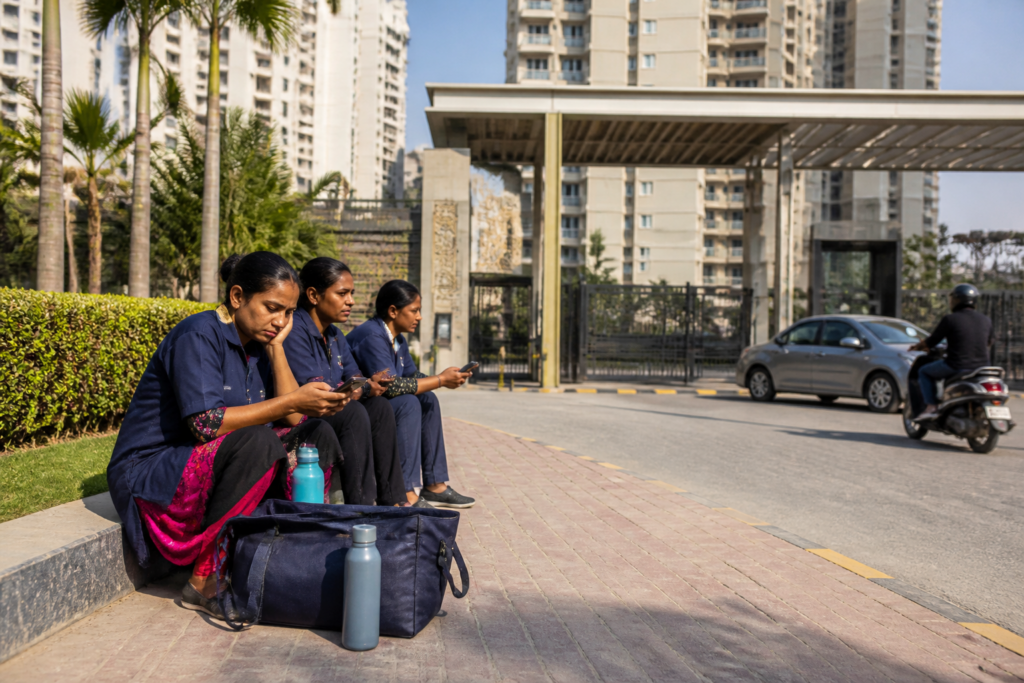
Six months after women gig workers in Noida protested over working conditions, some changes have followed: workers say they now receive four days of monthly leave, medical insurance and more geographically concentrated bookings. Yet the basic urban infrastructure they need between appointments—washrooms, drinking water and a place to rest—remains largely unresolved.
That gap reveals a central weakness in the way Indian cities accommodate platform work. Gig workers are visible across apartment complexes, commercial districts and residential streets, but the spaces they use are organised around customers, security systems and traffic movement rather than the workers who keep these services operating.
The April 15 protest by about 40 women associated with Urban Company took place amid wider labour unrest in Noida. The workers marched in company uniforms with a 10-point charter that included more predictable working hours and a place to rest. They were detained during the protest, but workers told The Indian Express that all protesters had subsequently been released.
Four days after the protest, the workers met company representatives. According to the workers, the meeting resulted in several changes. Bookings were limited to smaller geographic areas, reducing the distance between appointments. Workers also said the company introduced four days of leave each month and provided medical insurance. Earlier, they said, taking leave led to salary cuts.
These changes address some of the uncertainty built into platform-based service work. A worker may receive several appointments in a day but have limited control over where those appointments are located or how much time is available to travel between them. Riya, a 38-year-old worker from Bihar, said she previously received bookings across four or five areas. She now often receives multiple bookings in the same area, reducing the need to move long distances between homes.
The change is important because travel is not simply a question of distance. Workers must navigate traffic, apartment security gates, lifts, building layouts and customer schedules within short gaps between bookings. The source report describes one worker finishing an early-morning 45-minute booking before waiting for the next schedule during a 17-minute break. Such intervals are neither conventional working time nor genuine rest time, but they are essential to completing the day’s appointments.
The workers’ accounts also show how the built environment transfers the cost of missing facilities to individuals. Pinky Devi, whose name was changed in the report, said workers carry their own drinking water because asking customers for it can be uncomfortable. Some customers offer water, she said, while others are hesitant. This makes access to a basic utility dependent on personal interaction inside private homes rather than a predictable public or workplace arrangement.
Washrooms are an even sharper example. Sushma, another worker quoted under a changed name, said she once held her urine for four hours while moving between bookings. When she finally asked to use a customer’s washroom, she feared that the request could result in a low rating or negative feedback. The problem was therefore not only the absence of a toilet. It was also the worker’s dependence on the customer’s goodwill and the possibility that using a basic facility could affect her platform reputation.
According to Sushma, some women have relieved themselves near bushes when they had only a few minutes before the next appointment. The account points to a failure that is difficult to capture in conventional measures of urban infrastructure. A city may have toilets in public places, commercial buildings and housing societies, but those facilities are not necessarily accessible to workers moving through the city without a fixed workplace.
The distinction between having infrastructure and being able to use it is crucial. Women entering high-rise societies may be allowed through only when they have an active booking. Guards may prevent them from sitting inside the complex while waiting for the next appointment. Workers told the newspaper that supervisors have spoken to apartment complexes to request access to sitting areas, but that guards do not always allow it. In practice, access depends on security staff, building rules and whether a supervisor can intervene.
This creates a fragmented workplace spread across private homes and controlled common areas. Unlike an office worker, a gig worker may not have a designated staff room, toilet or drinking-water point. Unlike a street vendor or construction worker, she may not remain in one location long enough for a single facility to serve her. Her working day is distributed across a network of buildings, roads, parks and waiting points, but responsibility for the spaces between jobs remains unclear.
The lack of a rest area also exposes the tension between platform incentives and public health concerns. Sushma said workers sometimes lit wood fires in winter to keep warm and found it difficult to sit outdoors during summer. She also said the company offered an additional Rs 50-100 for working during the afternoon, when the government advises people to avoid the sun. The account shows how a worker’s need for additional income can conflict with the safety guidance associated with extreme heat.
The question is not limited to one company or one category of domestic service. The evidence in this case concerns Urban Company workers in Noida, but the underlying issue is broader: cities have not clearly assigned responsibility for the welfare of workers whose jobs are managed digitally but performed in physical neighbourhoods. Companies control bookings, ratings and incentives. Housing societies control entry and common areas. Municipal authorities control public infrastructure. The worker moves through all three systems without a guaranteed place to pause.
The reported changes after the protest demonstrate that worker action can influence platform conditions. Concentrating bookings by area reduces travel pressure. Leave and medical insurance provide protections that workers said were previously unavailable. The workers’ accounts suggest that collective action produced benefits that individual complaints had not secured, particularly because the protest converted scattered experiences into a shared demand.
But the unresolved demands are also significant. The company does not provide a travel allowance, according to the workers quoted in the report. Washrooms, water and rest spaces remain dependent on customers, guards, supervisors, parks or improvised arrangements. These are not marginal conveniences. They determine whether a worker can remain in the job without compromising bodily needs, safety or dignity.
The institutional question is therefore whether worker welfare can be addressed only through company-level changes. A platform can limit booking areas or provide insurance, but it cannot by itself create a connected network of accessible toilets and rest spaces across a city. A housing society can regulate entry, but its rules may not account for workers who spend much of their day serving residents. Municipal authorities can provide public facilities, but the report does not indicate that a coordinated system exists for workers whose routes change throughout the day.
Noida’s urban form makes this problem particularly visible. The workers described in the report move between high-rise apartment complexes, roads, parks and commercial areas. These spaces may be physically close yet institutionally separate. A worker can be within a large residential development but still have nowhere to sit. She can be surrounded by homes but unable to use a toilet without asking a customer. She can be employed through a formal platform but lack a fixed workplace with basic amenities.
The story also complicates the idea that shorter travel automatically means better working conditions. Reduced distance between bookings can lower time and transport pressure, but it does not resolve the absence of facilities during the remaining gaps. The platform may improve the schedule while the city continues to provide no place for the worker to wait. Better allocation of jobs is therefore only one part of the problem.
What the available evidence confirms is that the protest produced measurable gains in leave, insurance and booking locations, while basic access to water, toilets and rest remains unsettled. What remains unclear is how consistently the reported changes apply across all workers, how the company monitors them, and whether any public authority has accepted responsibility for facilities serving mobile gig workers. Those questions will determine whether Noida’s response becomes a durable urban-workplace arrangement or remains a partial adjustment to a continuing gap.


