

Maharashtra’s groundwater depletion has worsened sharply in a decade, with 3,321 observation wells reporting a decline in water levels in 2025 compared with 2,246 during the drought year of 2015. The 47.8% increase, presented to the state cabinet, is not only a measure of rainfall stress. It also reveals how heavily large parts of the state depend on groundwater for drinking water and irrigation, and how quickly a seasonal deficit can become an administrative crisis.
The immediate context is severe. The state is experiencing one of its most widespread droughts this year, with 85% of its talukas affected. Ten of Maharashtra’s 36 districts have recorded a rainfall deficit of more than 40% against the norm after the monsoon’s retreat, while 24 districts have reported a deficit of more than 25%. The groundwater figures therefore sit within a broader pattern of water scarcity rather than representing isolated well-level fluctuations.
Observation wells are selected across different parts of the state to track groundwater levels. In rain-dependent regions, these wells provide an important indicator of the water available for both households and agriculture. The Groundwater Survey and Development Agency, or GSDA, described the increase in depleted wells as significant. The comparison with 2015 is particularly important because that year was also marked by drought. A higher number of depleted wells in 2025 suggests that the current stress is spread across a wider network of monitored locations than it was during the earlier drought year.
The distribution of the 3,321 wells shows that the problem is not confined to one region. Marathwada has the highest number, with 862 wells reporting groundwater decline. North Maharashtra follows with 650, while Western Maharashtra has 558, Amravati 531, Nagpur 530 and Konkan 190. These figures reflect the number of affected observation wells in each region; they do not, on their own, establish the depth or duration of depletion across every district. But they do show that groundwater stress is geographically broad, extending from the drought-prone interior to regions outside Marathwada.
The comparison with 2015 becomes more revealing at the regional level. North Maharashtra recorded an increase from 362 depleted observation wells in 2015 to 650 in 2025, a rise of 79.5%. Nagpur saw the number rise from 279 to 530, an increase of 89.9%, while Amravati recorded an increase from 298 to 531, or 78.1%. These are among the sharpest increases reported in the state. They indicate that the deterioration is not simply a continuation of the long-established water stress narrative around Marathwada; other regions are also showing a marked worsening in monitored groundwater conditions.
The depth of depletion adds another layer to the data. In 964 observation wells across Maharashtra, groundwater has fallen by more than three metres. Of these, 594, or 61.6%, are in Marathwada and 160, or 16.5%, are in North Maharashtra. The government considers a decline of more than three metres an indicator that a region will face water problems from the month in which the threshold is recorded. This makes the measurement administratively significant: it is not only a scientific observation but also part of the framework used to assess drought and determine the need for emergency supply measures.
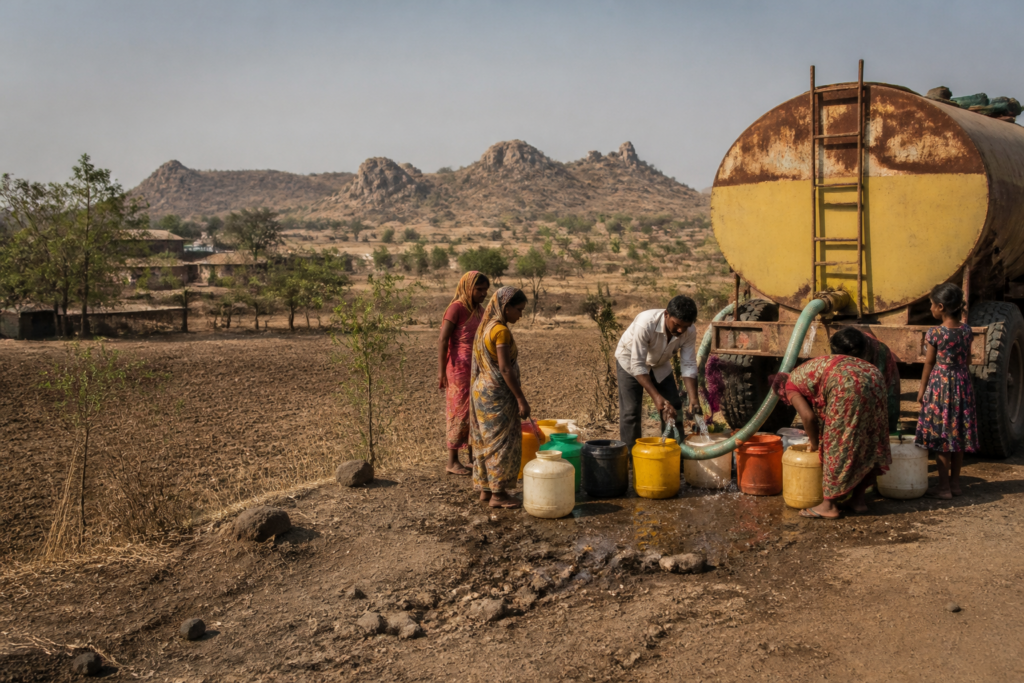
That emergency response is already visible in the number of tankers serving rural areas. A total of 768 tankers are supplying water in the state, an increase of 25.7% in just one week. Tankers provide a direct response to villages and settlements where regular sources are insufficient, but the rapid increase also shows how quickly water stress can create a logistical burden for the administration. Each additional tanker represents not only a shortage at the source but also the need to organise vehicles, routes, filling points and delivery schedules.
The rainfall data helps explain the immediate pressure on those sources. Solapur in Western Maharashtra recorded the highest deficit, at 53%. It was followed by Nandurbar in North Maharashtra at 51.3% and Latur in Marathwada at 51.2%. Other districts with deficits above 40% include Kolhapur at 49%, Amravati at 45.2%, Parbhani at 45.6%, Dharashiv at 41.3%, Akola at 41.1%, Washim at 40.9% and Beed at 40.3%.
These figures should not be read as a simple ranking of districts. Rainfall deficit measures the difference from the normal level, while groundwater depletion reflects the condition of monitored wells. The two indicators are related, but they describe different parts of the water system. Rainfall determines how much water can enter the system during the season; groundwater observations show what remains available below the surface. The cabinet data becomes more consequential because both indicators are moving in the same direction across large parts of the state.
The institutional role of the GSDA is central to this process. Its observation-well network provides the measurements used to identify groundwater decline, while the state uses groundwater depletion among the indicators for declaring drought. This creates a direct link between technical monitoring and public administration. A well-level reading can contribute to a wider decision about drought status, water tankers and the allocation of government attention.
The figures also show why groundwater cannot be treated as a private or invisible reserve. In rainfall-dependent areas, it supports two essential functions at the same time: drinking water and irrigation. When the water table falls, households may face shortages while farmers confront reduced access to a resource on which cultivation depends. The supplied data does not quantify the number of households, farms or villages affected by the decline, so the full social and economic impact cannot be established from these figures alone. It does, however, establish the scale of the underlying water stress.
The comparison between 2015 and 2025 further complicates the idea that one good monsoon can resolve the problem. The current report records conditions after a major rainfall deficit and does not provide a long-term annual series for every observation well. It therefore cannot by itself determine how much of the increase is permanent, how much is seasonal, or how local extraction patterns have influenced individual wells. What it does establish is that the state now has substantially more monitored wells reporting depletion than during a previous drought year.
This distinction matters for policy. The state’s immediate instruments include drought assessment and tanker supply, both of which respond to visible scarcity. The observation-well data, however, points to a need for continued measurement of the less visible reserve that supports villages between rainfall events. Without consistent monitoring, changes in groundwater can remain unnoticed until they become a drinking-water emergency. The supplied report does not detail any new groundwater-recharge programme, extraction regulation or funding decision, so the policy response beyond tanker deployment is not established here.
The geographic pattern also has implications for how Maharashtra understands water vulnerability. Marathwada accounts for most of the wells with depletion of more than three metres, but North Maharashtra, Nagpur and Amravati have recorded some of the sharpest increases compared with 2015. A state-wide water strategy based only on historically drought-prone districts would not fully reflect the current data. The monitoring results show that risk is expanding or intensifying across multiple regions, even though the scale and depth of the problem differ from one area to another.
For urban readers, the groundwater numbers are a reminder that Maharashtra’s water system is not divided neatly between cities and rural areas. The reported tanker response is rural, and the observation wells are distributed across the state, but the underlying issue concerns the reliability of water sources, the management of drought and the resilience of settlements dependent on rainfall. The data supplied does not establish a direct impact on Mumbai or another particular city. It does establish a state-wide water stress that places additional demands on public administration and essential services.
The evidence confirms three things: groundwater depletion is higher than in the comparable drought year of 2015; the decline is distributed across several regions; and the most severe readings are already linked to an expanding tanker response. What remains unclear from the available data is how long individual wells have been declining, how much extraction contributes to the fall and what measures will follow the cabinet’s review. Those questions will determine whether the current response remains an emergency supply operation or becomes part of a longer-term groundwater management framework.


