

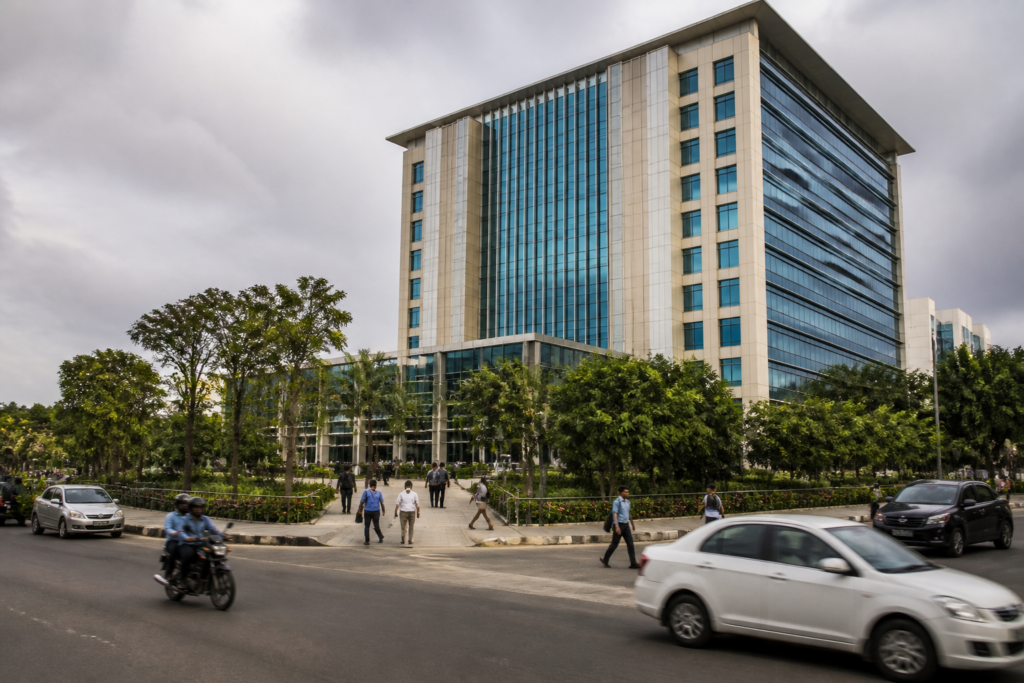
Cognizant’s decision to lease 645,172 sq ft at Embassy Splendid TechZone in Chennai is more than a large corporate real estate transaction. It is a visible indicator of how major occupiers are continuing to commit to office space even as the market’s demand profile changes and flexible workspace operators gain ground.
According to transaction documents accessed by Propstack and reported by Business Standard, Cognizant Technology Solutions India has signed a five-year lease for space from the ground to the ninth floor of Tower 3 at Embassy Splendid TechZone Block 1. The office park is located in Pallavaram, along the Pallavaram-Thoraipakkam Road corridor.
The company will pay a monthly rent of ₹4.77 crore for the chargeable area, equivalent to ₹74 per sq ft. The agreement provides for a 15 per cent escalation every three years. Over the initial five-year term, the starting monthly rental alone represents a commitment of more than ₹286 crore before accounting for the scheduled escalation. The calculation illustrates the scale of the transaction, although the supplied report does not provide the lease’s other commercial terms, such as deposits, fit-out costs, operating expenses or renewal conditions.
The transaction also places Pallavaram within a larger story about how Chennai’s office districts are being used by technology companies. The location sits on a corridor that connects the southern and southeastern parts of the metropolitan region, where office parks and employment centres have expanded alongside residential development and transport demand. The lease itself does not establish how many employees will occupy the premises or whether the space represents expansion, consolidation or relocation. Those details are not available in the supplied material.
What the deal does establish is that large technology occupiers continue to make substantial, multi-year commitments to physical workplaces. Cognizant’s latest lease follows another agreement signed in September with flexible workspace operator WeWork India for 141,392 sq ft at the same Pallavaram office park. Taken together, the two transactions indicate that the campus has attracted both a large direct occupier and a flexible workspace provider within a relatively short period.
The distinction between these two forms of occupation matters for the structure of office markets. A conventional corporate lease gives one large company direct control over a substantial block of space for a defined period. A flexible workspace agreement can serve a different requirement, allowing space to be used by teams or companies with changing headcounts and shorter or more adaptable workplace needs. The supplied evidence does not state how Cognizant will use its new premises or whether the WeWork transaction is connected to the company’s operations, so the two agreements should not be treated as a single corporate footprint without further documentation.
The Chennai transaction also comes at a time when national office demand remains high by recent standards. Anarock Research & Advisory reported net office absorption of 49.2 million sq ft across India during the first nine months of 2026, up 2 per cent from 48.2 million sq ft during the corresponding period of the previous year. Net absorption is a measure of occupied office space after accounting for space vacated, making it a more useful indicator of demand than new supply alone.
The increase is modest in percentage terms, but the absolute volume is substantial. It suggests that the market is still adding occupied space even after a period in which companies reassessed workplace requirements and operating models. The Cognizant lease fits into that broader pattern: large occupiers are not abandoning offices, but their decisions are becoming more specific about location, scale and contractual structure.
Anarock’s findings also point to a change in who is occupying office space. Flexible and co-working spaces overtook information technology and IT-enabled services companies as the largest occupier category for the first time in a nine-month period, according to the report cited by Business Standard. That shift does not mean IT demand has disappeared. Cognizant’s lease is evidence of continuing demand from a major technology company. Instead, it shows that the office market is becoming more diverse, with flexible workspace providers emerging as important intermediaries between buildings and users.
This change can affect how office parks are planned and managed. A campus serving one large company may be designed around predictable occupancy, dedicated facilities and a stable operating pattern. A campus with flexible workspace users may experience more variable demand, different access requirements and a wider mix of companies using the same asset. The available information does not provide operational data for Embassy Splendid TechZone, but the presence of both types of occupier highlights the range of leasing models now active in the market.
Knight Frank India reported that office leasing across eight key markets totalled 66.7 million sq ft in the first nine months of 2026, broadly matching the level recorded during the same period a year earlier. The two reports measure different aspects of the market: Anarock’s figure refers to net absorption, while Knight Frank’s figure refers to office leasing transactions across eight markets. They therefore should not be compared as identical measures. Read together, however, they indicate a market that is maintaining volume rather than experiencing an unchecked acceleration.
That distinction is important for interpreting the Cognizant deal. A single lease of 645,172 sq ft is large, but it cannot by itself prove that Chennai’s entire office market is expanding at the same rate. It does show that the national stability reflected in the market reports includes sizeable corporate commitments. The transaction provides a company-level view of a wider trend that appears strong in volume but more mixed in composition.
The rental terms also offer a limited view of how landlords and occupiers are structuring long-term commitments. The starting rate of ₹74 per sq ft and the scheduled 15 per cent escalation every three years create a defined rental path for the five-year agreement. Escalation clauses are common features of commercial leases, but the available report does not provide comparable rents from nearby buildings or explain how the agreed rate compares with the wider Pallavaram market. It would therefore be premature to treat this lease as a benchmark for Chennai office rents as a whole.
For the urban economy, the implications extend beyond the building’s balance sheet. Large office leases support demand for daily mobility, food services, retail, maintenance, security and other activities around employment districts. They can also increase pressure on roads, public transport and surrounding residential areas. In Pallavaram and along the Pallavaram-Thoraipakkam Road, the interaction between office growth and metropolitan movement is particularly relevant because the value of an office campus depends not only on its floor area but also on how reliably employees and services can reach it.
The supplied transaction report does not quantify employee numbers, commuting patterns, traffic effects or public infrastructure capacity around the campus. It also does not identify whether Cognizant’s lease will result in new hiring, a shift from other Chennai locations or a consolidation of existing operations. These are central questions for understanding the actual urban impact of the deal, but they cannot be answered from the lease information alone.
The institutional picture is similarly divided. The lease is a private contract between an occupier and the property owner, while the wider consequences involve municipal administration, road management, transport planning and local land-use decisions. A commercial transaction can therefore generate public infrastructure requirements without being a public infrastructure project itself. The available evidence confirms the scale of the private commitment, but not how public agencies are responding to the associated demand.
Cognizant’s earlier activity outside Chennai adds another layer to its property strategy. In 2025, the company renewed its office lease at Mindspace Business Parks in Navi Mumbai for 92,208 sq ft at a monthly rent of ₹62,70,144 under a fresh five-year agreement. That transaction is much smaller than the Chennai lease in area, and the supplied report does not explain whether the two deals reflect regional expansion, replacement of older premises or a broader portfolio strategy.
The evidence does, however, point to a technology company maintaining a significant physical office presence across multiple markets while the national occupier mix is changing. This complicates any simple reading of the office market as either a return-to-office story or a flexible-workspace story. Both models are visible at the same time: a large IT company is taking conventional leased space, while flexible workspace is gaining a larger share of overall absorption.
The bigger urban question is whether office-market growth is being matched by coordinated planning around employment corridors. A large lease can fill a building quickly, but the long-term performance of a commercial district depends on access, services, public realm, utilities and the availability of housing within a manageable commute. The supplied material does not establish whether those conditions are improving or deteriorating around Pallavaram. It does show why the property transaction deserves to be read alongside, rather than separately from, the city’s infrastructure and mobility systems.
For now, the confirmed facts are specific: Cognizant has leased 645,172 sq ft at Embassy Splendid TechZone for five years, at a starting monthly rent of ₹4.77 crore and with a 15 per cent escalation every three years. The deal arrives amid strong but broadly stable national office-leasing activity and a marked rise in the role of flexible workspace operators. The next evidence to watch is how the space is occupied, whether further transactions follow at the campus and whether Chennai’s surrounding transport and urban systems can support the scale of employment concentrated in its office corridors.


