

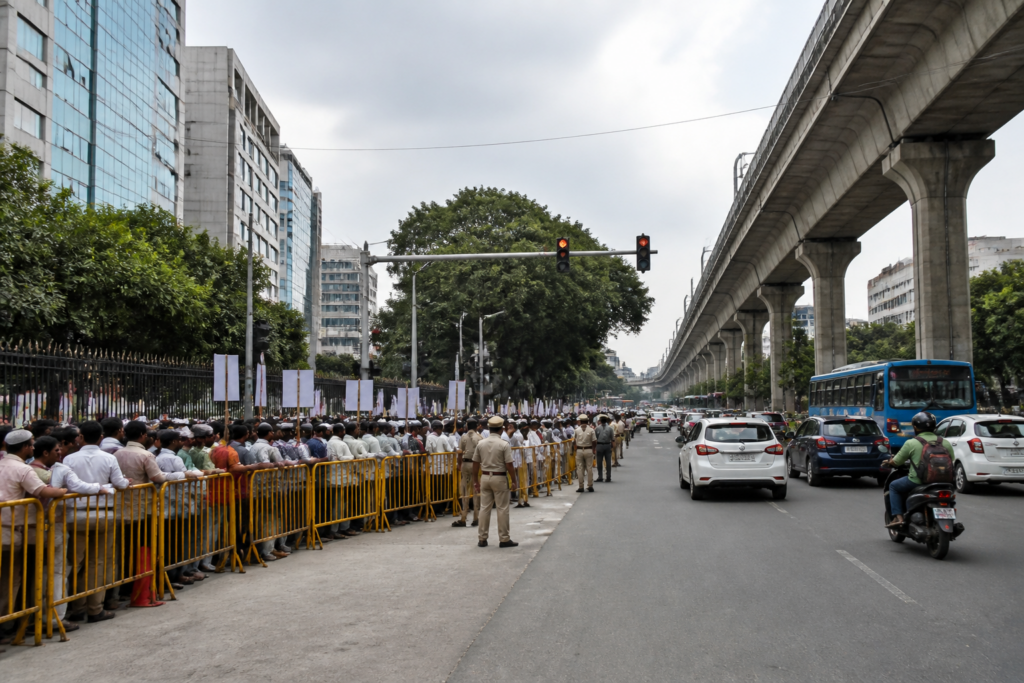
The Karnataka government’s willingness to review Bengaluru protest venues after detentions near KR Circle and the alleged manhandling of photojournalists has reopened a difficult urban governance question: how can a city protect the right to protest without allowing demonstrations to block critical public routes or compromise safety?
Home minister Priyank Kharge told The Times of India that the government would examine whether protests could be permitted at designated locations beyond Freedom Park. He also said the administration would have to study an existing 2021 order and court observations before deciding whether the rules should be changed or applied with greater discretion.
The immediate trigger was a protest near KR Circle involving people opposing the SIR. The report also refers to the alleged manhandling of photojournalists during a Monday demonstration. Kharge said the conduct was unacceptable and that there was no defence for it. He said officials, including circle inspectors, had been consulted, although no formal report had been submitted to him at the time of the interview.
The minister’s comments do not amount to a change in policy. They point instead to a review process in which the government will examine the existing legal and administrative framework before deciding whether protest locations should be expanded or decentralised. That distinction matters because the location of a demonstration is not only a policing decision. It determines who can reach the protest, which roads are affected, how emergency vehicles move and whether the gathering remains visible to the public.
Freedom Park has emerged in the report as the principal designated venue under the current arrangement. Kharge’s suggestion that other sites could be evaluated indicates that the present model may be placing too much pressure on a limited number of locations. However, the source material does not identify the additional venues under consideration, nor does it establish whether any site-selection exercise has begun.
The minister said several people had filed affidavits in relation to the matter and that the government itself was not the only party involved. He also referred to earlier observations by the Supreme Court and the Karnataka High Court. Until he reviewed the complete order, he said, the government would not be in a position to determine whether the 2021 order should be altered or whether the police commissioner could exercise discretion under it.
This legal background places a limit on how quickly the administration can respond to the latest incident. A change in protest venues would have to account for the existing order and the affidavits already filed. The report does not provide the text of the order, the exact court observations or the legal arguments made by the parties. What is clear is that the government is not treating the issue as a purely operational decision by the police.
The dispute also reveals how urban space becomes contested during public demonstrations. A protest venue is expected to be accessible enough for citizens to assemble and visible enough for their message to reach the wider public. At the same time, a venue located on a major road or near a critical public institution can interrupt daily movement far beyond the protest site. The challenge is therefore not simply to find an empty piece of land, but to manage competing claims over strategically important urban space.
Kharge used the example of the deputy commissioner’s office in Kalaburagi to explain the administration’s concern. He said the office is on the main road, is the only nerve centre connecting to Jayadeva and other institutes, and is frequently blocked during protests. He added that even turnaround routes become difficult and stressed the importance of the golden hour. Although the example concerns Kalaburagi rather than Bengaluru, it shows the government’s stated basis for evaluating protest locations: access to hospitals and other essential institutions must remain open when roads are occupied.
The reference to the golden hour gives the mobility argument a public-safety dimension. The concern is not limited to traffic delays or commuter inconvenience. According to the minister’s explanation, blocked routes can affect access to medical institutions and make it harder for emergency vehicles to navigate the city. The supplied report does not provide details of a specific emergency affected by the Bengaluru protest, but it establishes why the government considers route protection part of the decision.
At the same time, the administration’s own position recognises that restrictions cannot be justified only by convenience. Kharge said the government had to defend the right to protest as well as the rights of others. He said even a provocative act such as burning an effigy of the home minister could be permitted if it was planned and the authorities were informed so that people could be protected.
That formulation places prior communication at the centre of the proposed balance. For the police, advance information can help determine crowd-control requirements, traffic diversions and safety arrangements. For protesters, however, the effectiveness of a demonstration may depend on its timing, location and visibility. The source does not detail how the government intends to reconcile these interests or what criteria would be used to approve a venue outside Freedom Park.
The alleged treatment of journalists adds another layer to the institutional question. Kharge described the manhandling of photojournalists as bad and said that high-handedness could not be the only response from either side. He said officials had one version of events and protesters had another, but maintained that restraint should be the first requirement.
The absence of a formal report at the time of the interview leaves the incident unresolved in the material available. The minister said he had spoken to officials, including circle inspectors, and that the government would assess what had come to light. The report does not identify the journalists involved, specify the alleged actions or state whether disciplinary or legal proceedings were initiated. Those facts will be important in determining whether the episode reflects an isolated breakdown or a wider problem in the management of demonstrations.
Bengaluru’s protest-venue question is consequently about more than decentralisation. It concerns how responsibility is divided between the government, the police commissioner, local officials, courts, protesters and other users of the city. The government may designate a site, but the police must implement the arrangement on the ground. Courts can shape the legal boundaries, while protesters and commuters experience the consequences directly. Any revised system would have to operate across all these institutional layers.
The minister’s comments also show that the administration is attempting to move away from a single-response model. His remarks reject both unrestricted occupation of critical routes and the use of high-handed policing as the default solution. Yet the report provides no formal framework for how alternative venues would be selected, how many locations might be designated, how capacity would be assessed or how emergency access would be guaranteed.
Those unanswered questions will determine whether decentralisation becomes a meaningful administrative reform or remains a case-by-case exercise. A larger network of designated sites could reduce pressure on Freedom Park, but only if the sites are reachable, safe and capable of supporting demonstrations without creating new bottlenecks. Conversely, retaining a narrow set of venues may simplify policing while concentrating protests and limiting the practical choices available to organisers.
The available evidence confirms that the Karnataka government is reviewing the issue, not that it has approved new protest locations or changed the 2021 order. It also confirms that the administration has acknowledged the alleged mistreatment of photojournalists and is weighing competing accounts. The next significant developments will be the government’s examination of the court-related material, the submission of any formal incident report and a decision on whether protest venues in Bengaluru can be expanded beyond Freedom Park.


