

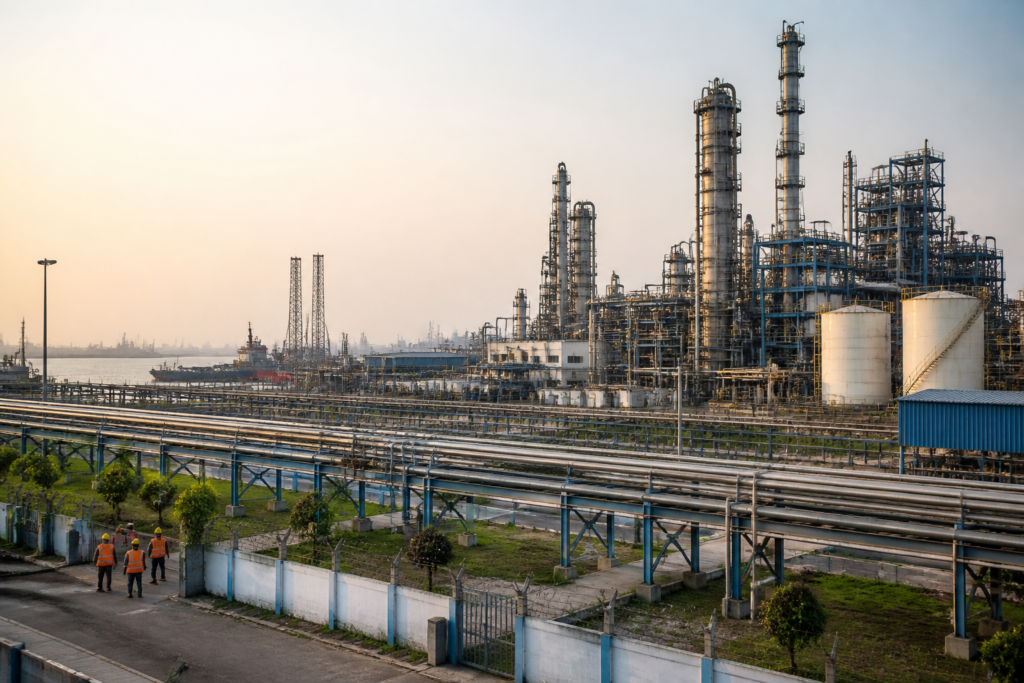
West Bengal Chief Minister Suvendu Adhikari on Wednesday inaugurated a Rs 6,000-crore phenol and acetone complex in Haldia, describing the facility as a major step towards reducing India’s dependence on imports of the two industrial chemicals and signalling a fresh industrial expansion drive in the state.
The facility has been developed by AdPerMa Private Limited, a wholly owned subsidiary of Haldia Petrochemicals Limited. According to the chief minister, the integrated plant is expected to generate about 400 direct jobs and another 1,000 indirect jobs. He said the complex would strengthen domestic manufacturing and support the Centre’s Atmanirbhar Bharat objective.
“Today, the material that we had to import from abroad will no longer need to be imported,” Adhikari said at the inauguration, according to The Statesman. He also said a further Rs 10,000 crore in investment was in the pipeline for Haldia and urged industry to expand its presence in the town.
The state government announced two additional projects linked to the industrial belt. A Pepsi manufacturing plant is proposed on 98 acres in Haldia, with the Haldia Development Authority having already provided the land. Adhikari said the state Cabinet would approve the project. Another 50 acres would be allotted to Truviss for a medical equipment manufacturing unit.
The chief minister also referred to proposals involving Indian Oil Corporation and Haldia Energy, saying the government aimed to accelerate industrial growth in Haldia within a year. He urged Haldia Petrochemicals chairman Purnendu Chatterjee to establish a data centre in West Bengal and assured him of government support.
The announcements place land, power, connectivity and industrial services at the centre of the state’s proposed investment push. Adhikari said a new industrial policy would be unveiled before Diwali, with provisions covering investment incentives, land allocation and power tariffs. He said the policy would seek to provide investors with a more predictable operating environment.
The chief minister attributed Bengal’s past industrial decline to several factors, including militant trade unionism during the 34-year Left Front regime, what he described as flawed land policies, the withdrawal of incentives and syndicate-related problems during the subsequent 15 years. He claimed that more than 50,000 industrial units had shut during the Left Front period.
The expansion plans are also tied to local skills and worker safety. Adhikari proposed closer coordination between companies and technical institutions, including CIPET and Durgachak ITI, to train fitters, welders, fire-safety personnel and other industrial workers. He said Chatterjee had shown interest in employing locally trained young people.
A 50-bed trauma centre with a burn unit is scheduled to open in Haldia by June 2027, according to the chief minister. The Haldia Development Authority is expected to contribute Rs 18 crore, while Indian Oil Corporation will provide Rs 5 crore through its corporate social responsibility programme and the National Health Mission will contribute another Rs 5 crore.
Adhikari said Haldia’s industrial and port infrastructure was important to West Bengal and neighbouring regions. The next milestones are the state Cabinet’s decision on the proposed Pepsi plant, the release of the new industrial policy before Diwali and the planned completion of the trauma centre by June 2027.


