

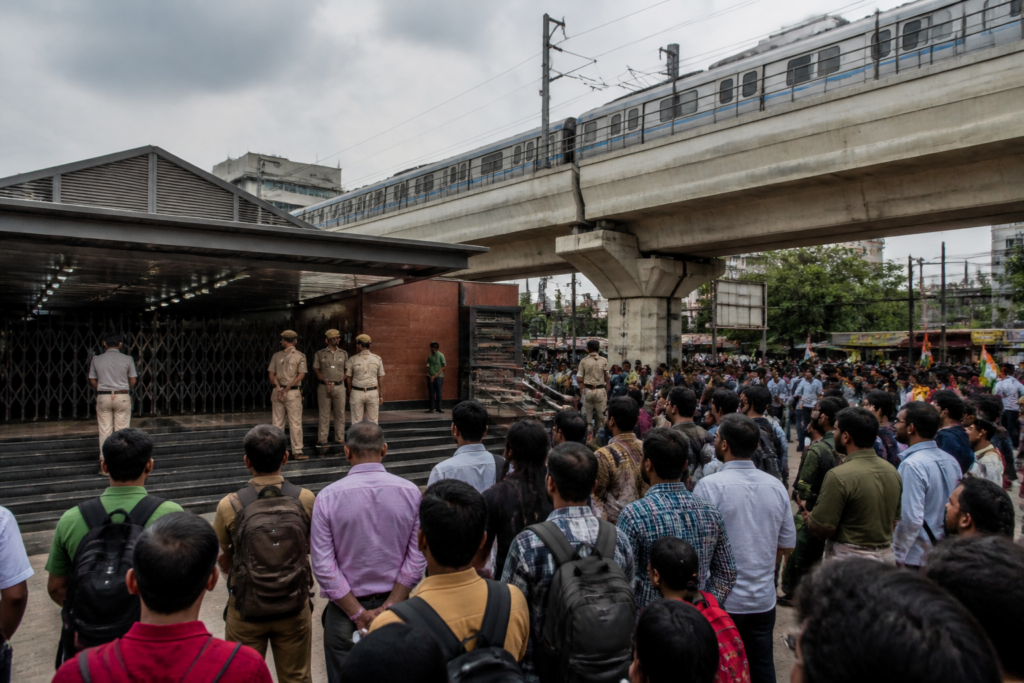
Delhi Metro’s response to the 10 October protest in the capital presents a revealing distinction in urban transport management: trains can continue running across a network even when access to a substantial number of stations is restricted. In an affidavit submitted to the Supreme Court, the Delhi Metro Rail Corporation said no train was cancelled, the number of train trips was not reduced and the overall volume of metro operations remained unchanged. At the same time, entry and exit were temporarily closed at 45 stations on the advice and instructions of law-enforcement agencies.
The episode matters because a metro system is not defined only by the movement of trains. For passengers, the network begins at the station entrance and ends at the exit closest to their destination. A service that continues to run but cannot be accessed at 45 stations creates a different form of disruption from a train cancellation. The operational system may remain intact while the passenger-facing system becomes uneven, selective and dependent on where a person lives, works or needs to travel.
The figures placed before the court provide a rare snapshot of this distinction. DMRC said its network had 303 stations, of which 258 remained fully operational for passenger access on 10 October. That means roughly 85 per cent of stations continued to allow entry and exit, while about 15 per cent did not. The corporation also said that no reduction was made in train frequency or in the number of trips across the network.
This is the central institutional question raised by the affidavit: should uninterrupted rail movement be treated as sufficient compliance when access points across the network are closed? The answer depends on what is being measured. From an operations perspective, DMRC’s position is that trains continued to run as planned. From a citizen’s perspective, however, the relevant measure is whether the passenger could reach a station, enter it, complete the journey and leave at the intended destination.
The Supreme Court proceedings emerged from a petition challenging the closure of metro stations and the cancellation of trains arriving in Delhi in connection with the protest. According to the report, the court’s 9 October order directed the Centre to ensure that there was no “complete restriction” on the movement of metros and trains entering Delhi. A bench headed by Chief Justice Surya Kant also directed DMRC and other parties to file compliance affidavits.
DMRC’s affidavit was therefore not simply an operational update. It was a response to a judicial direction concerning the balance between public mobility and security management. The corporation told the court that the decisions relating to entry and exit at 45 stations were implemented on the basis of assessments and instructions from law-enforcement agencies. This places the closures within a wider governance structure in which the metro operator controls train operations but station accessibility can be shaped by security agencies during a major public event.
That division of responsibility is important. Metro systems are often treated as single transport institutions, but their functioning depends on several agencies. The operator manages trains, stations and passenger movement within the system. Law-enforcement agencies assess security risks and may direct restrictions. Courts can impose limits on the extent of disruption. The Centre may be required to coordinate or ensure compliance. Passengers experience the combined result, even when responsibility is distributed across institutions.
The 10 October numbers also show the difference between network availability and actual use. DMRC told the Supreme Court that approximately 32 lakh passengers travelled by metro that day. On a normal second Saturday, ridership is around 58 lakh. The reported figure was therefore about 26 lakh lower than the usual second-Saturday level, or approximately 55 per cent of normal ridership. The source does not establish how much of this reduction resulted directly from station closures, how much came from changes in travel plans, or whether other restrictions connected to the protest affected demand.
That limitation is significant. The fact that trains were not cancelled does not mean that mobility was unaffected. A passenger may have been able to board at an open station, but not at a station near home, work, a court, a market or a connecting transport route. Some passengers may have shifted to buses, private vehicles, walking or other modes. Others may have cancelled their journeys altogether. The supplied affidavit figures establish the scale of the ridership decline, but do not break down the reasons behind it or identify which sections of the city experienced the greatest impact.
Nor does the report specify the 45 stations, the duration of the entry and exit restrictions, or whether all affected stations faced the same level of closure. Without that information, the headline figure of 45 stations cannot by itself show whether the disruption was evenly distributed across the network or concentrated in particular areas. A closure near a major interchange could affect more passengers than the closure of a station with lower demand. The evidence supplied does not provide station-level ridership or route-level effects.
This is where the episode exposes a recurring difficulty in measuring transport resilience. A network can be resilient in one sense and vulnerable in another. It can preserve train movement, maintain scheduled trips and avoid a system-wide shutdown. Yet it may still fail to provide reliable access to the people who depend on specific stations. Resilience, therefore, is not only about keeping vehicles in motion. It is also about preserving usable access, communicating restrictions and ensuring that a partial closure does not become an invisible burden for particular neighbourhoods or passenger groups.
The Supreme Court’s direction against a “complete restriction” appears to recognise this distinction at the level of public mobility. The court did not, according to the supplied report, require every station to remain open regardless of security assessments. Instead, the direction focused on preventing a total halt to metro and train movement into Delhi. DMRC’s response shows how that principle was operationalised: the rail service continued, while access was restricted at selected stations.
That arrangement leaves unanswered questions about the criteria for selecting stations. The report attributes the closures to law-enforcement assessments and instructions, but does not detail the threat assessment, the decision-making chain, the notification process or the passenger communication system used. It also does not state whether affected passengers were given alternative access points, replacement transport or information about the expected duration of closures. These details are essential for evaluating whether a partial shutdown protects public safety without imposing avoidable uncertainty on travellers.
The institutional design of the metro makes such questions especially important. The system’s value comes from its network effect: passengers rely on multiple stations, interchanges and access points working together. Closing one station may be manageable if nearby alternatives are available. Closing several stations in a connected area can change travel patterns across the network. Even when the trains continue to operate, the practical geography of the city can be altered for the duration of the restrictions.
The ridership data suggests that this practical effect was substantial, although it cannot be attributed entirely to the closures on the available evidence. A fall from approximately 58 lakh passengers to approximately 32 lakh passengers represents a decline of about 45 per cent from the normal second-Saturday figure. DMRC’s affidavit establishes that the system carried many passengers despite the restrictions, but it also shows that normal demand was not sustained. The two facts should be read together rather than treated as competing claims.
For urban governance, that distinction points to the need for more precise public reporting during security-related transport restrictions. A statement that “no trains were cancelled” communicates continuity of operations, but it does not tell passengers which stations they can use. A more complete public account would include the number and names of closed stations, the time of closure, the expected reopening window, alternative stations and any changes to interchange access. The supplied material does not say whether all of this information was made available on 10 October.
The case also illustrates why judicial oversight becomes relevant when essential urban infrastructure is restricted. The metro is not merely a commercial service; it is a major public mobility system for the National Capital Region. When access is reduced during a protest, the decision affects commuters, businesses, visitors and people travelling for essential purposes. At the same time, station-level security decisions may respond to risks that the operator and the public cannot fully disclose. The governance challenge lies in reconciling those competing requirements through a process that is lawful, proportionate and transparent enough for citizens to plan their journeys.
The report does not provide the Supreme Court’s final determination on the compliance affidavit, nor does it record a detailed judicial assessment of the 45 closures. It records DMRC’s explanation that train services and trip volumes were maintained, and that station access restrictions followed law-enforcement directions. It also records the court’s earlier instruction that metro and train movement into Delhi should not face a complete prohibition.
What the evidence confirms is narrower but important. Delhi Metro preserved train operations during the 10 October protest, yet passenger access was restricted at 45 of its 303 stations. The network remained largely open by station count, but ridership fell sharply below the normal second-Saturday level. The episode therefore cannot be described accurately either as a full metro shutdown or as an unaffected service. It was a partial-access disruption managed through coordination between the metro operator, security agencies and the court-supervised compliance process.
The developments that merit monitoring are the court’s treatment of the affidavit, any further disclosure about the affected stations and the criteria used to impose such restrictions. Those details would determine whether the episode becomes a documented model of limited, targeted disruption or a reminder that keeping trains moving is only one part of keeping a city mobile.


