

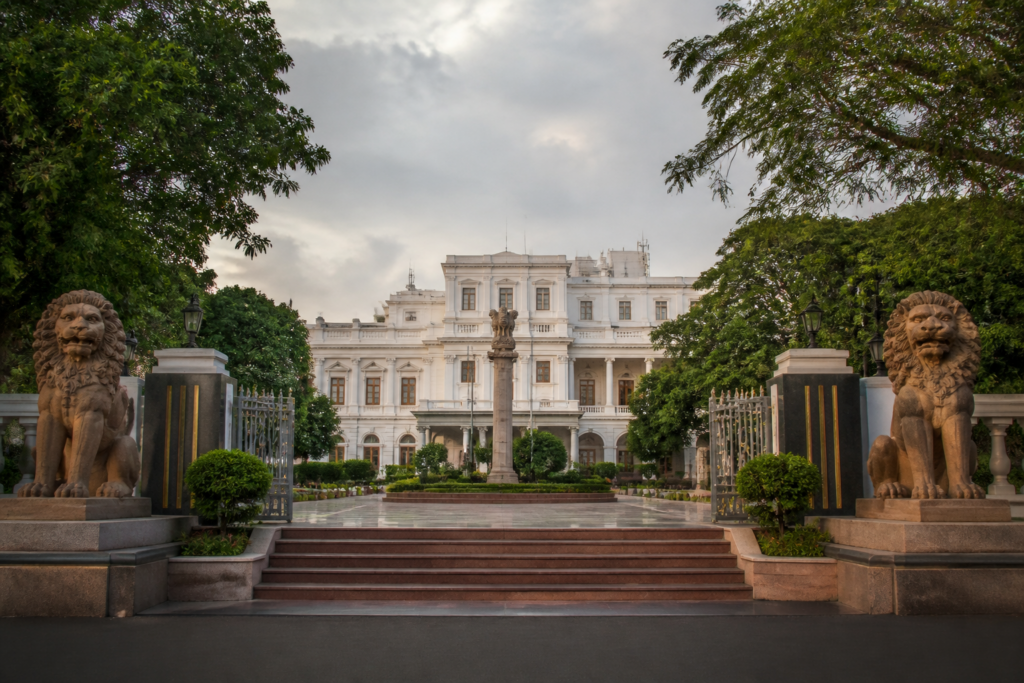
West Bengal Lok Bhavan’s renamed gates, halls and rooms do more than replace colonial or royal references with names linked to Bengali literature, social reform, tribal resistance and the freedom struggle. They show how a public institution can become a site where the state decides which figures and histories should be made visible in everyday civic language.
The changes, made on the initiative of Governor R N Ravi and detailed in a Lok Bhavan notification issued on October 7, affect six gates, several internal rooms and a building in Barrackpore. They come almost a year after Raj Bhavan was renamed Lok Bhavan during the tenure of Governor C V Ananda Bose in November 2025. At the same time, a 10-member committee constituted by the West Bengal government is examining proposals to rename roads, bridges and public places across the state.
That timing gives the exercise a significance beyond the walls of the governor’s residence. Renaming is often treated as a matter of signage, ceremonial language or administrative updating. But names attached to gates, roads, halls and public buildings also determine how institutions present themselves to visitors and how the state narrates its own history. In this case, the new names combine literary figures, political leaders, social reformers, tribal leaders and symbols associated with the freedom movement.
The South Gate, used for the movement of the President, Prime Minister and Governor, is now Rishi Bankim Dwar, after author and poet Bankim Chandra Chatterjee. The road linking that gate to the building’s inner entrance has been named Kartavya Path, while the northern driveway is Shakti Path. The North Gate, the principal entrance used by visitors and the public, has been renamed Kabiguru Dwar after Nobel laureate Rabindranath Tagore.
The other four gates have names drawn from different strands of West Bengal’s political and social history. The South West Gate is now Dr Bidhan Chandra Roy Dwar, after the former chief minister. The South East Gate has been named Sidho Kanho Dwar after the tribal leaders associated with the Santhal Rebellion. The North West Gate is Khudiram Bose Dwar, after the young revolutionary, and the North East Gate is Raja Rammohan Roy Dwar, after the social reformer. The Ashoka Pillar has been engraved before the name of each gate.
The selection is notable because it does not rely on a single historical category. Tagore and Bankim Chandra represent literary and cultural memory; Rammohan Roy and Bidhan Chandra Roy connect the building to social reform and public leadership; Khudiram Bose evokes the freedom struggle; and Sidho and Kanho bring the history of tribal resistance into the naming of a state institution. The result is a deliberately assembled historical vocabulary rather than a simple one-for-one replacement of names.
The internal spaces have undergone a similar transformation. The Governor’s office has been renamed Dr Syama Prasad Mookerjee Kaksh, while the Governor’s residence is now Shanti Niketan. The Throne Room, where oath-taking ceremonies are held, has become Vande Mataram Sabhaghar. The Prince of Wales Suite is now Gurudev Kaksh. Other rooms carry the names of Paramahansa, Vivekananda, Ma Sarada, Mahananda, the Ganga and Vidyasagar. The library is now Vidyasagar Granthagar, and the grand staircase with the north portico has been named Netaji Subhas Prangan.
This interior vocabulary matters because rooms inside a constitutional building are not merely functional spaces. They host official meetings, ceremonies, visits and public-facing events. The former names identified rooms through hierarchy, royal association or colonial-era institutional convention. The new names instead attach those spaces to people, places and ideas associated with Bengal’s cultural and political history. The notification therefore changes not only what visitors read on a sign, but also the language used to describe the institution’s working spaces.
The renaming of the Throne Room is especially significant in administrative terms. The room is used for oath-taking ceremonies, according to the report, yet its earlier name carried a monarchical association. Its replacement, Vande Mataram Sabhaghar, shifts the reference from a throne to a national movement and a formal gathering space. That does not alter the room’s constitutional function, but it changes the symbolic frame through which that function is presented.
The same distinction applies to the renaming of the Prince of Wales Suite as Gurudev Kaksh. The report does not indicate any change to the suite’s use or layout. What changes is the institutional reference attached to it. Such decisions can be understood as an attempt to align the vocabulary of a public building with a different account of local history, one centred on figures and movements associated with Bengal rather than imperial or aristocratic titles.
The broader question is who gets to rename public places and through what process. In the Lok Bhavan case, the changes were notified by the institution on the Governor’s initiative. Separately, the state government’s 10-member committee is considering proposals for roads, bridges and public places. The supplied report does not specify the committee’s membership, criteria, recommendations or timetable, so it is not possible to establish how the two processes relate institutionally.
That distinction is important. Public naming can be an executive decision within an institution, a matter for a municipal or state government authority, or the outcome of a committee and consultation process. Each route carries different questions about jurisdiction, public participation and continuity of records. The report confirms that a committee is examining proposals, but it does not establish whether the Lok Bhavan names were among those proposals or whether the two exercises follow a common policy.
There is also a practical administrative dimension. Renaming a gate, room or public building requires updated signage and changes to references used in official communication, visitor directions and event documentation. The notification confirms the new names, while the report mentions the engraving of the Ashoka Pillar before each gate name. It does not provide details of the cost, implementation schedule, archival treatment of former names or arrangements for avoiding confusion during the transition.
The absence of those details does not diminish the symbolic importance of the decision, but it sets a boundary around what is established. The changes are confirmed; their administrative cost, public consultation and long-term effect on the building’s operation are not provided in the supplied material. Those questions will become more relevant if the wider renaming exercise extends to roads, bridges and other public places.
The list also reveals how a state institution can use naming to bring multiple histories into one official setting. The inclusion of Sidho and Kanho places a tribal uprising within the symbolic geography of Lok Bhavan. The presence of Raja Rammohan Roy, Vidyasagar, Ma Sarada and Swami Vivekananda creates a reformist and religious-cultural layer. Tagore, Bankim Chandra and Netaji Subhas add literary and nationalist associations. The names do not represent one uniform tradition; they create a curated collection of figures whose public meanings may differ.
That curation is the central urban and governance issue. Cities are experienced through names: people use them to navigate, remember, identify institutions and understand authority. A public building’s gates and halls form a small but highly visible part of that civic vocabulary. When names change, the state is not only updating directions. It is also making a statement about which histories belong in the everyday language of public administration.
West Bengal Lok Bhavan’s renaming exercise therefore sits at the intersection of institutional design, political memory and administrative authority. The immediate changes are clear from the notification: six gates, internal spaces and the Flagstaff House in Barrackpore have received new names. What remains to be established is how the state government’s wider committee will approach similar proposals, what criteria it will apply, and whether the process will produce a consistent naming policy across public infrastructure.
For now, the evidence confirms a significant symbolic reorganisation of one of West Bengal’s principal public institutions. The next developments to watch are the committee’s proposals on roads, bridges and public places, and any further official details on how the newly notified names will be implemented and recorded.


