

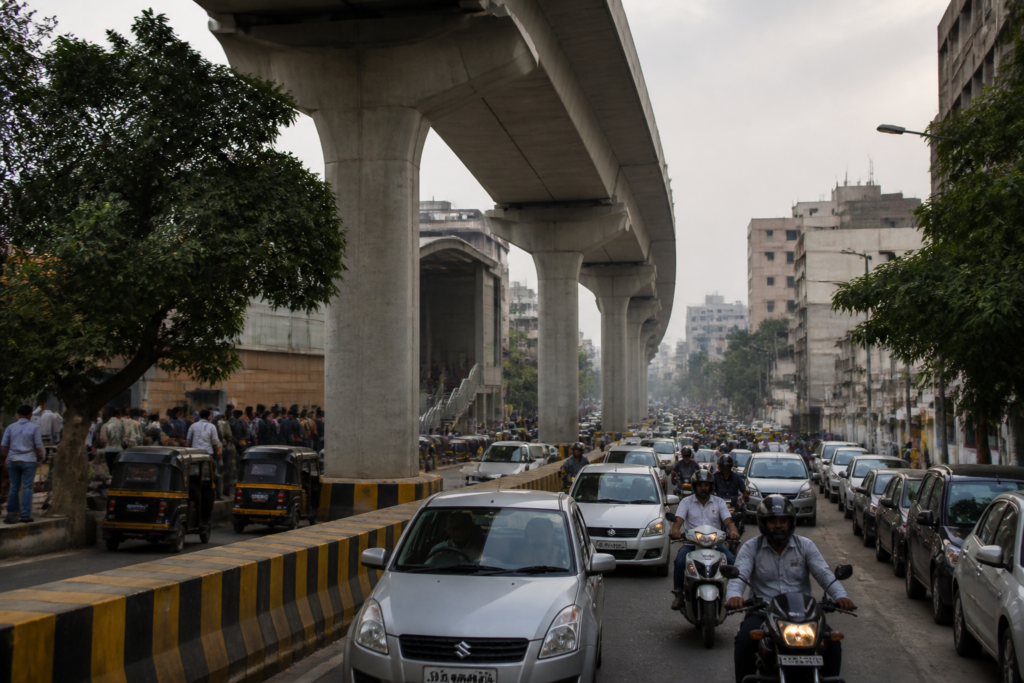
Pune metro pillars, roadside barricades, parking and unauthorised autorickshaw stands are reportedly narrowing traffic lanes and increasing congestion and accident risks along the Dapodi–Pimpri-Chinchwad stretch of the old Mumbai–Pune highway, according to commuters, activists and a road-design expert cited by Civic Mirror.
The metro viaduct runs through the central portion of much of the corridor. In some sections, the pillars are not aligned in a uniform straight line, with certain structures extending further into the road than others. Road dividers have been installed around pillars between Pimpri and Dapodi, but congestion reportedly continues at junctions and near metro stations.
The problem is particularly visible around station entrances and exits, where limited space must accommodate pedestrians, parked vehicles and passengers being picked up or dropped off. Road-design expert Pranjali Deshpande said vehicles parked between pillars often extend into the carriageway. Access to and from parking areas can also obstruct footpaths and pedestrian movement, she said.
Deshpande added that pillars, barricades and other structures occupying open space at junctions can make turning difficult for large vehicles. Locations such as Nashik Phata and Bhosari may face additional movement constraints where the available road width is reduced, according to the report.
Traffic conditions are further complicated by autorickshaws stopping in the middle of the road and cars being parked on the carriageway, commuter Rishi Phadnis said. The Pimpri-Chinchwad Municipal Corporation has made around 1,100 traffic wardens available to assist the police, but Phadnis alleged that enforcement remains inadequate and that some wardens focus on catching rule violators rather than clearing congestion.
At the metro station area in Morwadi, referred to in the report as Pimpri station, local residents alleged that unauthorised autorickshaw stands operate on both sides of the road. As many as 25 to 30 autorickshaws may gather near the station stairs and access ramps at one time, according to the report. With traffic signals nearby, vehicles may receive only 30 to 40 seconds to move through the junction, allowing relatively few vehicles to pass and resulting in queues on the main road.
Social activist Maruti Bhapkar questioned the planning and coordination behind the corridor. He alleged that the metro project had disrupted existing road infrastructure and imposed additional costs and inconvenience on residents. Bhapkar also questioned the use of public funds for bus stops and other facilities built for the Bus Rapid Transit System between Nigdi and Pune station, claiming that some of the infrastructure became ineffective after metro construction began.
Bhapkar said an agreement between the metro corporation and the Pimpri-Chinchwad Municipal Corporation placed responsibility on the metro agency for preventing potholes, traffic obstructions and accidents during construction. He alleged that these responsibilities had not been adequately fulfilled. He also criticised the narrowing of roads for footpaths and cycle tracks and claimed that congestion near the municipal corporation building lasts between 30 minutes and an hour during the evening peak.
The activist proposed examining a metro alignment alongside the Lonavala–Pune railway route as an alternative that could have reduced disruption on the highway, while locating stations near existing railway stations. He also alleged a lack of coordination between the Pimpri-Chinchwad Municipal Corporation, Pune Municipal Corporation and the metro corporation. The report does not include a response from the civic bodies, traffic police or metro authorities to the allegations.


