

The dispute over Hindu College admission irregularities has expanded into a wider contest over who is accountable when decisions at a publicly funded institution are made through centralised systems, elected bodies are bypassed and faculty members face disciplinary action for raising objections. The immediate trigger was the Hindu College Staff Association’s allegation that the 20% cap on supernumerary seats in Sports and Extra-Curricular Activities admissions was violated. But the more consequential question is whether institutional safeguards can function when authority is dispersed between Delhi University, the college administration, its Governing Body and statutory internal bodies.
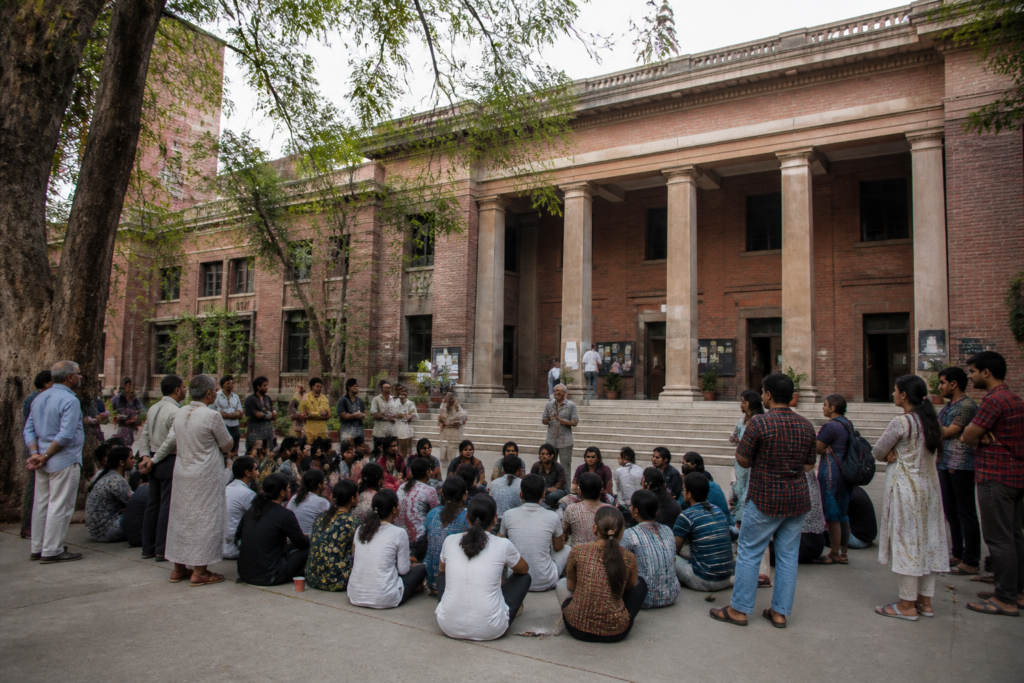
The Hindu College Staff Association has been protesting for nearly a month and said its sit-in had entered its 22nd day when representatives addressed mediapersons at the college portico. Its allegations cover three connected areas: admission irregularities, the weakening of the elected Staff Council and what faculty members described as caste and gender insensitivity on campus. The association has also objected to disciplinary action and showcause notices issued to faculty members.
These are allegations, not findings established by an independent inquiry. The college administration has disputed the suggestion that the Principal had a discretionary role in the admissions process. Principal Anju Srivastava told The Indian Express that Delhi University determines student eligibility, college allocation and subject preferences. Applications, she said, are processed through the Central Admission Committee and approved by the Principal before students pay their fees. This account places the operational responsibility for the disputed allocations largely within the university’s central admission framework.
According to officials cited in the report, Delhi University attributed the excess allocation of supernumerary seats in popular courses to an inadvertent programming error in its central admission algorithm. That explanation is significant because it shifts the issue from an individual decision at Hindu College to the design and oversight of a university-wide digital admissions system. It also creates a second accountability question: how quickly were the allocations detected, who reviewed them and what mechanism exists to correct errors without leaving students, faculty or colleges to resolve the consequences through protest?
Centralised admissions are intended to create consistency and reduce discretionary decision-making across colleges. In principle, a common system can standardise eligibility, course preferences and seat allocation. But centralisation can also make responsibility harder to locate when something goes wrong. A college may receive students through a process it does not fully control, while the university may rely on software and committees whose decisions are not visible to applicants or college staff. In such a structure, procedural clarity becomes as important as the final allocation itself.
The admission dispute therefore cannot be separated from the Staff Association’s complaint about internal governance. Staff Council secretary Professor Chandrachur Singh alleged that the elected Staff Council had been bypassed for years and said that only about five meetings had been held in the last 10 years. He also alleged that emergency meetings were called with emergency agendas that were then pushed through under the justification of urgency. These claims have not been tested by an independent process, but they identify the institutional mechanism at the centre of the dispute: whether a statutory body exists as a functioning forum for academic and administrative deliberation or only as a formal requirement.
The distinction matters because public institutions do not rely solely on the authority of a principal or governing body. Their legitimacy also depends on rules that distribute decision-making, create records and allow affected stakeholders to challenge decisions. If elected or statutory bodies are not regularly consulted, the formal structure of accountability may remain intact on paper while becoming weak in practice. The allegations at Hindu College have brought that gap into public view, but the supplied material does not establish how the Staff Council was constituted, what its meeting requirements are or whether any university-level review has already examined the claims.
The controversy also includes a social dimension. Commerce professor Poonam Saji raised concerns about caste and gender insensitivity and said students’ accounts had prompted faculty members to question the condition of a college ranked number one in the National Institutional Ranking Framework. Her remarks connect institutional reputation with the everyday experience of students and staff. A ranking can communicate academic performance or institutional standing, but it cannot by itself establish whether a campus is inclusive, responsive or procedurally fair. Those questions require separate evidence, complaints mechanisms and transparent review.
The disagreement over corporate naming adds another layer to the debate about public institutions. Staff Association president Ratan Lal alleged that corporate influence on campus had increased and objected to buildings and staff rooms being named after corporate entities. He argued that Hindu College is a public institution and that attempts to privatise it should be resisted. The report does not establish that the college is being privatised, nor does it provide the terms governing naming rights or institutional donations. What it does show is a conflict over how public identity is represented in a campus whose buildings, facilities and administrative choices are visible to students, staff and taxpayers.
The institutional chain involved in the dispute is therefore unusually important. Delhi University is responsible for the central admission framework cited by the Principal and officials. The college administration is responsible for implementing decisions on campus and responding to faculty and student concerns. The Staff Council represents an internal statutory forum, while the Governing Body forms part of the college’s administrative structure. The Staff Association has asked the university to intervene directly, including through a temporary takeover, an independent and time-bound inquiry and changes involving the Governing Body chairperson and the Principal.
Those demands were included in a memorandum submitted to the Delhi University Vice-Chancellor on October 1. The association also sought an inquiry into alleged administrative and financial irregularities and an unconditional withdrawal of disciplinary notices issued to faculty members. The report does not state that Delhi University has accepted these demands, ordered an inquiry or taken over the college. That distinction is central: a memorandum records a demand, not an administrative decision.
The protest has received support from Rajya Sabha MP Manoj Jha and Lok Sabha MP Sudhakar Singh, who visited the campus earlier in the month. HCSA representatives also briefed members of the Parliamentary Committee on the Welfare of Scheduled Castes and Scheduled Tribes, including Faggan Singh Kulaste and P Wilson. Political and parliamentary attention increases pressure on the university, but it does not replace an institutional fact-finding process. The core questions remain documentary and administrative: what happened in the admissions algorithm, how many seats were affected, whether the cap was breached, what corrective action was taken and whether the relevant internal bodies were consulted.
The numbers in the dispute point to the importance of transparent records. The 20% cap is the specific rule cited by the association. The Staff Council secretary’s reference to roughly five meetings in 10 years is an allegation about institutional functioning. The protest had reached its 22nd day when the association spoke publicly. These figures establish the shape of the dispute but not its final merits. A credible inquiry would need to examine admission data, committee records, meeting minutes, disciplinary notices, naming decisions and the university’s explanation of the programming error.
The larger urban question is how publicly funded institutions operate when their services are increasingly mediated by centralised digital systems and layered administrative structures. Admissions affect access to scarce educational opportunities, while governance procedures determine whether errors and complaints can be resolved before they become prolonged conflicts. The Hindu College dispute shows that technology can centralise allocation without automatically clarifying responsibility. It also shows that institutional accountability is not only about preventing wrongdoing; it is about making decisions traceable to rules, records and clearly identified authorities.
The available evidence confirms that Hindu College faculty members have escalated a prolonged protest, that the Staff Association has made detailed allegations and that the Principal and Delhi University officials have offered an explanation centred on the central admission process and a programming error. It does not establish whether the admission cap was definitively breached through misconduct, whether the alleged governance failures occurred as described or whether the college will face an administrative takeover. Those questions depend on the university’s response and any independent, time-bound inquiry that may follow.


