

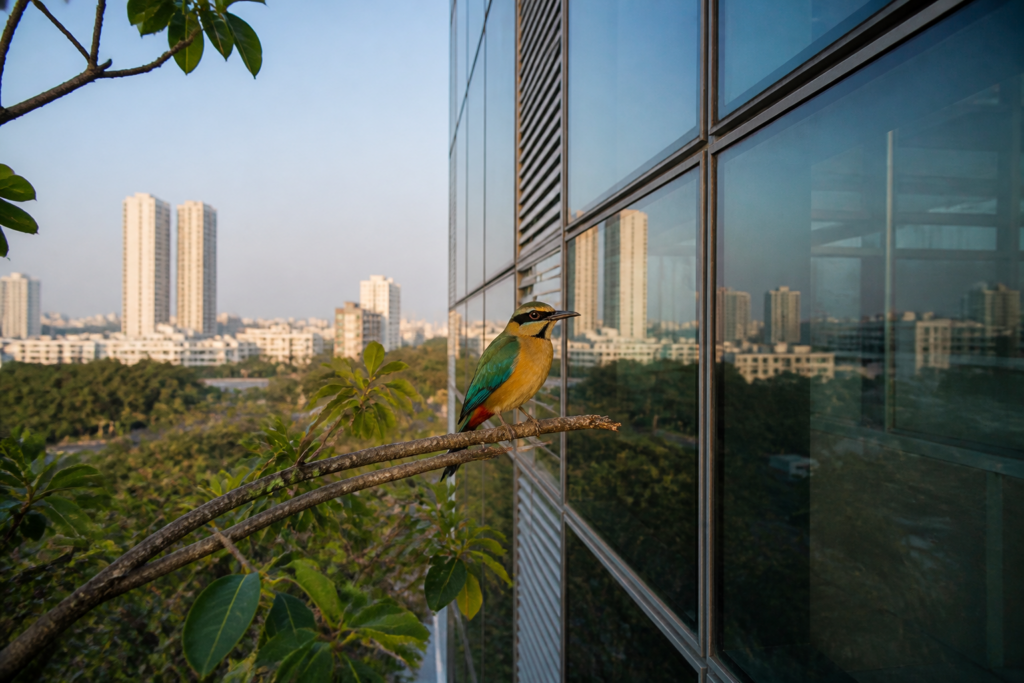
Seven Indian Pittas rescued in Hyderabad over 10 days, of which five died after colliding with glass facades, have exposed a largely unaddressed consequence of the city’s vertical growth: buildings designed to appear open and transparent can become invisible barriers for migrating birds.
The cases were reported by the Animal Warriors Conservation Society (AWCS) as Indian Pittas began their winter migration to southern India. The species breeds in the Himalayan foothills of India, Nepal and parts of Pakistan and travels south to escape harsh weather in the north. In and around Hyderabad, some of these birds encountered high-rise buildings rather than open flight paths. Two survived but were injured and were recovering at the organisation’s rehabilitation centre, according to AWCS founding member Santoshi Pradeep.
The immediate cause is straightforward. Birds do not recognise transparent glass as a solid obstacle. Reflections of the sky, trees and surrounding space can make a facade appear to be a continuation of the flight path. A bird moving at speed may therefore collide with a surface it cannot see. For a migratory bird already weakened by a long journey, the impact can be fatal.
That explanation makes the Hyderabad incidents more than a wildlife rescue story. It places them within a built-environment problem created at the intersection of architecture, construction and urban ecology. As cities add taller buildings and larger glazed surfaces, the design decision to use extensive glass can affect not only energy performance or appearance, but also how animals move through the urban landscape.
The seven cases known to AWCS offer only a partial picture. Pradeep said the organisation had recorded the incidents that came to its notice, while many similar collisions could go unreported across Hyderabad and other parts of Telangana. A dead or injured bird may never reach a rescue organisation, particularly when a collision occurs on private property, at height, or in an area with limited public access.
This reporting gap matters because rescue numbers are not the same as collision numbers. The seven birds represent cases that were found, identified and taken to an organisation capable of responding. They do not establish the total number of collisions in Hyderabad, the number of buildings involved, the most dangerous locations, or the seasonal pattern of incidents. Without that information, authorities and building owners have little evidence with which to prioritise interventions.
The reported pattern nevertheless provides an identifiable warning signal. Seven Indian Pittas were rescued in 10 days, five died and two were injured. The mortality rate within the cases that reached AWCS was therefore high. That figure should not be treated as a citywide mortality rate, because the sample is small and not designed as a formal survey. It does show, however, that collisions reaching rescuers can have serious outcomes.
The issue also appears to have continuity. Telangana Today reported similar incidents in October last year. According to the report, neither the Forest Department nor civic authorities had taken steps over the following year to prevent such collisions. That alleged absence of follow-up shifts the question from individual accidents to institutional responsibility: once a recurring hazard is identified, which authority records it, informs building owners, and requires or encourages corrective action?
Shiva Kumar, founder of the Voice of Nature Foundation, told Telangana Today that certain patterns on glass facades could help birds recognise obstacles and change direction. The proposed intervention is significant because it targets the visibility problem rather than treating each collision as an isolated rescue emergency. The source report does not specify a citywide programme, building code requirement, enforcement mechanism or approved design standard currently in operation in Hyderabad.
That gap is central to the urban-policy question. The Forest Department may be contacted when an injured bird is found, while civic authorities oversee parts of the built environment and municipal administration. Building owners, developers, architects and facility managers control many facade decisions. Yet the supplied report does not identify a single system that connects wildlife rescue data with construction approvals, facade design or post-occupancy safety measures.
In practical terms, this means the city’s response appears to be organised around incidents rather than prevention. A rescue number can mobilise help after impact. It cannot, by itself, make a reflective facade visible to a bird, identify a building that repeatedly causes collisions, or ensure that a design modification is installed before the next migration period.
The distinction between new construction and existing buildings is also important. The report concerns high-rise buildings with glass facades but does not establish whether the buildings were recently constructed, whether they complied with applicable approvals, or whether retrofitting has been attempted at any location. Any effective response would therefore need evidence from specific sites, including facade orientation, surrounding vegetation, lighting, height, reflective surfaces and the timing of collisions. Those details are not available in the supplied account.
Hyderabad’s case illustrates a broader planning challenge: urban growth is often assessed through land use, floor space, transport access, fire safety and structural performance, while the movement of birds and other urban wildlife receives less visible attention. The Indian Pitta’s migration makes the problem easier to notice because the collisions occur during a defined seasonal movement. Other species may also be affected without attracting comparable documentation.
The evidence currently supports three conclusions. First, collisions between migratory Indian Pittas and glass facades are occurring in Hyderabad and have caused deaths and injuries. Second, the incidents may be undercounted because only cases reported to AWCS are visible in the available record. Third, the problem has reportedly appeared in more than one migration season without a documented preventive response from civic or forest authorities.
It does not yet establish how widespread the hazard is, which buildings contribute most to it, or whether particular facade treatments would reduce collisions under Hyderabad’s conditions. Those questions require systematic recording rather than isolated rescue reports. A citywide database could begin with the locations, dates, species, injury outcomes and facade characteristics of reported incidents. The supplied report does not say that such a database exists.
For citizens, the immediate role remains reporting injured birds rather than attempting untrained rescue. AWCS can be contacted at 96978 87888, while the Telangana Forest Department’s listed number is 1800 425 5364. For the city’s institutions, the unresolved issue is whether recurring wildlife deaths near buildings will remain a rescue concern or become part of how urban facades are designed, approved and managed.
The next meaningful development would be an official response from the Forest Department or civic authorities, along with evidence of whether the buildings associated with the reported collisions have been identified and whether patterned treatments or other preventive measures are being considered. Until that information becomes available, the seven cases remain both a documented loss and an incomplete measure of the risk created by Hyderabad’s glass-heavy urban landscape.


