

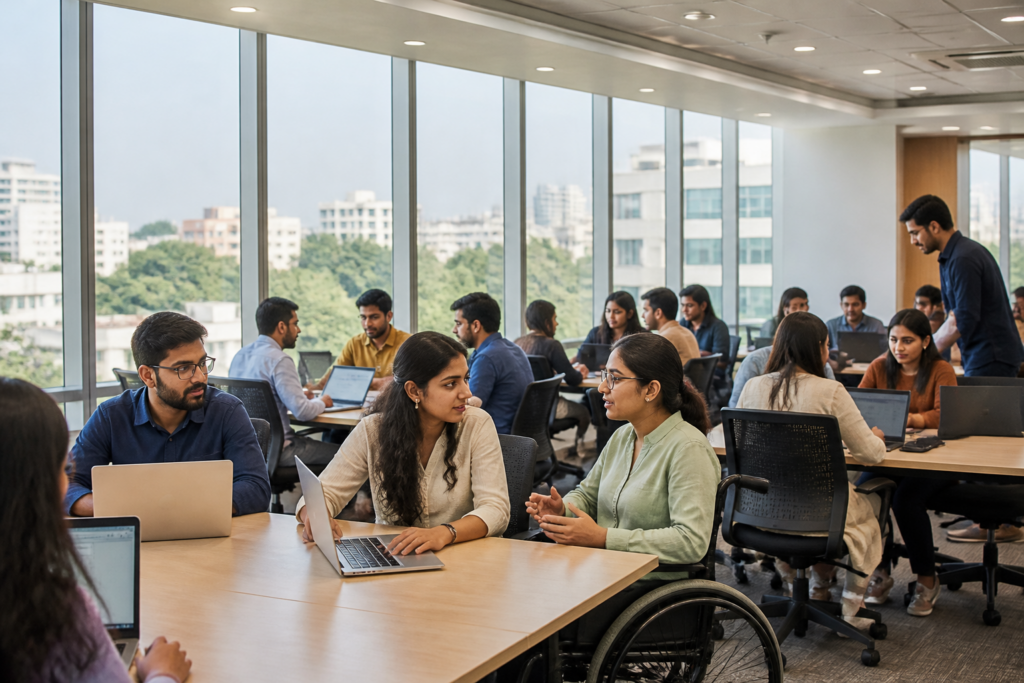
Infosys Foundation’s claim that its Springboard Livelihood Programme has enabled more than 2.5 lakh job offers is significant not only because it represents half of the programme’s stated 2030 target, but also because it highlights a central challenge in India’s urban economy: connecting education and employability to actual income-generating opportunities. The milestone, announced by the foundation on October 13, places the emphasis on the transition from training to employment, a stage at which many skilling initiatives are ultimately judged.
The programme, launched last year, is designed around three elements identified by Infosys Foundation: industry-relevant skilling, employment pathways and ecosystem partnerships. According to the foundation, it operates through 20 implementation partners, including Nirmaan Organisation, ICT Academy, Magic Bus, Centum Foundation and Aga Khan Rural Support Programme (India). The arrangement indicates that the programme is not being delivered as a single institutional training pipeline. Instead, it uses a network model in which different organisations help reach, train or connect young people to potential employers.
That institutional structure matters in cities and towns where the distance between formal education and employment is shaped by more than qualifications. Young people may need access to training, placement networks, digital platforms and employers at the same time. A programme that addresses only one of these stages can leave the transition incomplete. Infosys Foundation’s stated model attempts to combine them through its implementation partners and an employment platform developed with AssisTech Foundation.
The headline number, however, needs to be read with precision. The foundation said the programme has enabled more than 2.5 lakh job offers, including more than 1.17 lakh offers for graduates and over 96,000 for undergraduates. It also claimed that more than 1.25 lakh job offers went to women and more than 1,000 to Persons with Disabilities. These figures describe the scale of opportunities reported by the foundation, but the supplied announcement does not establish how many offers were accepted, how many candidates joined, how long they remained in employment, or what wages and working conditions were involved.
That distinction is central to understanding the programme’s significance. A job offer is an important point in the employment process, but it is not identical to sustained employment. The difference includes whether a candidate accepts the offer, whether the role matches the training received, whether the workplace is accessible, and whether the income is sufficient to support continued participation in the labour market. The foundation’s figures therefore provide a measure of reach and placement activity, while the longer-term livelihood outcome remains unspecified in the material supplied.
The programme’s reported graduate and undergraduate numbers also point to a broad target population. More than 1.17 lakh offers for graduates and over 96,000 for undergraduates suggest that the employment pipeline is intended to serve people at different stages of formal education. That can be useful in an economy where employers may seek both degree holders and candidates with more applied or entry-level skills. At the same time, the announcement does not provide a sector-wise breakdown, geographic distribution, salary range or information on the types of roles offered. Without those details, it is not possible to determine which parts of the urban economy are absorbing the candidates.
The participation figures for women and Persons with Disabilities introduce a second layer to the programme’s design. The foundation claimed that more than 1.25 lakh job offers were enabled for women, while more than 1,000 offers were made to Persons with Disabilities. These numbers indicate that inclusion is part of the programme’s stated employment objective rather than a separate afterthought. But inclusion is measured not only by access to an offer. It also depends on whether recruitment processes, workplaces, transport, technology and employment conditions allow people to remain in work.
Infosys Foundation said it would work with the Association of People with Disability to expand access to career opportunities for people with disabilities. This planned partnership could strengthen the programme’s ability to connect candidates with employers, but the announcement does not specify the number of roles, locations, accommodations or industries involved. Those details will be important in assessing whether the initiative is expanding access across the employment chain or primarily improving entry-point recruitment.
The programme’s use of 20 implementation partners reflects another feature of contemporary livelihood initiatives: the importance of intermediaries. A foundation may have resources and a national platform, but local and specialist organisations often provide the relationships needed to reach candidates, understand barriers and support placement. The named partners include organisations associated with skilling, youth engagement, employment support and rural development. Their participation suggests an attempt to combine different forms of institutional capacity, although the announcement does not disclose the responsibilities or performance measures assigned to each partner.
The collaboration with AssisTech Foundation for an employment platform adds a technology layer to the model. Digital systems can help connect candidates, training providers and employers, and can make a large programme easier to coordinate. They can also generate records on applications, offers and placements. Yet the announcement does not describe how candidates are matched to jobs, what information employers receive, or how outcomes are tracked after recruitment. Those mechanisms will determine whether the platform is primarily a listing service or an integrated employment-support system.
The 2030 target gives the announcement a longer time frame. Infosys Foundation said the programme aims to create half a million job opportunities in India by 2030, making the 2.5 lakh milestone the halfway point. The remaining target, as described by the foundation, is therefore another 2.5 lakh opportunities over the period to 2030. The pace achieved during the programme’s first year is presented as evidence of what the model can deliver, but future progress will depend on whether the initial network can maintain placement activity and whether the reported opportunities translate into durable employment.
The programme also illustrates how corporate philanthropy and corporate social responsibility are entering areas traditionally associated with public employment and skills institutions. The foundation describes itself as Infosys’s philanthropic and CSR arm, while the implementation network includes non-profit organisations, an employment-platform partner and a disability-focused organisation. This creates a layered governance arrangement rather than a single public scheme with one administrative chain. Its potential strength is flexibility and the ability to draw on specialist partners. Its accountability challenge is the need to make definitions, outcomes and responsibilities transparent across the network.
For urban India, the larger issue is the quality of the connection between learning and livelihoods. Cities concentrate colleges, training providers, employers and digital services, but access to these systems is uneven. A candidate’s ability to benefit from an opportunity can depend on information, mobility, digital access, language, social networks and workplace conditions. The announcement establishes the scale of the reported employment pipeline, but it does not provide evidence on how these barriers were addressed for the candidates who received offers.
The milestone therefore confirms the reach claimed by Infosys Foundation, while leaving several outcome questions open. The available figures show reported offers divided across graduates, undergraduates, women and Persons with Disabilities, and identify a partnership model involving 20 organisations. They do not establish joining rates, retention, wages, job quality, geographic concentration or the distribution of roles across industries. Those indicators will be necessary to assess whether the programme is creating short-term placement opportunities or sustained livelihood pathways.
Infosys Foundation’s next stated step is to continue working towards its target of half a million job opportunities by 2030, including expanded access for people with disabilities through its partnership with the Association of People with Disability. The programme’s future reporting will be most meaningful if it shows not only how many offers are enabled, but also what happens to candidates after those offers are made.


