

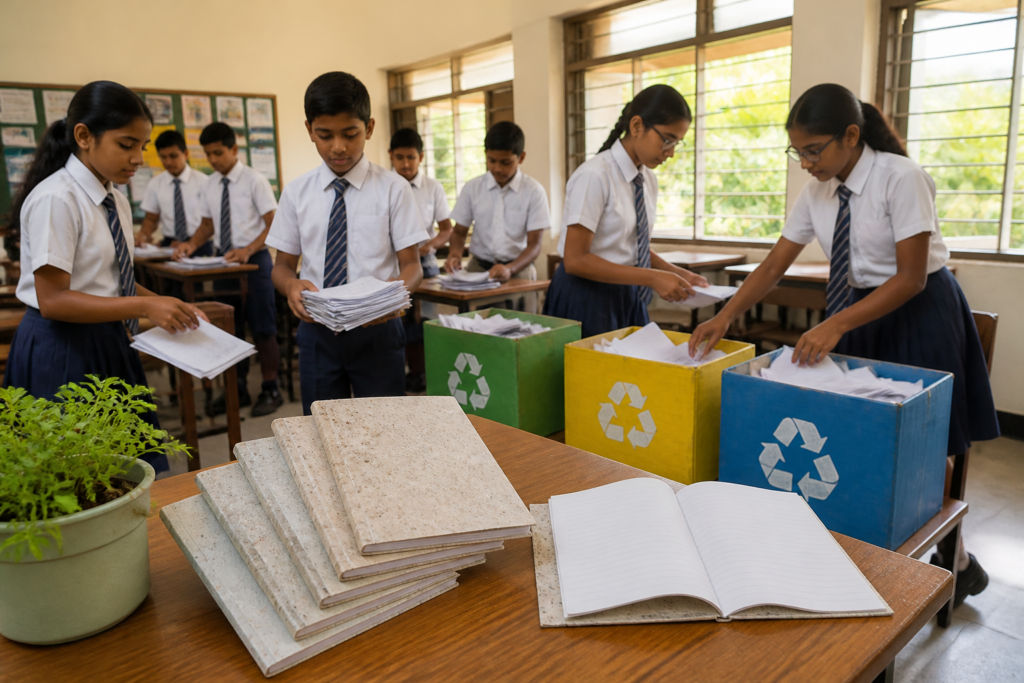
Made@gain notebooks began with a simple observation: school notebooks often contain unused pages when the academic year ends. In Bengaluru, 16-year-old Samaira Garg turned that overlooked waste stream into a structured collection and recycling initiative that has so far produced around 12,000 notebooks and distributed 8,000 of them to children in 10 schools and other communities.
The initiative is small compared with the scale of urban waste, but its significance lies in the chain it has created. Paper collected from schools, corporates, apartment communities and individual donors is sent for reprocessing by Rescript, a Bengaluru company that uses pre- and post-consumer waste to manufacture stationery. The notebooks are then supplied to students, including children from the Soliga tribal community at BR Hills and children of migrant construction workers.
That chain addresses two urban problems at the same time. Paper that might otherwise be discarded is redirected into production, while new notebooks reach students who may not be able to afford stationery. The model also shows why waste segregation alone does not complete the recycling process. Material must be collected consistently, moved to an appropriate processor and connected to a use for the finished product.
Samaira started the effort after noticing the unused sheets in her own notebooks. Her first attempt involved taping pages together, producing about 20 notebooks with between 60 and 100 pages each. She then approached Ashutosh Ananth, co-founder of Rescript, to understand whether the pages could be processed into new notebooks with a more finished appearance. The partnership led to a paper collection drive and the formal creation of Made@gain in February 2025.
The first drive collected 2,000 kilograms of paper and produced 1,000 notebooks. Since then, the initiative has collected more than 20,000 kilograms of used stationery. Its collection network now covers five schools, 10 corporates, six communities and about 800 individual donors, according to the information shared by Made@gain and reported by The Hindu.
The numbers show both the potential and the limits of such a model. Twenty thousand kilograms of collected stationery is a substantial result for a student-led initiative, but it has required a network rather than an isolated act of charity. Schools, offices, residential communities and individual households have each become collection points. Rescript provides the processing link, while beneficiary schools and communities provide the route through which the finished notebooks are distributed.
National Public School-East illustrates the importance of this institutional connection. Principal Meenu Bhattacharya said the school generated significant paper waste, particularly at the end of the academic year. The school had introduced Made@gain through its Social Empowerment through Work Education and Action programme, allowing high-school students to present the initiative to younger classes. The arrangement turned collection into a school-wide activity rather than leaving recycling dependent on individual households.
This distinction is important for urban waste systems. Residents and institutions may be willing to segregate waste, but the material can still be discarded if there is no clear collection pathway or if the recycling process is not visible to them. In the account of Made@gain, the request from a school, office or apartment community is linked to a defined processor and a tangible final product. A notebook made from collected paper gives participants a direct way to see where their discarded material has gone.
Ashutosh Ananth said Made@gain notebooks had saved approximately 46,200 litres of water and prevented 1,368 kilograms of carbon dioxide emissions, while no trees were cut for their creation. These figures are attributed to the initiative and are not independently assessed in the supplied report. They nevertheless indicate the environmental claims that the project uses to explain the value of reprocessing paper. Its wider contribution is easier to observe: waste is collected, converted into stationery and directed towards students who need it.
The initiative also provides a practical setting in which sustainability education moves beyond classroom terminology. Made@gain has created an ambassador programme in which students lead collection drives in their schools. Through that programme, concepts such as sustainability, leadership and responsible consumption are connected to an activity with a measurable output. Students are not only asked to dispose of paper correctly; they participate in organising collection, communicating the purpose of the drive and distributing the resulting notebooks.
The involvement of schools also exposes a wider institutional challenge. Paper waste is often concentrated at predictable points in the academic calendar, especially when old notebooks are cleared out. Without a workable recycling arrangement, that material can enter ordinary waste channels. The experience of NPS-East suggests that a school can become both a source of recyclable material and a place where students learn how a circular system operates.
Made@gain’s distribution network extends beyond Bengaluru’s schools. The notebooks have reached children from the Soliga tribal community at BR Hills and children of migrant construction workers. These groups experience different forms of disadvantage, but the initiative’s distribution model places stationery within a broader question of access: a basic school supply can be routine for some families and difficult to obtain for others. Samaira said her visits to schools serving children from the Soliga community showed her how a new notebook could carry a meaning beyond its material value for children accustomed to receiving hand-me-downs.
That element separates Made@gain from a recycling campaign focused only on diversion from landfill. The project combines material recovery with redistribution. Its stated objective is not simply to collect paper, but to create a product that can be used by students. The social outcome depends on both sides of the chain functioning: enough paper must be collected and processed, and the finished notebooks must reach schools and communities where they are useful.
The initiative has also begun to move into apartments and corporate offices. This expansion matters because urban waste is generated across multiple settings, each with different collection habits and administrative structures. A school can mobilise students and teachers; a corporate office can organise employees; an apartment community can use its internal communication and maintenance systems. Made@gain’s network reflects an attempt to connect these separate institutions to one recycling pathway.
Its personalisation service, priced at ₹18 per notebook, allows contributors to add a cover design, contributor branding and the Thinking Circular concept to the back cover. This feature creates another link between collection and participation. Organisations can see their role represented in the finished product, while the notebook remains connected to the broader message of responsible consumption. The supplied report does not establish how much of Made@gain’s total output is personalised or how the service affects its finances.
The project’s growth also depends on people who can translate a general sustainability message into a specific plan. Samaira’s proposal to NPS-East was accepted because, according to the principal, it included an actionable process rather than only an appeal to good intentions. That observation captures a recurring problem in urban environmental programmes: awareness is easier to generate than a reliable operational system.
Made@gain does not replace municipal waste-management systems, nor does the supplied material establish its financial model, processing capacity or long-term scalability. It does, however, demonstrate how institutions can create a focused channel for one material stream. Ashutosh Ananth noted that paper is often thrown into dustbins and may ultimately reach landfills despite segregation efforts. He advised households and institutions to hand paper to responsible collectors, including waste-paper dealers or aggregators working with recycling companies.
The central lesson is therefore not that one student-led initiative can solve Bengaluru’s paper-waste problem. It is that a circular economy becomes visible when collection, processing and reuse are designed as one connected process. Made@gain’s record—more than 20,000 kilograms of collected stationery, around 12,000 notebooks produced and 8,000 distributed—shows what that connection has achieved so far.
The next test is whether the model can continue expanding without losing clarity about where material is collected, how it is processed and who receives the finished notebooks. Made@gain is seeking participation from additional schools, apartments and corporate offices, while its ambassador programme places students at the centre of new collection drives. The initiative’s progress will be measured not only by the volume of paper diverted, but also by whether its collection network and distribution partnerships remain active as it grows.


