

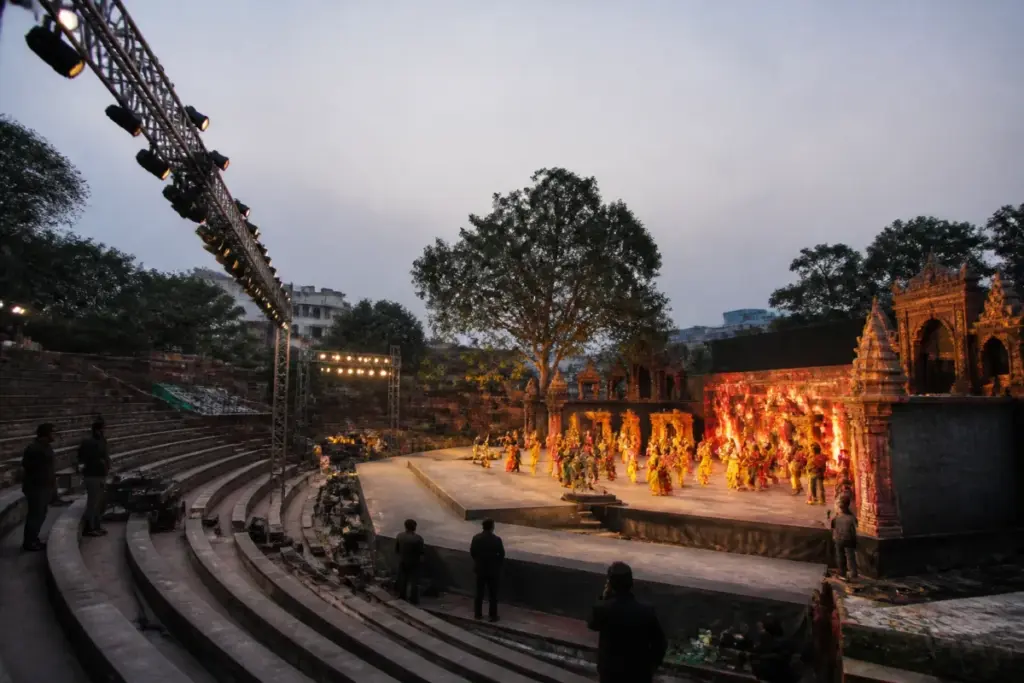
The leadership transition at Shriram Bharatiya Kala Kendra is being presented as more than a family succession. At an institution whose open-air arena, Kamani Auditorium, dance productions and music festivals have helped define Delhi’s performing-arts landscape, the change is also a test of how a long-running cultural organisation can preserve artistic identity while introducing formal systems of management.
Gauri Keeling, the new Vice Chairperson of SBKK, is taking on much of the financial and cultural decision-making as her elder sister, long-time artistic director and Chairperson Shobha Deepak Singh, reduces her day-to-day involvement. Keeling plans to divide her time between Delhi and the United Kingdom and work with SBKK Director Jayant Kastuar and working trustee Meenakshi Dass.
Her stated priority is to “put things in order” at an institution that has been operating for about seven decades. The changes already visible in the current production include a return to traditional sets and older compositions, the restoration of chaupais from the Ramcharitmanas, and the removal of older LED screens. At a full-dress rehearsal of the 69th edition of the 22-day Ramlila production ‘Shri Ram’, Keeling was also reviewing details such as stage lighting, subtitles and costume-related presentation.
Those decisions may appear technical, but they reveal the scale of the transition. At SBKK, questions about a beard, a subtitle screen or a moving light are connected to a larger question: who defines the artistic language of an institution when the person most closely associated with that language is no longer able to oversee every decision?
### SBKK’s institutional inheritance
SBKK’s history began with Sumitra Charat Ram, who hosted an all-night baithak at her residence on Independence Day in 1947. That gathering developed into Jhankar, a cultural society dedicated to Indian classical music and dance. The institute was formally registered in 1952 as Shri Ram Bharatiya Kala Kendra.
Its Ramlila was first presented as a dance drama in 1957 and became the institution’s signature annual production. SBKK also presents the Shriram Shankarlal Music Festival. The organisation’s work therefore extends beyond a single performance season. Its identity has been built through recurring cultural programming, training and the operation of venues that have served Delhi’s performing-arts community for decades.
Keeling describes SBKK’s history as having two broad phases. The first was the Sumitra Charat Ram period, based on traditional writing. The second followed the 1970s and was shaped by Shobha Deepak Singh, whose approach was more modern. Keeling identifies herself as traditional and says she wants to restore older elements while removing what she describes as “gimmicks”.
The distinction is important because it frames the transition as a debate over institutional direction, not simply a change in personnel. Shobha Singh’s tenure established a strong artistic identity, while Keeling’s arrival introduces a different emphasis on continuity, discipline and administrative structure. The challenge is to make that change without treating the past as an obstacle or modernisation as an automatic improvement.
Shobha Singh took over the artistic direction after Sumitra Charat Ram and shaped SBKK’s productions for decades. Her husband, Deepak Singh, also helped run the organisation before his death a couple of years ago. Keeling’s new responsibilities follow this period of personal and institutional change, with family members still closely involved in the organisation’s governance.
### From family stewardship to formal systems
The most consequential part of Keeling’s plan is not the stage redesign. It is the attempt to create a more formal decision-making structure around a historically family-led institution.
Keeling says she wants to find a professional chairperson and does not believe in a “mai baap”, or paternalistic, system of functioning. She plans to create a team answerable to a committee consisting of the Chairperson, Vice Chairperson and Director. She also says every project will have a project report and that an annual budget will be prepared, with spending beyond the approved budget requiring her consent.
These measures place budgeting, reporting and accountability at the centre of the transition. They also respond to the particular constraints of a charitable institution. Keeling says SBKK does not have money to squander, linking artistic decisions to financial responsibility rather than treating production quality and administration as separate concerns.
For a cultural institution, project reports and annual budgets can change how decisions are recorded and evaluated. They can create a common framework for performances, festivals, venue operations and other activities. However, the supplied account does not establish how these procedures will be implemented, what governance documents will be adopted or how authority will be divided between the family members, the director and the proposed professional leadership.
Kastuar’s comments underline that difficulty. He says the transition has to happen slowly and that finding professionals without personal biases or “an axe to grind” is difficult. His stated role is to ensure a smooth transition. Dass similarly describes the process as one of professionalisation and the introduction of standard operating procedures, while stressing that SBKK remains closely connected to Shobha Singh.
This combination of statements shows that the organisation is not attempting a clean break. It is trying to formalise an existing structure while retaining the people and institutional memory that have sustained it. That makes succession more gradual, but it also means that the boundaries of responsibility will need to become clearer over time.
### Cultural infrastructure is also operating infrastructure
The transition affects not only SBKK’s productions but also the physical venues through which its public role is delivered. Keeling is expected to take over major decision-making for Kamani Auditorium, the 55-year-old, 625-seater venue located next to SBKK and described in the report as one of the oldest auditoriums of its kind in Delhi.
Kamani Auditorium and SBKK’s open-air arena represent two different kinds of cultural infrastructure. One is a fixed indoor auditorium with a defined seating capacity; the other is an open-air performance setting associated with a large, recurring production. Both require programming decisions, technical systems, maintenance, budgeting and coordination with audiences and performers.
The rehearsal details show how these systems meet the artistic product. Lighting that does not work, subtitles that are misaligned or set elements that are considered unsuitable are not merely aesthetic imperfections. They can affect accessibility, audience comprehension, production reliability and the public experience of a performance. The decision to move away from older LED screens and return to traditional sets is therefore also a decision about the technical and visual infrastructure of the stage.
At the same time, the report does not provide information on Kamani Auditorium’s current maintenance needs, financial performance, occupancy, staffing or capital requirements. Nor does it establish whether the changes to the Ramlila are part of a broader venue strategy. Those questions remain relevant because leadership reform will ultimately be judged through the organisation’s ability to manage both artistic ambition and physical infrastructure.
SBKK’s public significance also comes from its continuity. The Ramlila has been presented as a dance drama since 1957, and the current edition is its 69th. That long run gives the production a built-in institutional memory, but it can also make change more sensitive. Audiences, performers and staff may associate particular visual and musical choices with specific phases of the Kendra’s history.
### The succession question in Delhi’s cultural institutions
Keeling’s proposed reforms raise a wider governance question for cultural institutions that have grown around founder-led or family-led stewardship. Such organisations often depend on personal relationships, artistic judgement and accumulated knowledge. Those qualities can sustain a distinctive identity, but they may also make succession difficult when authority is concentrated in one individual or family.
SBKK’s present transition is significant because it makes that tension visible. The organisation has a strong legacy, a recognisable annual production, a major adjacent auditorium and a history that reaches back to the early years of independent India. Its next phase will require the preservation of that legacy alongside clearer procedures for budgets, projects, professional appointments and accountability.
The available evidence supports a picture of an institution attempting to move from informal or personality-driven decision-making towards a committee-based and documented system. It does not yet show whether that system has been fully established or how it will perform. The proposed professional chairperson has not been identified, and the division of authority among the Chairperson, Vice Chairperson, Director and working trustee remains a work in progress.
That uncertainty is not necessarily evidence of institutional failure. Dass describes the transition as a process in which family members are informing Shobha Singh about developments, while Kastuar calls for a smooth and gradual change. It does, however, show that the current phase is one of adjustment rather than a completed transfer of power.
The larger urban question is how Delhi’s cultural infrastructure can remain durable when its founding or defining generation steps back. Buildings and venues alone do not preserve an institution. Continuity depends on governance, finances, programming, technical capacity and the ability to transmit artistic knowledge across generations.
For SBKK, the evidence currently points to a controlled transition with three stated priorities: restore elements of the institution’s traditional artistic language, remove production choices considered unnecessary, and introduce tighter administrative systems. Whether those priorities reinforce one another will depend on implementation. The next milestones will be the functioning of the proposed committee structure, the appointment of a professional chairperson, the use of project reports and budgets, and the way SBKK manages both its Ramlila production and Kamani Auditorium under the new arrangement.


