

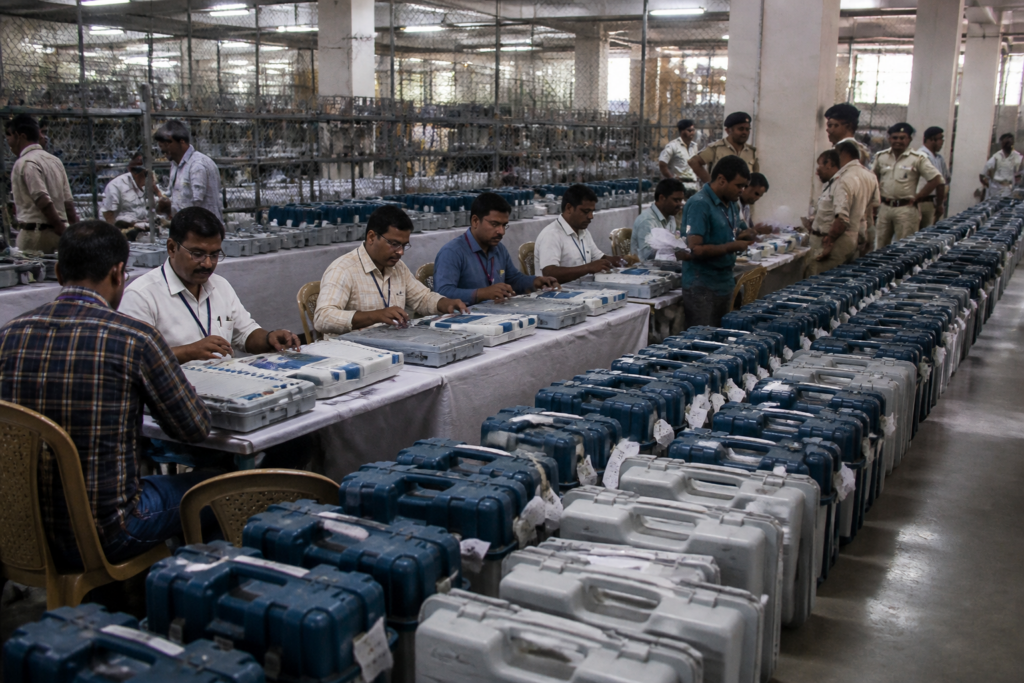
The Calcutta High Court has cleared a major operational hurdle for West Bengal municipal polls, directing the State Election Commission to immediately erase old data from electronic voting machines used in previous elections, except in three specified wards of the Kolkata Municipal Corporation and the Contai municipality.
The order allows the commission to proceed with preparations for elections in seven municipalities. During Wednesday’s hearing, the commission told a division bench that it was prepared to conduct the polls in November and December. The bench comprised Chief Justice Ravindra V. Ghuge and Justice Om Narayan Rai.
The court’s intervention followed questions over whether polling data stored on electronic voting machines and Voter Verifiable Paper Audit Trail units could be transferred and retained separately on hard disks. The commission had been asked to submit a detailed report on the storage of the data and whether such an arrangement was legally permissible.
After considering the report, the court directed the commission to erase the old data stored in the machines. The direction addresses concerns about the availability of the equipment for the forthcoming municipal elections while retaining an exception for the three specified civic areas.
The first phase of the proposed elections will cover Kolkata, Howrah, Bally, Haldia, Dhupguri, Kalimpong and Kurseong. Polling is expected to take place across 6,301 booths, and administrative preparations have already begun, according to the report placed before the court.
The State Election Commission currently has 21,184 ballot units and 19,564 control units. The availability and deployment of this equipment is central to the commission’s preparations because the elections will require machines to be configured, allocated and made ready across multiple municipal jurisdictions.
The court order comes as at least 15 municipalities across 12 districts are functioning without elected civic boards. Municipal services in these areas are being overseen by administrators rather than elected local bodies, leaving the conduct of pending polls as a significant issue for urban governance in the state.
Howrah is the most prolonged case among the municipalities listed in the report. Its last municipal election was held in 2013, while the elected board’s tenure ended in 2018. The Howrah Municipal Corporation has since continued to function without an elected board.
The municipal election process has also gained political and administrative attention following the formation of the new state government. Chief minister Suvendu Adhikari had stressed the need to hold the pending elections at the earliest, after which the commission stepped up preparations.
The immediate next steps are expected to include the implementation of the court’s data-erasure direction and continued administrative preparation for the proposed November-December polling schedule. The commission will also have to complete arrangements for the seven municipal jurisdictions and their 6,301 polling booths.


