

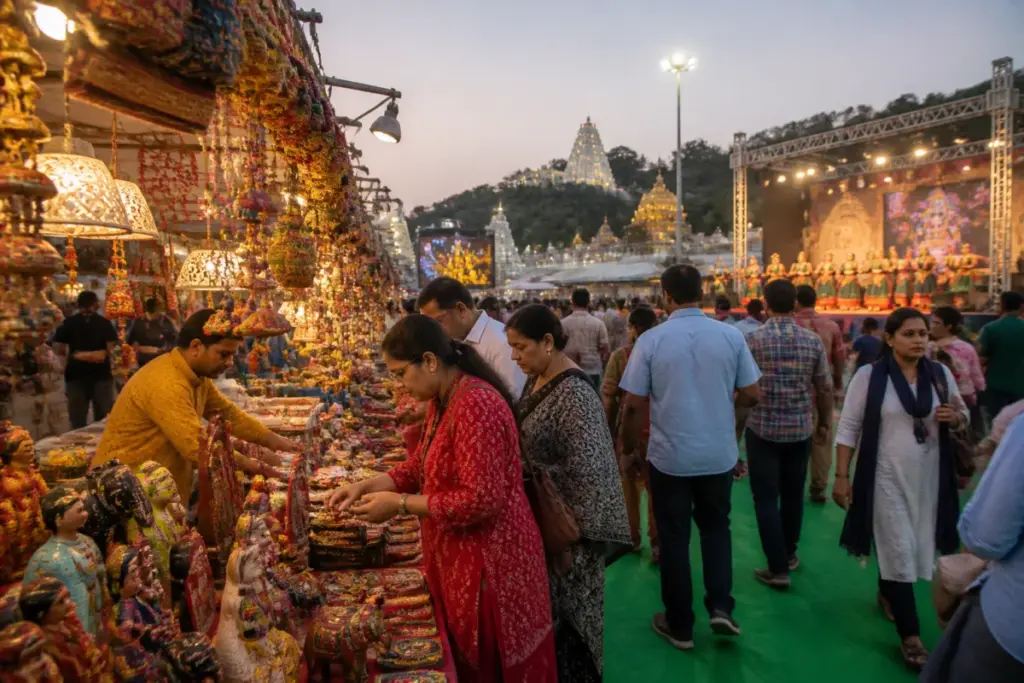
The conclusion of the 10-day Vijayawada Utsav on October 20 has left Vijayawada with a proposition that extends beyond a festival calendar: the city can use its religious importance, cultural traditions and artisan economy to build a broader tourism identity. The event brought together devotional programmes, classical and folk performances, exhibitions, craft sales and visitors from across India during the Dussehra season.
That proposition is significant because Vijayawada already has a powerful source of visitor demand. The Kanaka Durga temple attracts nearly 1.5 lakh to 2 lakh devotees every day during Navratri, according to Vijayawada MP Kesineni Sivanath. The festival’s organisers and state leadership are attempting to connect that established religious footfall with a wider experience of Andhra Pradesh’s heritage, including its performing arts, traditional crafts and rural livelihoods.
The strategy is not simply to add entertainment around a religious event. It is to bring different urban functions into the same public programme: pilgrimage, cultural presentation, retail, hospitality, visitor movement and livelihood generation. The supplied account does not provide figures for visitor spending, accommodation demand, transport use or municipal costs. But it makes clear that Vijayawada Utsav is being positioned as an instrument for expanding the city’s role in spiritual and cultural tourism.
From religious destination to cultural platform
The festival was centred on the worship of Goddess Kanaka Durga, reflecting Vijayawada’s established religious significance. At the same time, it featured classical art forms, folk performances, devotional events, entertainment programmes, exhibitions and the Rural Artisans Society, or SARAS, Mela. The combination gave the event a national dimension by bringing crafts and traditions from different parts of India into the city.
This matters for the way a destination is experienced. A pilgrimage visit is often organised around a principal religious site and a limited period of worship. A cultural festival can extend the visitor’s itinerary by creating additional reasons to stay, return or explore. In Vijayawada’s case, the festival sought to connect the Kanaka Durga temple’s spiritual appeal with a marketplace of crafts, live performances and regional traditions.
The event also placed local identity within a wider national setting. Visitors from outside Andhra Pradesh were given an opportunity to encounter traditions from different parts of India in one location, while local residents could present Vijayawada’s own artistic heritage. The account specifically identifies Kondapalli Bommalu, the state’s well-known wooden toys, as one of the traditional crafts showcased during the celebrations.
That exchange works in two directions. Vijayawada becomes a host city for national cultural traditions, while its own artistic heritage gains a platform before visitors who may not otherwise encounter it. The city’s cultural identity is therefore being presented not as a static heritage product, but as part of a larger network of regional crafts, performance traditions and religious travel.
The institutional design behind the festival
The event was backed by the Andhra Pradesh government and promoted through statements from Chief Minister N Chandrababu Naidu. Naidu said festivals such as Vijayawada Utsav could bring spirituality, knowledge and technology together while creating a platform to showcase Andhra Pradesh’s cultural heritage. He also stressed the need to take the state’s arts, traditions and Telugu cultural heritage to a wider audience.
These statements indicate how the festival is being framed institutionally. It is not being presented only as a seasonal celebration or a tourism spectacle. It is also being connected to cultural preservation, public communication and economic opportunity. The inclusion of the SARAS Mela reinforces that approach by linking cultural presentation to the sale of goods made by rural artisans.
The source account says the festival aimed to create opportunities for artisans, craftspeople, vendors and businesses. It does not establish how many sellers participated, how much revenue was generated or whether the opportunities were temporary or sustained. Those details would be necessary to measure the event’s economic performance. What can be established is that livelihood generation was part of its stated purpose.
The presence of President Droupadi Murmu, Tamil Nadu Chief Minister C Joseph Vijay, Madhya Pradesh Chief Minister Mohan Yadav and a Chinese delegation also gave the event a high-profile character. Their participation increased the festival’s visibility, although the supplied material does not specify whether it produced new tourism agreements, cultural partnerships or investment commitments.
The civic challenge behind cultural tourism
A city that seeks to grow religious and cultural tourism must manage more than programming. It must accommodate large visitor volumes, maintain access to important sites, support public safety and provide spaces in which performances and markets can operate. Vijayawada’s daily Navratri footfall, estimated at 1.5 lakh to 2 lakh devotees, indicates the scale of the challenge during the peak religious season.
The festival’s success, therefore, cannot be judged only by the quality of performances or the number of dignitaries who attended. It also depends on how the city handles the movement and needs of visitors. The input does not provide information on crowd management, transport arrangements, sanitation, accessibility, temporary infrastructure or the distribution of visitors across the city. These omissions do not negate the festival’s cultural role, but they define what remains unknown about its urban performance.
The same applies to the relationship between tourism growth and residents’ everyday experience. A festival can create opportunities for local vendors and craftspeople, but it can also place pressure on public spaces, roads and services. No evidence in the supplied material indicates that such problems occurred during Vijayawada Utsav. The broader point is that the city’s tourism strategy will increasingly be judged through the systems that support events, not only through the events themselves.
For Vijayawada, the religious base provides a substantial starting point. The stated objective is to build on that base by showcasing artistic heritage, reviving traditional folk forms and creating economic opportunities. Whether this becomes a durable city strategy depends on the continuity of these activities beyond the 10-day festival window. The supplied report confirms the ambition, but not yet the long-term institutional arrangements or funding model behind it.
What the festival reveals about urban economies
Vijayawada Utsav illustrates how cities attempt to connect culture with local economic activity. The presence of the SARAS Mela created a formal setting for rural artisans to sell goods, while performances and exhibitions generated a wider cultural environment around those transactions. This is different from treating heritage as a monument or a religious site as a single-purpose destination.
The approach also broadens the range of participants in the tourism economy. Visitors may spend on accommodation and transport, but the festival’s stated design includes artisans, craftspeople, vendors and businesses. That distribution is important because the benefits of tourism are often assessed not only by aggregate visitor numbers but also by who is able to earn from them. The available material does not quantify that distribution, so it cannot establish whether benefits were widespread or concentrated.
Traditional crafts face a further challenge: visibility does not automatically create sustained demand. Kondapalli Bommalu and other regional products may gain exposure through a major event, but the report does not say whether the festival resulted in repeat orders, new retail channels or longer-term support for craftspeople. The event nevertheless provides a public platform through which such products can be encountered by residents, domestic visitors and international delegates.
The same question applies to folk traditions. The festival aimed to revive traditional forms by placing them alongside classical arts, devotional programmes and entertainment. That creates visibility, but revival also requires regular performance opportunities, audiences, transmission between generations and institutional support. None of these longer-term outcomes is established in the supplied account. They are the areas that future reporting would need to examine.
A national ambition built around a local identity
The festival’s organisers are seeking to raise Vijayawada’s profile alongside established spiritual and cultural destinations such as Varanasi and Mysuru. That comparison expresses an ambition to compete for national attention, but Vijayawada’s proposition is rooted in its own combination of religious importance, Andhra Pradesh’s cultural heritage and access to regional craft traditions.
The city’s advantage, as described in the report, lies in the ability to combine a high-volume religious season with a wider cultural programme. The presence of the Kanaka Durga temple provides an established reason to visit. Vijayawada Utsav adds a curated set of experiences around that reason: performances, exhibitions, craft markets and cultural exchange.
This model can strengthen a city’s identity when the different components reinforce one another. Religious tourism supplies scale and continuity. Cultural programming provides variety. Craft markets connect visitors to livelihoods and material traditions. Public events create opportunities for the city to represent itself to visitors, institutions and businesses. The evidence supplied for Vijayawada shows these components being brought together, but it does not yet demonstrate their measurable impact.
The larger urban question is whether an event-led tourism strategy can become a durable city system. That requires clarity on who is responsible for planning, funding, operating and evaluating the programme. It also requires evidence on visitor numbers, local earnings, transport demand, public-space use and the treatment of cultural assets. Without those measures, the festival’s success remains primarily a statement of intent and visibility.
Vijayawada Utsav has nevertheless established a clear direction. It presents the city not only as a place of worship, but as a meeting point for faith, performance, craft and commerce. The event concluded on October 20, but the next test will be whether its cultural and livelihood objectives continue between festival seasons, and whether future editions can show how the city’s tourism ambitions translate into measurable benefits for residents, visitors and artisans.


