

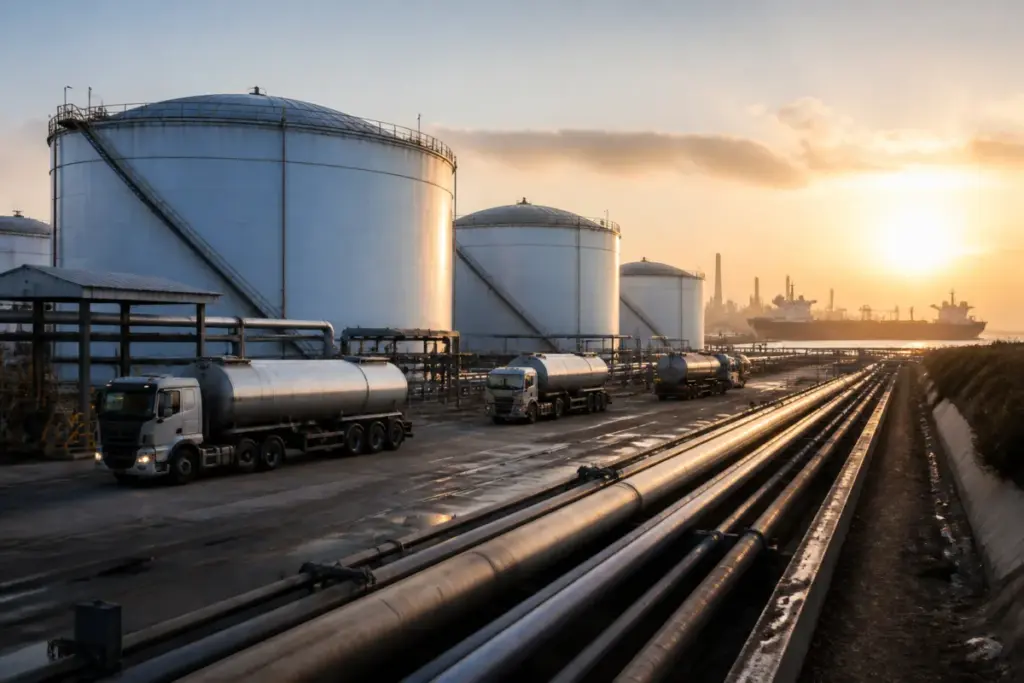
The United States is preparing to release 17 million barrels of crude oil from its Strategic Petroleum Reserve through an exchange arrangement with companies, as Brent crude approaches $110 a barrel and concerns grow over supply disruptions. For India, the immediate question is not simply whether global oil prices fall, but whether any decline lasts long enough to pass through the country’s fuel, transport and household-cost systems.
The US Energy Department sought proposals from companies on Friday for the new oil-swap plan. Under the arrangement, companies would receive crude from the government now and return oil later under specified conditions. The stated purpose is to increase near-term availability in the international market and ease upward pressure on prices.
The decision comes as West Texas Intermediate crude rose 3.51% to $101.4 a barrel on Saturday, while Brent crude climbed 3.72% to around $110 a barrel, according to the supplied report. The rise reflects concern over the security of oil supplies rather than a routine movement in demand alone. The report links that concern to the conflict involving the United States and Iran, attacks on ships in the Gulf region and disruption around the Strait of Hormuz.
That geography is central to the significance of the announcement. The Strait of Hormuz is one of the world’s major maritime oil routes. Any obstruction or threat to shipping through the strait increases the risk that crude will not reach importing countries on schedule. Even before a physical shortage appears, markets can price in the possibility of reduced supply. The result is higher crude prices, greater uncertainty for refiners and increased pressure on countries that rely heavily on imports.
An emergency reserve can respond to that pressure, but it does not remove the underlying risk. The US plan is designed to provide additional barrels to companies quickly. If participating companies receive crude from the reserve, they may need to make fewer purchases in the open market for their immediate requirements. That could reduce competition for available cargoes and moderate prices in the short term.
The exchange structure also explains why the move is not the same as a permanent increase in oil production. Companies must return the borrowed crude later. The arrangement therefore shifts the timing of supply rather than creating a lasting new source of oil. Its effect will depend on how much crude companies accept, when the barrels enter the market and whether shipping and production concerns continue.
The report’s account of an earlier proposal shows the implementation challenge. In March, the United States had pledged to make 172 million barrels available from its strategic reserve as part of a wider plan involving about 30 International Energy Agency member countries. The combined objective was to release 400 million barrels from emergency stocks to reduce the effects of supply disruptions.
However, the earlier US offer received limited interest from companies. In June, companies reportedly showed interest in borrowing only about 500,000 barrels. One reason was the repayment condition: companies could have been required to return up to 24% more crude than they borrowed. That obligation reduced the attractiveness of the arrangement, particularly for firms that were uncertain about future prices and supply conditions.
The new offer will therefore be tested not only by the size of the reserve release but also by market participation. A headline quantity does not automatically translate into the same quantity reaching the market. Companies must judge whether the terms justify taking the crude now and returning additional volumes later. If participation remains low, the intended price effect could be limited even if the announced reserve is large.
The United States is also pursuing other ways to increase the availability of refined products. The report says US President Donald Trump and Russian President Vladimir Putin have agreed on the release of Russian diesel exports, initially involving around 300,000 tonnes. Additional diesel could ease pressure in markets facing product shortages. At the same time, the arrangement has drawn criticism from Ukraine and European leaders, who argue that easing restrictions on Russian oil products could provide economic benefit to Moscow.
This shows that energy-market intervention is also an institutional and geopolitical process. Governments must balance immediate supply concerns against sanctions, military conflicts and diplomatic commitments. A decision that may support lower prices or greater availability can have consequences for foreign policy. For importing economies, however, the market result will depend on whether these measures produce reliable physical supply rather than only announcements.
The G7 has announced another emergency release plan. According to the report, the group declared on 2 October that around 100 million barrels could be made available over four months through the International Energy Agency, with additional attention to diesel supply. The US reserve exchange, the G7 plan and possible Russian diesel exports all seek to narrow the gap between available supply and market demand.
Their combined impact cannot be assessed only by adding the announced volumes. Crude and diesel are different parts of the energy system, and timing matters. Oil must be released, transported, refined and delivered to the markets where it is needed. A release that arrives after a shipping disruption has eased may have a different effect from one that reaches buyers during the peak of a supply scare. The conditions attached to each programme also affect whether companies participate.
For India, the transmission mechanism begins with crude imports. When international crude becomes more expensive, the cost of importing oil rises. That can affect the operating costs of oil companies and add pressure to the wider economy. Transport is especially exposed because road vehicles, freight movement and several other urban activities depend on petroleum products. Higher fuel costs can influence logistics expenses and, through them, the prices of goods and services moved across cities.
The effect on Indian petrol and diesel prices is not automatic or immediate. International crude is one input, but domestic prices also reflect the rupee-dollar exchange rate, oil companies’ costs, central and state taxes and other charges. A fall in the international benchmark would therefore not necessarily produce an equivalent fall at the retail pump. The duration and scale of the decline would matter, as would the currency’s movement against the dollar.
This is why the US announcement should be understood as a potential pressure-relief measure rather than a guaranteed reduction in Indian fuel prices. If the reserve release and other international initiatives increase availability and bring crude prices down for a sustained period, India could benefit through lower import costs. If concerns around the Strait of Hormuz, shipping attacks or the wider conflict continue, the additional barrels may only partially offset the disruption premium in global prices.
The available report places crude at around $106 a barrel in its discussion of the potential impact on India and records Brent near $110 during the latest rise. At those levels, the margin for relief depends on whether supply anxiety recedes. The data also reveals the limits of emergency stocks: they can cushion a shock, but they cannot permanently replace normal production, secure shipping routes or stable diplomatic conditions.
The larger urban question is how exposed city economies are to energy decisions made far beyond their boundaries. Residents experience the outcome through fuel bills, public and private transport costs, freight prices and household expenditure, while the causes may lie in maritime chokepoints, reserve policy and international negotiations. That distance can make fuel-price pressure appear domestic even when the initial shock is external.
What the evidence confirms is that the United States is attempting to add short-term oil supply through its emergency reserve, alongside wider international efforts involving the G7 and the IEA. What remains uncertain is how much crude companies will take under the new terms, how long geopolitical supply risks will persist and whether any international price relief will be large and sustained enough to affect Indian consumers. The next milestones are company participation in the US exchange plan, the delivery of the announced volumes and the movement of crude prices, currency values and domestic fuel costs.


