

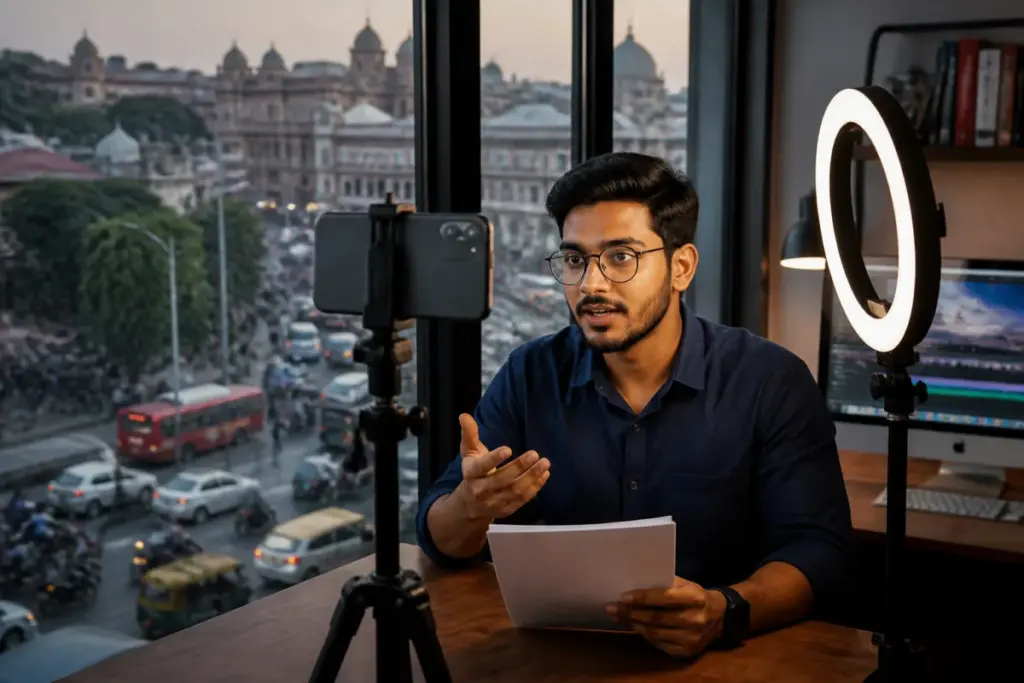
The UP election 2027 digital campaign is already taking shape long before voting begins, with political parties building influencer networks, experimenting with artificial intelligence and planning direct engagement in schools and colleges. The shift reflects a wider change in how parties compete for attention, but it also raises questions about transparency, misinformation and the boundary between public communication and political promotion.
The emerging contest in Uttar Pradesh is not confined to rallies, posters or conventional media appearances. Parties are preparing for an electorate that increasingly encounters politics through mobile phones, short-form videos and creator-led conversations. The strategy is aimed particularly at Gen Z and, increasingly, Gen Alpha, even though the precise electoral role of younger audiences will depend on their age, eligibility and participation.
The timing matters because the issues being discussed by young people are not limited to cultural or identity-based messaging. Examinations, recruitment, unemployment, education and infrastructure have featured in youth-led protests and public debates, according to the report. These subjects connect digital outreach to the performance of the state itself: jobs, public institutions, transport, education facilities and the reliability of recruitment systems.
For political parties, the challenge is therefore twofold. They must reach audiences in formats that younger citizens actually consume, while also responding to the material concerns that drive those audiences into public debate. A reel may attract attention, but it does not by itself establish whether a party has addressed an examination delay, a recruitment dispute or an infrastructure gap.
The BJP has begun building the most visibly structured youth-focused digital operation described in the report. Himanshu Raj Pandit, the party’s IT and social media head, said the party was planning artificial intelligence hackathons and had organised school championships on the Tiranga in August. He also said youth leaders would engage with students in colleges and that dedicated teams were being organised for outreach in schools and colleges.
The party’s approach combines two forms of communication that are often treated separately. One is digital distribution through creators and short videos. The other is physical engagement in educational institutions. Together, they create a system in which online visibility can be reinforced by direct contact, while campus events can be converted into digital content for wider circulation.
The Samajwadi Party and Congress are also exploring technology and influencer-led communication. An SP functionary associated with campaign management said the party planned to examine the use of artificial intelligence and other technologies to make its outreach more effective. The party also plans to use elements of Gen Z language in campaign videos and focus on subjects of particular interest to younger voters.
Congress spokesperson Anshu Awasthi said the party would use influencers with creative ability and focus on issues concerning people, especially Gen Z. He also said the party would use artificial intelligence but distinguish between its use and misuse. The BSP has separately asked its organisation to pay special attention to Gen Z and Gen Alpha issues, according to the report, following an all-India party meeting in Lucknow on September 23.
This makes the digital campaign more than a communications upgrade. It is becoming an organisational layer of electoral politics. Parties are not simply publishing content through their own accounts; they are seeking access to existing communities assembled around local identity, entertainment, food, travel, culture and city life.
The numbers cited by creators illustrate the scale of this intermediary system. Harshvardhan Patel, who runs the Instagram account ‘ayodhyawale’, told the Times of India that he had 2.1 million followers and was approached for government and public-welfare messaging. Ashutosh Mishra, who runs ‘lucknow_shehar’, said the account had 186,000 followers and that a one-minute reel could command around Rs 15,000. Alok Shrivastav of ‘ishq_e_lucknowi’, with 216,000 followers, said he was in talks with the ruling party for the 2027 election, although no arrangement had been finalised.
These figures show why influencers are attractive to parties. A political organisation can reach a large, pre-existing audience without first persuading that audience to follow a formal party account. Local creators can also bring a degree of geographic and cultural familiarity that national campaign material may lack. A Lucknow or Ayodhya-focused page can place political messaging inside an information stream that already includes neighbourhood life, local events and city-specific identity.
At the same time, the influencer model makes political communication harder to identify and evaluate. A party advertisement is generally recognisable as party communication. A short video delivered through a creator’s account may appear to be entertainment, local information or personal commentary, even when it has been commissioned or shaped by a political organisation. The report does not establish that the cited creators have published undisclosed political promotions, but the commercial arrangements described make disclosure an important institutional question.
The use of artificial intelligence adds another layer of complexity. The India International Institute of Democracy and Election Management held a symposium on AI and elections on February 20, 2026, focusing on innovation, integrity and institutional preparedness. The discussions, held under India’s chairship of International IDEA and aligned with the India-AI Impact Summit 2026, identified misinformation, AI-generated deepfakes, algorithmic bias, cybersecurity vulnerabilities, opaque automated systems and dependence on external technology ecosystems as risks.
The significance of these risks is not limited to fabricated videos. Political parties can use automated systems to produce large volumes of targeted messages, adapt language to different communities and respond rapidly to online trends. The same tools can also make it difficult for citizens, journalists and election authorities to determine who created a message, who paid for it, what audience received it and whether the content was altered after publication.
The symposium’s emphasis on a human-centred approach is relevant because technology does not remove institutional responsibility. Rakesh Kumar Verma, director general of IIIDEM, said artificial intelligence should expand access and strengthen participation, particularly for marginalised communities. That objective depends on safeguards that preserve transparency and accountability rather than treating technological reach as an end in itself.
The Election Commission and other electoral institutions face a changing communications environment in which the speed of online distribution is far greater than the pace of conventional verification. The supplied report does not detail a new regulatory framework for influencer campaigns or AI-generated electoral content. It does, however, establish that election-management bodies are actively discussing the problem and that the issue has moved from a future concern to an institutional priority.
The expansion of creator-led politics also has a history. During the 2024 Lok Sabha campaign, political parties increasingly used digital creators, while several BJP functionaries and Union ministers appeared in informal interviews with creators. The Centre launched the National Creators Award in 2024 across categories such as storytelling, social change, education, gaming and technology. These developments helped establish creators as more than entertainment figures: they became channels through which public policy, political identity and personal image could be combined.
The distinction between government messaging and party campaigning is central to this evolution. The creators cited in the report described assignments involving welfare schemes, public events and party campaigns. Those categories can overlap in the public’s experience, particularly when a government achievement is communicated by a party-linked account or when a creator is paid to present official information. The report does not provide a complete accounting of payment disclosure, campaign expenditure or content labelling, so the extent of the overlap remains unestablished.
For urban citizens, the consequences are visible in the subjects being promoted. Infrastructure, education and recruitment are not abstract campaign themes. They shape whether young people can reach colleges, find employment, trust public examinations or access government services. Yet digital communication can reduce complex urban and administrative questions to short, highly shareable claims. The format may improve reach while weakening context, especially when a one-minute video substitutes for details about funding, delivery schedules, eligibility or institutional responsibility.
This is the larger urban question raised by Uttar Pradesh’s evolving campaign strategy: can digital political communication improve citizens’ access to information without turning public services into promotional content? The answer will depend less on the popularity of individual creators than on whether parties, governments and electoral institutions make the source, purpose and evidence behind digital messages clear.
The evidence currently confirms a clear transition. Uttar Pradesh’s parties are preparing to compete for attention through influencers, reels, artificial intelligence, campus outreach and issue-based youth messaging. It also confirms that electoral institutions recognise the risks posed by deepfakes, misinformation and opaque automated systems. What remains unclear is how these campaigns will disclose paid partnerships, distinguish government communication from party promotion and control synthetic content as the 2027 election approaches. Those implementation details will determine whether the digital campaign broadens participation or merely accelerates political persuasion.


