

Unauthorised homestays in Ernakulam are becoming part of a wider urban housing problem in which tourism accommodation, informal rentals and shared housing increasingly overlap without a clear enforcement system. A report by Madhyamam – Kochi says hundreds of homestays and rental buildings across the district are operating without adequate basic infrastructure, affecting students, interstate workers and employees who depend on low-cost accommodation.
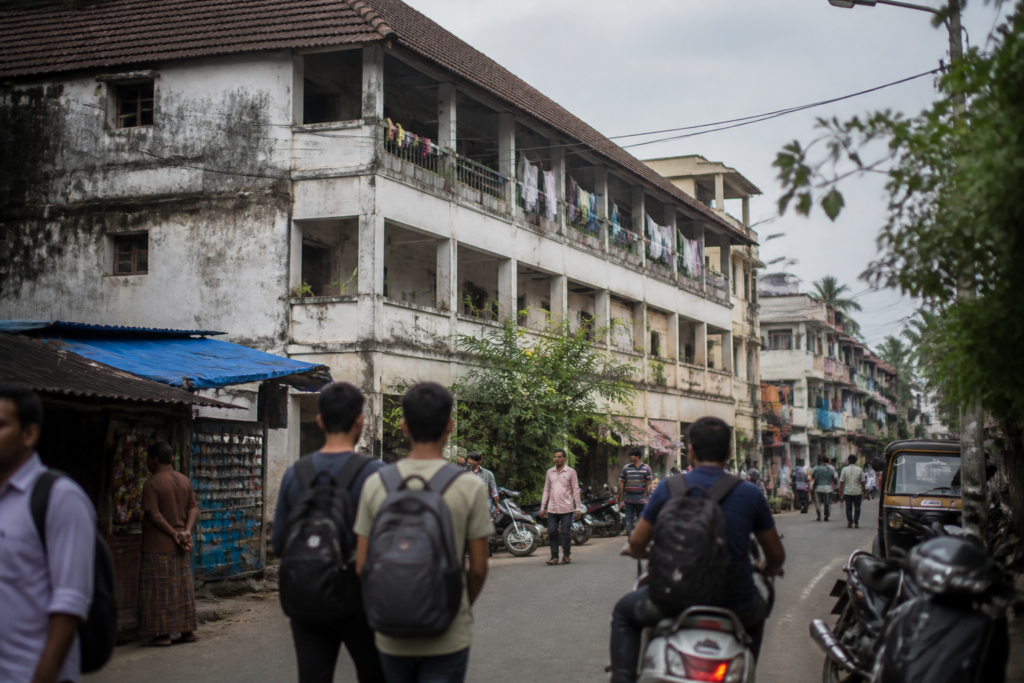
The report places the issue most visibly in Mattancherry, Fort Kochi and Vypin, established tourism areas where homestays have expanded alongside visitor demand. Within the limits of the Kochi Corporation, it reports that there are around 200 homestays. However, the Kerala Tourism Department website lists only 110 registered homestays in the district. The difference does not by itself establish the exact number of unauthorised properties, but it points to a regulatory gap between accommodation operating on the ground and accommodation formally recorded by the tourism authority.
That gap matters because a homestay is not simply a room made available to a visitor. Under the rules described in the report, a legally operated homestay must obtain homestay classification or registration from the Kerala Tourism Department. The eligible operator is expected to live in the same house with the family and provide rooms to tourists. A homestay cannot be operated from a rented building. The permitted scale is between one and six guest rooms, with a maximum of 12 guests.
The rules also specify minimum physical and safety requirements. A guest room must have at least 120 square feet of space, along with an attached bathroom measuring at least 30 square feet. Food Safety Department registration is required when applying for a homestay licence. The Tourism Department classifies approved homestays into Diamond, Gold and Silver categories. Properties functioning under the homestay label without the required approval are therefore outside the formal classification system.
The reported expansion raises a basic question about how the city distinguishes between a family-run homestay, a hostel-like shared accommodation facility and an informal rental building. The article describes buildings and flats where groups of students and workers are housed, sometimes without formal agreements. In such cases, the transaction may be reduced to a UPI rent payment, leaving little documentation beyond the financial transfer. The report says owners use this arrangement to avoid obligations under rental-building rules.
This is not merely a question of paperwork. For tenants, the absence of a documented rental relationship can weaken their ability to establish responsibility for water supply, electrical safety, sanitation, repairs and security. The report says residents in some properties face inadequate food, drinking water and accommodation. It also carries complaints that owners may respond aggressively when questioned about conditions. These claims are attributed to the report and require direct examination by the relevant authorities, but they indicate the vulnerability of people who have limited bargaining power and few formal records of their tenancy.
Rental housing rules, as outlined in the report, assign several responsibilities to building owners. These include ensuring uninterrupted drinking water, providing water-storage facilities, maintaining electricity connections and providing adequate points for lights and fans. Electrical faults and other safety risks are also described as matters for the owner to address. Tenants should have access to clean and private bathrooms, toilets, lockable doors and windows, grills where required, and basic boundary or wall protection around the building.
The responsibilities extend beyond the interior of a rented room. Owners are expected to provide arrangements for storing and removing kitchen waste and other garbage. Structural defects, leaks and external maintenance are also identified as owner responsibilities. A house should be handed over in a clean and safe condition before the tenant moves in. The report further states that owners cannot unnecessarily interfere with a tenant’s personal freedom.
These requirements show why the issue sits at the intersection of housing, public health, tourism and municipal administration. The Tourism Department has a clear role in classifying and registering homestays. Local bodies are responsible for a broader range of building, sanitation, waste-management and local-service functions. Food safety authorities become relevant when food is prepared or supplied as part of the accommodation. Rental relationships create another layer of responsibility between owners and occupants.
The problem is that an occupant does not experience these functions separately. A student or worker living in an overcrowded building needs water, toilets, electricity, waste removal and structural safety regardless of whether the premises is described as a homestay, rental house or shared accommodation. When institutions classify the property differently, responsibility can become fragmented. A property may operate commercially while presenting itself as an informal household arrangement, leaving tenants uncertain about which authority should receive a complaint.
The figures in the report also reveal the limits of relying on registration data alone. The Tourism Department’s website lists 110 registered homestays, while the report estimates around 200 homestays within the Kochi Corporation area. These numbers are not directly comparable because one refers to the district and the other to the corporation area, and the report does not provide a complete property-level survey. Even so, the difference highlights the need for authorities to clarify the size and nature of the accommodation market rather than assume that registered properties represent all active operators.
The distinction is particularly important in tourism districts. Fort Kochi, Mattancherry and Vypin attract visitors, but they are also lived-in neighbourhoods with students, workers, families and long-term tenants. When accommodation demand grows in such areas, the same building stock may serve several markets at once. A house that appears to be a visitor homestay during one period may function as group accommodation or a rental property at another. Without inspection and consistent classification, the public record can fail to reflect how buildings are actually being used.
The report says neither the Tourism Department nor local bodies are undertaking adequate inspections of whether homestays, group accommodation buildings and flats provide basic facilities. This is the central governance concern. Rules exist on paper, but their value depends on identification, inspection, documentation and enforcement. Registration is only the first step; an effective system must also establish who is living in a property, what use has been approved, how many occupants are present and whether essential services are being maintained.
The lack of formal rental agreements compounds the problem. A UPI payment may show that money changed hands, but it does not necessarily record the duration of the tenancy, the number of occupants, the condition of the premises, maintenance obligations or complaint procedures. For tenants, a documented agreement can provide a basic record of the relationship. For authorities, it can help connect a building to its actual use. The report does not state how many properties lack agreements, but it identifies the practice as a mechanism through which owners may avoid rental-law obligations.
The urban significance of the issue extends beyond the immediate properties named in the report. Informal accommodation can absorb demand that formal housing, hostels or registered guest facilities do not meet. It can also create uneven standards across the same neighbourhood: one property may comply with room-size, food-safety and registration conditions, while another may house more people with fewer facilities. This can disadvantage compliant operators while exposing occupants and nearby residents to risks that remain difficult to measure without inspections.
The available evidence confirms a mismatch between the visible growth of accommodation and the information available through formal registration. It also establishes that Kerala’s homestay framework sets specific conditions on ownership, residence, room capacity, space, bathrooms and food-safety registration. What remains unclear from the report is the exact number of unregistered properties, the scale of overcrowding, the number of complaints received by local authorities and whether enforcement action has been initiated.
Those unanswered questions are central to understanding the problem. Authorities would need to establish a verified inventory of homestays and rental buildings, distinguish tourist accommodation from long-term or shared rentals, and identify which agency is responsible for each category. Until that administrative picture is made clear, Ernakulam’s housing market will continue to operate across overlapping regulatory systems, while students, workers, tenants and visitors bear the consequences of weak oversight.


