

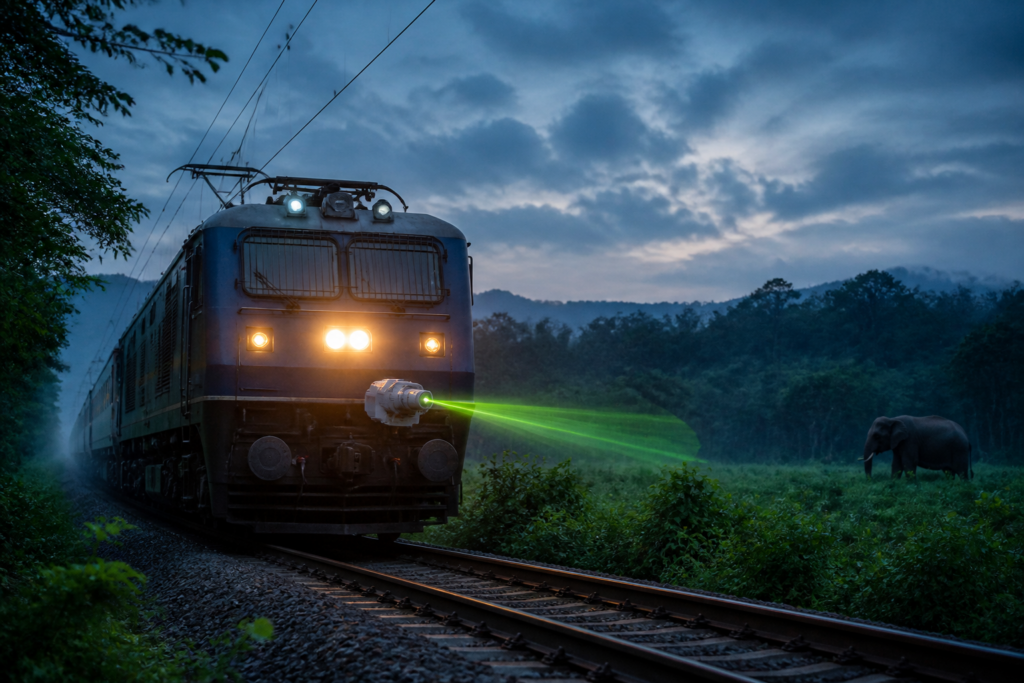
Tonbo Imaging’s move from battlefield surveillance to railway safety and advanced driver assistance systems shows how defence technology is beginning to enter the civilian infrastructure market. The Bengaluru-based company is adapting thermal imaging, electro-optical sensors and radar for applications that include detecting pedestrians, cattle and wildlife in low-visibility conditions, while preparing for an ₹852-crore initial public offering.
The shift is significant because the technologies being developed for military platforms address a basic limitation of conventional transport systems: drivers and locomotive crews cannot always see hazards early enough. Headlights, ordinary cameras and human observation become less reliable on dark highways, during poor weather or along railway corridors passing through wildlife habitats. Thermal imaging offers a different form of visibility by detecting heat signatures, while electro-optical systems and radar can help identify and track objects.
For Tonbo, the civilian opportunity is an extension of capabilities developed for defence rather than a departure from its core business. The company develops electro-optical sights, driver-vision systems and thermal imaging payloads for military platforms built by partners including Larsen & Toubro and the Defence Research and Development Organisation. Its MGS-23 system equips conventional anti-aircraft guns with thermal imaging and targeting capabilities. It is also developing WaveStrike, a high-power microwave system designed to disrupt the electronics of drone swarms, although that programme remains at the prototype stage.
A source familiar with Tonbo’s defence programmes told The Hindu BusinessLine that the company’s technologies had been deployed across multiple military theatres and had demonstrated operational readiness under battlefield conditions. The source declined to share details about Operation Sindoor, citing military non-disclosure agreements. “We don’t make the weapon; we make the eyes and the brains of the weapon,” the source said.
That description also explains the company’s civilian strategy. Tonbo does not need to manufacture an entire vehicle or train to participate in a transport market. Its potential role is to supply the sensing and decision-support layer that allows an existing platform to identify risks more reliably. In cars, trucks and mining equipment, this could mean systems that detect hazards beyond the reach of headlights. In railways, the same principle could be used to warn locomotive drivers about animals or other obstacles on the track.
The company is reportedly working on an advanced pilot project with Indian Railways in Assam, where railway corridors pass through wildlife areas and elephant movement has created a recurring safety challenge. People familiar with the development said the proposed railway systems would combine thermal imaging, electro-optical sensors and radar. The source described an elephant as “one big thermal signature”, pointing to the potential for heat-based detection to alert train crews before a collision becomes unavoidable.
The Assam application illustrates why the civilianisation of defence technology is primarily an infrastructure question. Railway safety does not depend only on track quality, signalling or train control. It also depends on whether the system can recognise conditions outside the narrow operational field visible to a driver. Wildlife corridors, unlit sections, heavy rain and roadside encroachment can all create detection problems that conventional equipment may not address adequately.
The same logic applies to road transport, although the commercial path may be different. Tonbo’s source identified heavy vehicles as the shortest-term opportunity in India’s automotive and transportation market. Commercial trucks operate for long hours, often on roads with inconsistent lighting and varied traffic conditions. Mining vehicles face dust, darkness, uneven terrain and restricted visibility. Thermal and multi-sensor systems could potentially supplement drivers, but the report does not establish that Tonbo’s products have entered mass deployment in these applications.
This distinction between potential and proven adoption is important. The report identifies an advanced railway pilot, ongoing exploration of ADAS applications and a defence business with existing programmes. It does not provide independent performance data for the proposed civilian systems, the number of railway routes that could eventually use them or a confirmed production contract with an automotive manufacturer. The civilian opportunity is therefore commercially promising but still partly developmental.
Tonbo’s defence pipeline remains central to its growth plans. The company has supplied seeker-related technology for missile programmes involving Bharat Dynamics, according to the report, while a potential market is emerging from the modernisation of India’s Su-30MKI fighter aircraft. Tonbo has not disclosed a direct Su-30MKI integration contract. Its missile-related technologies help detect, identify and track targets in poor visibility and can be integrated with targeting pods and missile guidance systems, but the report does not establish the value or timing of any specific future order.
People familiar with the company’s growth plans expect missile seekers to become a significant revenue driver around financial year 2029, followed by high-power microwave systems during financial years 2029–30. These are expectations from people familiar with the plans, not formal company guidance. WaveStrike is still a prototype, which means its commercial contribution remains dependent on development, qualification and eventual procurement.
The company’s reported order book offers a more immediate measure of its commercial position. Tonbo has a signed order book of approximately ₹290 crore, excluding defence programmes undergoing qualification and commercial negotiations, according to people familiar with its operations. The report also cites estimates that revenue could exceed ₹550 crore in financial year 2027 and approach ₹1,000 crore in financial year 2028, compared with turnover of ₹362.65 crore in financial year 2026. These figures are not formal guidance from the company.
The planned ₹852-crore IPO adds another layer to the story. The issue is entirely an offer for sale, meaning the proceeds will allow existing investors, including Celesta Capital and Edelweiss, to sell their holdings rather than provide fresh capital to Tonbo. Investors including SBI Mutual Fund, Amansa, ValueQuest, 360 ONE, HDFC Life and Malabar participated in pre-IPO transactions worth approximately ₹400 crore, according to people familiar with the deals.
An offer-for-sale structure matters because it does not directly expand the company’s capacity, research budget or deployment capability. Tonbo may still raise fresh capital later as revenue scales, but the current issue itself is not a funding round for civilian pilots or manufacturing expansion. The company’s ability to convert defence expertise into transport products will therefore depend on operating cash flows, future fundraising and the pace at which customers move from trials to procurement.
The institutional challenge is equally important. A sensor can detect an object, but a safe railway or road system must also decide how that information reaches the operator, how false alarms are managed and which agency is responsible for acting on it. A railway pilot involving thermal imaging, cameras and radar would need integration with locomotive systems, operating procedures and safety protocols. For ADAS, manufacturers and regulators would need to establish how much responsibility rests with the driver, the vehicle maker and the technology supplier.
The report does not provide details of the proposed pilot’s route, technical specifications, deployment scale or evaluation criteria. Those details will determine whether the technology can move beyond a promising demonstration. A system that performs well in controlled conditions may still face difficulties across different terrains, weather patterns, train speeds, traffic conditions and maintenance environments. The supplied material confirms the direction of development but not the final operational model.
Tonbo’s civilian pivot nevertheless reflects a wider industrial possibility: India’s defence manufacturing base can become a source of technology for civilian infrastructure, not only a supplier to the armed forces. Thermal imaging, sensing and autonomous-vehicle expertise have obvious applications in transport, but transferring them successfully requires more than technical capability. It requires long-term procurement, standards, testing, integration with public agencies and clear evidence that the systems improve safety at an acceptable cost.
For cities and transport networks, the immediate question is not whether military-grade imaging sounds advanced. It is whether these systems can become dependable parts of everyday operations. Tonbo’s defence experience, its reported railway pilot and its interest in heavy-vehicle ADAS provide an early test of that transition. The next indicators will be the outcome and scale of the Indian Railways deployment, confirmed civilian contracts, disclosed performance results and the company’s ability to fund development while meeting the expectations attached to its IPO.
The evidence currently supports a company with an established defence technology base, a reported ₹290-crore signed order book and a developing civilian strategy. It does not yet establish widespread use of Tonbo’s systems on Indian roads or railways. The gap between prototype, pilot and routine infrastructure deployment will determine whether the company’s battlefield “eyes and brains” become a meaningful part of civilian safety systems.


