

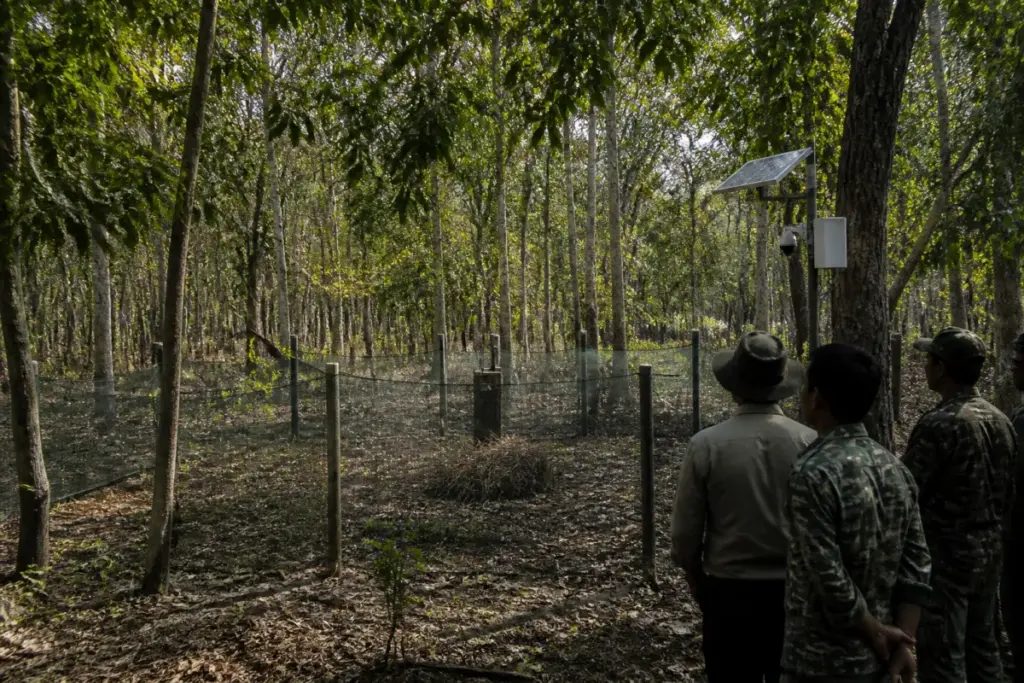
The Maharashtra Forest Department has built a 30×30-foot walk-in enclosure in the Samda forest of Saoli taluka to capture tiger T-122, which officials believe is responsible for three deaths and one serious injury in Chandrapur district over the past two months.
The experimental operation uses a concealed enclosure, live bait and an extensive camera network after repeated attempts to locate and tranquillise the tiger failed. Forest officials said T-122 has repeatedly detected the presence of capture teams and changed its route before it could be safely immobilised.
The enclosure has been designed to blend into the surrounding woodland and reduce direct human presence. A solar-operated CCTV camera will monitor the structure, while live bait is intended to draw the tiger inside. Officials said the approach is aimed at preventing the animal from associating the trap with human activity or danger.
Nine Garuda CCTV cameras, 20 trap cameras and three live-feed cameras have been installed for the operation. A team of 60 Forest Department personnel and labourers is maintaining round-the-clock surveillance, while ground patrols and village awareness campaigns have also been intensified to reduce the risk of further encounters.
The capture operation began on September 27. Forest teams have tracked T-122 for about 22 days and repeatedly positioned themselves along suspected movement routes. On several occasions, teams prepared for a tranquillisation attempt, but the tiger withdrew after detecting their presence, officials said.
The Forest Department’s decision to use a walk-in enclosure follows the failure of conventional baited trap cages to capture tigers in the district. More than 150 tigers have been captured through tranquillisation in Chandrapur, but officials said no tiger has entered a conventional baited trap cage in the past 25 years.
Adult tigers have strong senses and can become especially cautious after repeated encounters with people pursuing them. Officials said a tiger may avoid an unfamiliar structure, detect human smells or approach bait without entering a cage, making conventional traps ineffective in some cases.
Divisional Forest Officer Ranjan Talmale described the enclosure as a first-of-its-kind experimental initiative in Maharashtra. He said the structure could be dismantled and transported to another location for use in future capture operations.
The department has not indicated how long the enclosure will remain in place. The operation’s immediate objective is to get T-122 to enter the structure and contain the animal safely, while surveillance, patrols and village-level alerts continue in the affected area.


