

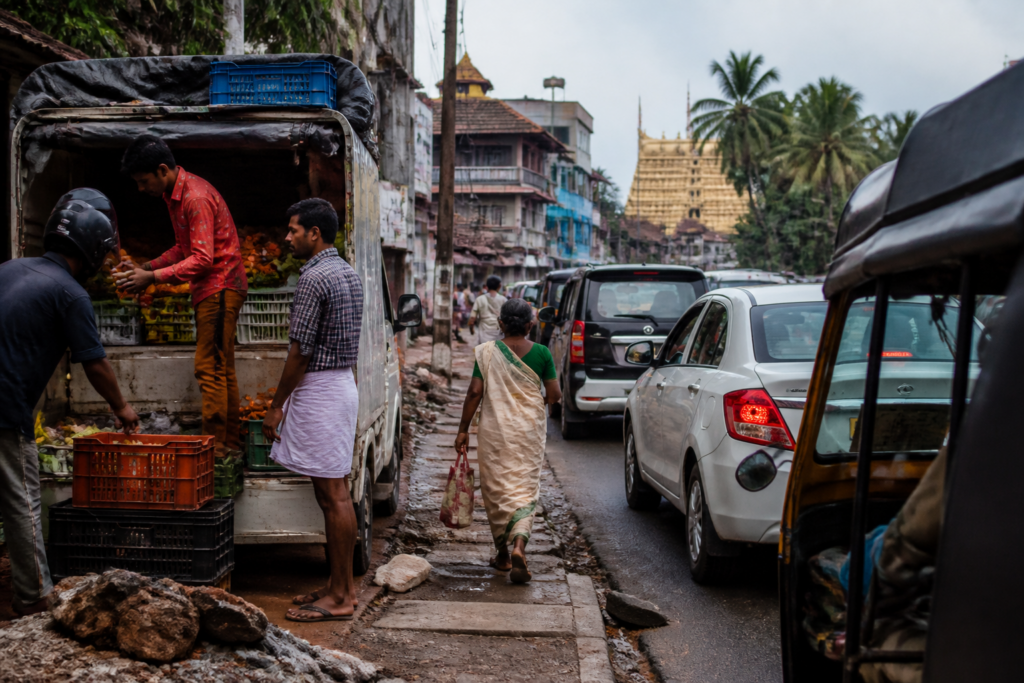
Thrippunithura’s road encroachment problem is no longer limited to isolated roadside vending. A report by Mathrubhumi says vehicle-based sellers, roadside displays, illegal parking and damaged footpaths are combining to make several important streets difficult to use for both pedestrians and motorists. The reported inaction by municipal authorities and police raises a wider question about who is responsible for protecting public road space in a busy town.
The locations identified in the report include Statue Junction, Kizhakkekotta Junction, the Statue–Kizhakkekotta road, the Taluk Hospital Junction, Kannankulangara Road and the area around the Poornathrayeesa Temple. The activity described is primarily the sale of vegetables and fruit from tempos, goods vehicles and autorickshaws. Customers reportedly stop their cars on the carriageway to buy goods, leaving other vehicles with little room to pass.
This is a familiar urban pattern: a road edge that begins as a temporary trading point gradually becomes a permanent extension of commercial activity. Once goods, vehicles and customers occupy the edge of the carriageway, the road ceases to function only as a movement corridor. It becomes a mixed-use space without clear rules governing loading, parking, walking and through traffic. The result is not simply congestion. It is a loss of predictable access for everyone using the street.
### What the Thrippunithura road encroachment report reveals
The Mathrubhumi report describes particularly difficult conditions on the busy Statue–Kizhakkekotta road, where vending is reportedly carried out from a tempo van and box-style autorickshaw. The account says vehicles cannot move close to the edge of the road, while pedestrians also have no adequate space to walk. The problem is intensified by footpaths that are broken or unstable in several places.
The distinction between a road and a footpath matters here. When a footpath is unusable, pedestrians are pushed into the carriageway. When the carriageway is then occupied by vending vehicles or customer parking, the same person is forced to navigate between moving traffic and stationary obstructions. The report does not provide accident data or traffic counts, so the precise safety impact cannot be quantified from the available evidence. It does, however, document a street arrangement in which the most vulnerable users appear to have the least reliable space.
The report also points to established vendors placing goods directly on footpaths. This suggests that the problem is not confined to mobile sellers who stop briefly. Some commercial activity is described as fixed and recurring, with merchandise occupying space intended for walking. That distinction is important for administration because temporary obstruction and continuing occupation may require different forms of enforcement, licensing or relocation.
A second layer of difficulty comes from parking. The Statue–Laiam Road and the Taluk Hospital–Kannankulangara Road areas are reported to face unauthorised vehicle parking that adds to traffic problems. Parking near a vending point can attract more stopping vehicles, while reduced road width makes every additional obstruction more consequential. A road that carries frequent large and small vehicles has less tolerance for informal occupation than a low-volume local street.
The report says complaints have been raised but that no action has followed from the authorities. That claim is presented by Mathrubhumi and is not accompanied in the supplied material by responses from the municipality or police. The absence of an official response is therefore part of the reporting gap that readers should note. It is not possible from the report alone to establish whether enforcement drives were attempted, whether notices were issued, or whether the vendors have any form of permission.
### The institutional problem behind a crowded street
Roadside vending sits at the intersection of several public responsibilities. The municipality is responsible for local administration and the management of public spaces within its jurisdiction. The police are responsible for traffic regulation and enforcement of road-use rules. Road ownership and maintenance can also involve other agencies, depending on the classification of the street. When these responsibilities are not coordinated, enforcement can become intermittent and the physical condition of the street can be treated separately from how the space is being used.
The source report refers to a Kerala High Court order that prohibits roadside vending when it obstructs movement. It describes the reported activity as a violation of that order. The supplied material does not identify the case number, date, exact wording or enforcement mechanism of the order. Those details would be necessary to assess the legal position fully. Still, the report’s reference to the order highlights an important administrative issue: a restriction on obstruction has limited effect if the agencies responsible for identifying, documenting and removing obstructions do not act consistently.
This does not mean that enforcement is a simple matter of clearing every vendor from the road. The report establishes that vegetables and fruits are being sold in locations used by residents and motorists, but it does not provide information on the vendors’ licences, livelihoods, access to alternative markets or the existence of designated vending areas. It also does not state whether the municipality has carried out a survey or issued relocation notices. These missing details matter because street management involves both the protection of public movement and the regulation of livelihoods.
The immediate urban question is therefore not whether vending should exist, but whether it can operate without taking away essential pedestrian and traffic space. A functioning street requires visible boundaries between movement, stopping, loading, walking and selling. Where those boundaries are absent, the strongest users of the road—usually moving vehicles or organised commercial activity—can displace people on foot.
### Why damaged footpaths make the problem worse
The report’s description of broken and unstable footpaths adds a crucial physical dimension. Even if roadside vendors were removed, pedestrians would still face difficulties where walking surfaces are damaged or discontinuous. Conversely, repairing footpaths without addressing encroachment may not restore access if traders continue to place goods over them.
This is why street obstruction cannot be treated only as a policing issue. It is also a maintenance and design issue. A usable footpath needs a continuous surface and enough clear width for people to pass. It must remain accessible at junctions, near hospitals and around religious or commercial destinations. The supplied report does not provide measurements of the footpaths or identify the agencies responsible for each stretch, so the extent of the physical deficit remains unclear. It does show, however, that road use and infrastructure condition are interacting rather than operating as separate problems.
The location list also indicates that the issue affects more than one isolated corner. Junctions, a hospital approach road, a temple area and connecting roads are all mentioned. These places attract different kinds of movement: through traffic, pedestrians, customers, patients, visitors and local residents. When vending and parking occupy the same limited edge space, congestion can spread beyond the original stopping point.
### The larger urban governance question
Thrippunithura’s reported conditions illustrate how public space can be gradually privatised without any formal change in land ownership. A vendor’s vehicle, a customer’s parked car or a shop’s goods may occupy only a small area individually. Repeated across a corridor, those small occupations can remove the continuous public space required for walking and moving traffic.
The report does not establish the total number of vendors, the duration of the problem, the number of complaints or the scale of traffic delays. It also does not include responses from municipal officials, police authorities or the vendors themselves. Those are the next pieces of evidence needed to determine whether the situation reflects enforcement failure, inadequate street design, weak coordination, insufficient vending infrastructure or a combination of these factors.
What is clear from the available account is that Thrippunithura’s roads are being asked to perform too many functions without adequate management. They are carrying moving traffic, accommodating parked vehicles, serving as vending locations and compensating for damaged pedestrian infrastructure. The result is a street system in which access is negotiated informally every day.
The immediate test for the authorities will be whether complaints lead to a documented response: an assessment of the affected stretches, clarification of jurisdiction, action on obstructive parking and vending, and restoration of pedestrian access. Until those steps are visible, the reported road encroachment will remain more than a local inconvenience. It will be evidence of how quickly urban public space can be lost when responsibility is shared but enforcement is not.


