

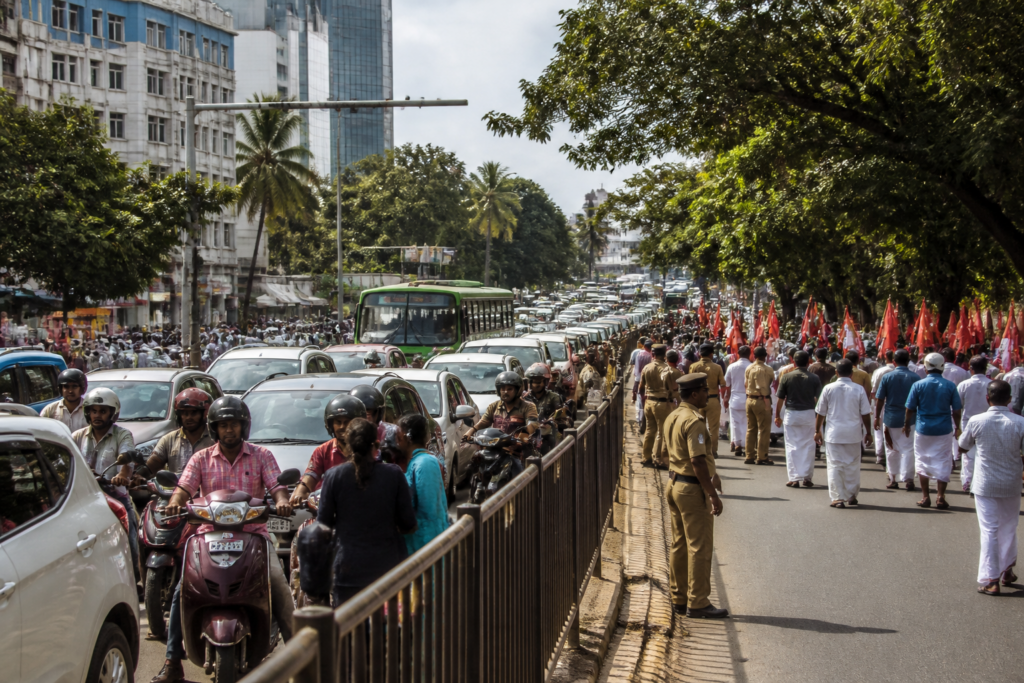
Thiruvananthapuram traffic was severely disrupted for several hours on Thursday after four separate groups held marches across the city, affecting key arterial roads, office-goers, businesses and other commuters. Police said around 10,000 people participated in the demonstrations, with the worst congestion reported between 10.30am and 1.30pm.
The most affected stretch ran from Bakery Junction through Statue, Vellayambalam, Palayam, Law College Junction and PMG Junction. Traffic movement along the corridor slowed considerably as marchers moved towards different government destinations, leaving commuters stranded and disrupting work schedules and professional commitments.
City police commissioner Arul R B Krishna said managing traffic during simultaneous demonstrations had presented a major challenge, particularly because the marches used busy roads connecting important junctions and government offices. He said the movement of a large group could create substantial congestion even when the number of participants was smaller.
“Even if around 2,000 people were marching towards the Lok Bhavan, it would cause huge traffic congestion. Traffic diversions have limitations. Traffic moves along with the march, but it takes at least 40 to 50 minutes for the participants to reach their destination,” Krishna said.
The commissioner also said some marches had taken place without police permission. Cases are generally registered against organisers afterwards, he said. The police response highlighted the operational difficulty of managing protests that begin at different locations, follow separate routes and converge on government offices during working hours.
The Kerala Mining and Crusher Owners Association marched to the directorate of mining and geology, seeking withdrawal of a 2023 rule amendment and resolution of issues affecting quarry and crusher operators. The Kerala Pravasi Sangham marched to the Secretariat, demanding clearance of pending welfare pension arrears and improved support for expatriates.
Another march, organised by the Kerala Vyapari Vyavasayi Ekopana Samithi, proceeded towards Lok Bhavan to protest the proposed levy on UPI transactions. The Kerala Library Association marched to the state assembly, seeking better salaries and restoration of allowances withdrawn from library employees.
The simultaneous demonstrations placed pressure on the city’s traffic-management system because several groups were using routes that serve government offices and major junctions at the same time. Police said traffic diversions could not fully prevent delays because vehicles had to move alongside or around the marches, while each procession required time to reach its destination.
The disruption also renewed commuter demands for advance traffic advisories, better coordination between organisers and police, and more effective diversion plans during large public gatherings. Office-goers and businesses in the affected areas faced delays, while the prolonged congestion added to the difficulties of daily travel.
Police action against organisers of marches held without permission and coordination for future demonstrations are expected to remain the immediate administrative responses to the disruption.


