

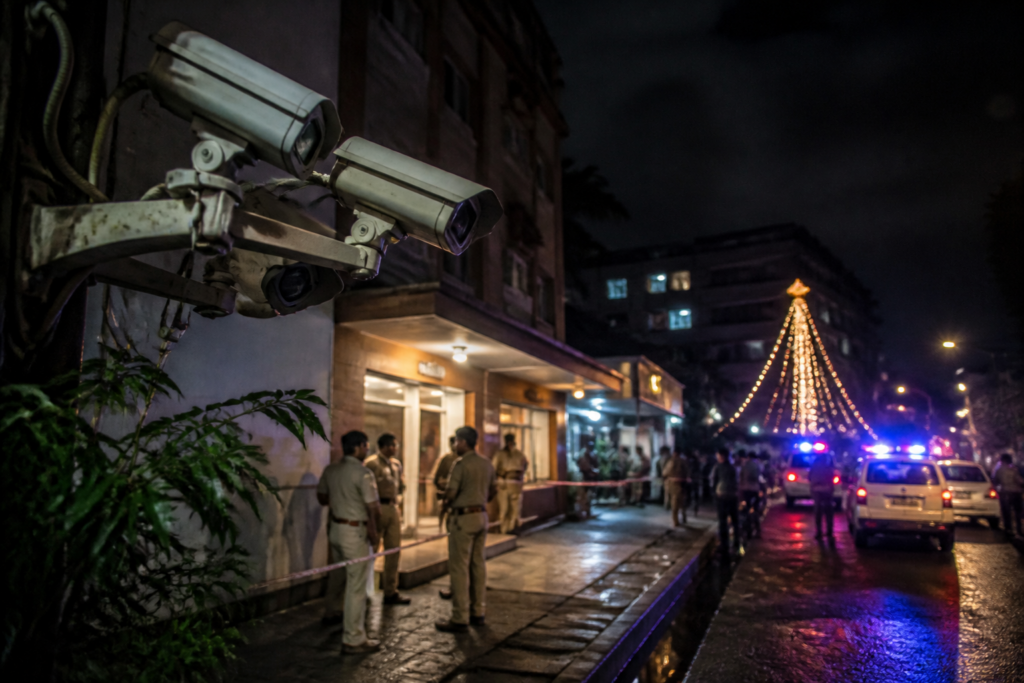
The alleged failure of three CCTV cameras at a Thane political office during the killing of Shiv Sena UBT Vibhag Pramukh Pradeep Purnekar has turned a murder investigation into a wider question about how urban security infrastructure is managed, maintained and scrutinised. The cameras could have captured the assailants, but were not operating when Purnekar was shot and stabbed at his office on September 29 at around 9.30 pm.
According to the report, police are examining whether the cameras stopped working because the switchboard supplying them was being used to power lights at a nearby Ganesh pandal, or whether they were deliberately disconnected. Police are also investigating whether the attackers knew the cameras were not functioning and chose that time to strike.
That distinction is central. A camera that fails because of an improvised electrical arrangement points to weak coordination and inadequate redundancy. A camera deliberately disconnected before an attack would raise a different question: whether surveillance equipment was studied and neutralised as part of the crime. The available report does not establish either explanation. It records both as lines of inquiry being pursued by the police.
The episode shows that CCTV coverage is not simply a question of installing cameras. Its value depends on a chain of conditions: uninterrupted power, functioning equipment, controlled access to electrical systems, recording storage and timely monitoring. If any link fails, the existence of a camera can create a false impression of security while leaving investigators without visual evidence at the precise moment it is needed.
In Purnekar’s case, the cameras were located at his office and would have been positioned to capture the attack, according to police sources cited in the report. Their failure therefore affects not only the investigation but also the reliability of the security arrangements around a local political office. The report does not state whether the cameras had backup power, whether their recording systems were independently powered or whether their operational status was being checked routinely.
Those missing details matter because the reported explanation involves a nearby public installation. The cameras allegedly became non-functional when the electrical supply was used to light a Ganesh pandal. The account, if established, would indicate that temporary event arrangements were able to interfere with a security system. It would also raise questions about who had access to the switchboard, whether the change was authorised and whether anyone was responsible for checking the cameras after the electrical connection was altered.
The police are separately examining whether one of the arrested accused had information about the office’s surveillance. A source told the newspaper that Pappya Shinde had conducted a recce of the office a few days before the murder and may have noticed the cameras. The report does not establish that he disconnected them or that the accused knew they were switched off. It only indicates that investigators are examining whether knowledge of the cameras’ condition formed part of the attack.
This is where the case moves beyond a single equipment failure. A surveillance system is useful only when its vulnerabilities are not obvious, its power supply is protected and its status is known to the people responsible for security. The possibility that an attacker may have observed the cameras during a prior visit places the focus on the physical design and operational routines of the office, rather than on the cameras alone.
The investigation has also widened because the police have not yet identified the motive. The report lists several angles: political rivalry; a building redevelopment project in Thane that Purnekar and Ravindra Shinde were allegedly eyeing; a woman whom Purnekar had handed over to police after she was found with two boys in the area; and complaints he had made about people supplying drugs locally.
The redevelopment angle is particularly relevant to the built environment. The report does not provide details of the project, its location, ownership or stage of approval, and it does not establish that the redevelopment dispute caused the murder. It does, however, place a real-estate or redevelopment interest within the range of motives being examined by investigators. In cities where redevelopment decisions can involve land, buildings, permissions and competing local interests, the police inquiry will need to distinguish documented project-related links from unproven associations.
Ravindra Shinde, the husband of former Thane Mayor Meenakshi Shinde, was questioned by Thane police for the second consecutive day at the Anti Extortion Cell office. He arrived at around 1 am and was not allowed to leave until 8 pm, after having been questioned for eight hours the previous day, according to the report. Sources said he was questioned about his links with some of the arrested accused. The report does not say that he has been accused of the murder.
The Thane Crime Branch special investigation team, led by Deputy Commissioner of Police Amar Sinh Jadhav, is conducting the probe. Five people have been arrested: Pappya Shinde, Nikhil Yadav, Nitesh Pawar, Santosh Kanojia alias Talli and Amit Singh alias Paplu. Kanojia has been described as the key accused and Singh as his aide. The two were arrested in Prayagraj, Uttar Pradesh, while Yadav and Pawar were produced before a court and remanded to judicial custody.
The case therefore involves several institutions and urban systems at once: a political office, temporary public-event infrastructure, local policing, crime-branch investigation and a possible redevelopment dispute. None of these connections, by themselves, proves a motive or establishes responsibility for the CCTV failure. Their significance lies in showing how a criminal investigation can expose weaknesses across systems that are normally treated separately.
The immediate institutional question is whether the camera failure was detected before the murder. The supplied report does not say when the cameras stopped recording, whether anyone received an alert, or whether footage from the remaining cameras and nearby premises was preserved. It also does not state whether the police have recovered technical records from the camera system or examined the electrical switchboard for evidence of deliberate tampering.
Those facts will determine whether the failure is treated as an operational lapse, an accidental power diversion or a planned act. Until the investigation establishes that sequence, claims about deliberate disconnection remain allegations under examination. The same caution applies to the possible redevelopment motive and to the alleged links between the arrested persons and others questioned by police.
The larger lesson from the Thane case is limited but important: urban surveillance cannot be measured by camera count alone. Its public-safety value depends on maintenance, power continuity, access control and accountability for outages. The reported failure of three cameras during a murder investigation makes those administrative details part of the evidence, not merely technical background.
The Crime Branch SIT’s continuing investigation is expected to establish the motive, clarify the circumstances in which the cameras stopped working and determine the roles, if any, of the arrested persons and those questioned in connection with them. Until those findings emerge, the central fact is that surveillance equipment capable of recording the attack was not functioning when the killing took place.


