

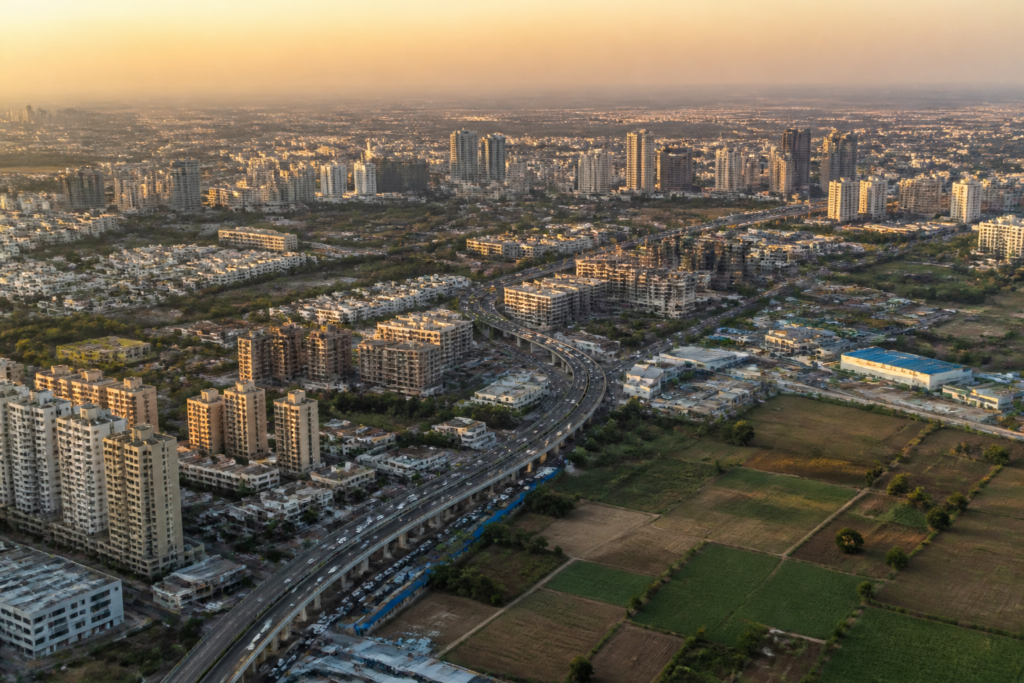
Telangana Chief Minister A Revanth Reddy has presented Telangana Rising 2047 as a long-term economic strategy built around a sharper division of the state’s urban, peri-urban and rural functions. Its most consequential feature for the built environment is the creation of three development zones: CURE, or Core Urban Region Economy, within Hyderabad’s Outer Ring Road; PURE, or Peri-Urban Region Economy, between the Outer Ring Road and the proposed Regional Ring Road; and RARE, or Rural Agriculture Region Economy, beyond that belt.
The framework is intended to support the government’s stated ambition of turning Telangana into a USD 1 trillion economy by 2034 and a USD 3 trillion economy by 2047. Reddy said the state wants to raise its contribution to India’s gross domestic product from the current five per cent to 10 per cent and position Telangana as a global investment destination. The speech, however, also reveals that the central challenge is not merely attracting investment. It is deciding how growth will be distributed across Hyderabad, its expanding edge and the rural economy connected to it.
The CURE-PURE-RARE model places Hyderabad at the centre of the strategy, but does not treat the city as a self-contained metropolitan area. According to Reddy, the CURE zone within the Outer Ring Road is being developed as a hub for information technology and services. The PURE zone, between the Outer Ring Road and the Regional Ring Road, is intended for manufacturing industries, industrial parks and logistics. The RARE zone is expected to focus on agriculture, food processing, agro-based industries and rural employment.
This is an important shift in the way the state is describing its economic geography. Instead of presenting Hyderabad’s growth as a single-city success story, the government is linking the city’s services economy with industrial activity around its perimeter and agricultural production beyond it. That makes roads, logistics, land use, utilities and employment access central to the plan. It also means that the success of the strategy will depend on whether the three zones work as an integrated system rather than as separate administrative or investment labels.
The speech supplied by the Press Trust of India does not provide details of the legal status of the zones, their governing institutions, land-use controls, infrastructure budgets or implementation timelines. Those omissions matter because the proposed geography covers areas with different development pressures and different public-sector responsibilities. Hyderabad’s established urban core, the rapidly changing belt outside the Outer Ring Road and the rural regions beyond it cannot be planned or serviced in the same way.
The CURE zone already represents the most established part of the state’s economic proposition. Reddy described it as a centre for information technology and services, sectors that have made Hyderabad an important investment destination. The government’s stated objective is now to use that base to generate wider economic strength, including through new companies and technology enterprises. At the event, Reddy cited Skyroot Aerospace, founded by Pawan Chandana, as an example of a Telangana company whose emergence has strengthened the state’s profile.
His appeal to young people was framed around ownership rather than employment. Referring to Indian-origin executives such as Microsoft chief executive Satya Nadella, Adobe’s Shantanu Narayen and World Bank President Ajay Banga, Reddy argued that Indian professionals have often led global corporations without founding or owning them. He urged the younger generation to build start-ups and create global companies. In urban terms, that argument expands the policy focus from office-based service employment to the institutions, workspaces, finance and support systems required for entrepreneurship.
Yet the source material does not establish how the government plans to measure the success of this transition. It records the ambition to encourage entrepreneurship and the assurance that investors will receive support and protection through investor-friendly policies. It does not specify new funds, incubation programmes, land parcels, regulatory changes or procurement mechanisms. The distinction between an investment invitation and an operating policy will therefore be significant as Telangana Rising 2047 moves beyond its vision-stage messaging.
The PURE zone is where the spatial consequences of the strategy are likely to become most visible. The government intends this belt to host manufacturing, industrial parks and logistics between the two ring roads. That would place the peri-urban region in the role of a connective economic platform: close enough to Hyderabad to draw on its services and workforce, but outside the city’s established core.
Such a model makes the area between the ring roads more than a reserve for future construction. It becomes the proposed interface between the metropolitan economy and the wider state economy. Industrial locations, logistics activity and new employment centres would influence where workers live, how goods move and where public infrastructure must be extended. The supplied account does not provide estimates of land requirements, projected employment, transport capacity or utility demand, so the practical scale of this transformation remains undefined.
The RARE zone gives the plan a rural employment dimension. Reddy said it would focus on agriculture, food processing, agro-based industries and rural jobs. This suggests that the state does not want growth to be measured only through Hyderabad’s services output or through the arrival of large investors. It is also presenting value addition in agriculture and rural industry as part of the state’s long-term economic structure.
The connection between the three zones is therefore the framework’s central institutional question. The CURE zone is expected to generate services and high-value economic activity. The PURE zone is expected to accommodate production and logistics. The RARE zone is expected to support agriculture and agro-based employment. The source does not say which authority will coordinate these functions, how revenue and infrastructure responsibilities will be divided, or how conflicts between industrial expansion, agriculture and settlement growth will be managed.
The chief minister also linked the state’s development plans to women’s participation in the workforce. He said countries that had achieved significant economic growth had more than 50 per cent of women in the workforce, while India’s share was lower. The state government, he said, had facilitated bank linkages worth Rs 61,000 crore for women’s self-help groups, which have 67 lakh members in Telangana. He also said self-help groups had been enabled to purchase buses and lease them to the state-run Road Transport Corporation.
These figures place women-led development within the same economic narrative as investment and entrepreneurship. They also point to a broader interpretation of infrastructure: access to finance, transport assets and institutional linkages can influence participation in the economy alongside roads, industrial parks and urban services. The report does not provide a breakdown of the bank linkages, the number of buses or the employment outcomes, so their direct contribution to the state’s targets cannot yet be assessed from the available evidence.
Policy continuity was another part of Reddy’s appeal to investors. He said Telangana had not witnessed major policy changes and that his government had not scrapped beneficial initiatives introduced by the Bharat Rashtra Samithi regime between 2014 and December 2023. He also referred to the continuity of policies between the earlier Congress and Telugu Desam Party governments in undivided Andhra Pradesh.
For investors, this message is intended to reduce uncertainty across political cycles. For the urban system, continuity has a different implication: long-term infrastructure and land-use decisions often extend beyond the tenure of a single government. The statement indicates a political commitment to policy stability, but the supplied material does not identify the specific policies being continued or explain how that continuity will be formalised.
The numbers attached to Telangana Rising 2047 are substantial: a USD 1 trillion state economy by 2034, USD 3 trillion by 2047, and a rise in Telangana’s contribution to India’s GDP from five per cent to 10 per cent. These are targets rather than reported outcomes. Their importance lies in the scale of planning they imply. Achieving them would require the state to connect business formation, investment, industrial activity, rural production, transport and workforce participation over several decades.
The evidence currently available establishes the government’s direction of travel, not its delivery record. It identifies the preferred economic sectors, the proposed spatial structure and the political argument for continuity. It does not establish the capital required, the sequence of projects, the performance indicators, the land and infrastructure arrangements or the institutional mechanism for coordinating the zones.
That gap is central to understanding the announcement. Telangana Rising 2047 is not simply a start-up appeal or an investment pitch. It is a proposed restructuring of the relationship between Hyderabad and the rest of the state. The CURE-PURE-RARE framework gives that restructuring a spatial vocabulary, while the economic targets give it a long horizon. Whether it becomes an effective regional development model will depend on how clearly the government converts those concepts into enforceable plans, funded infrastructure and measurable outcomes.
For now, the confirmed development is the government’s stated vision and its decision to place Hyderabad’s core, peri-urban belt and rural economy within one growth framework. The next developments to monitor are the detailed policy documents, institutional responsibilities, infrastructure commitments and implementation timelines that would determine whether the three-zone model moves beyond an economic narrative into an operating plan.


