

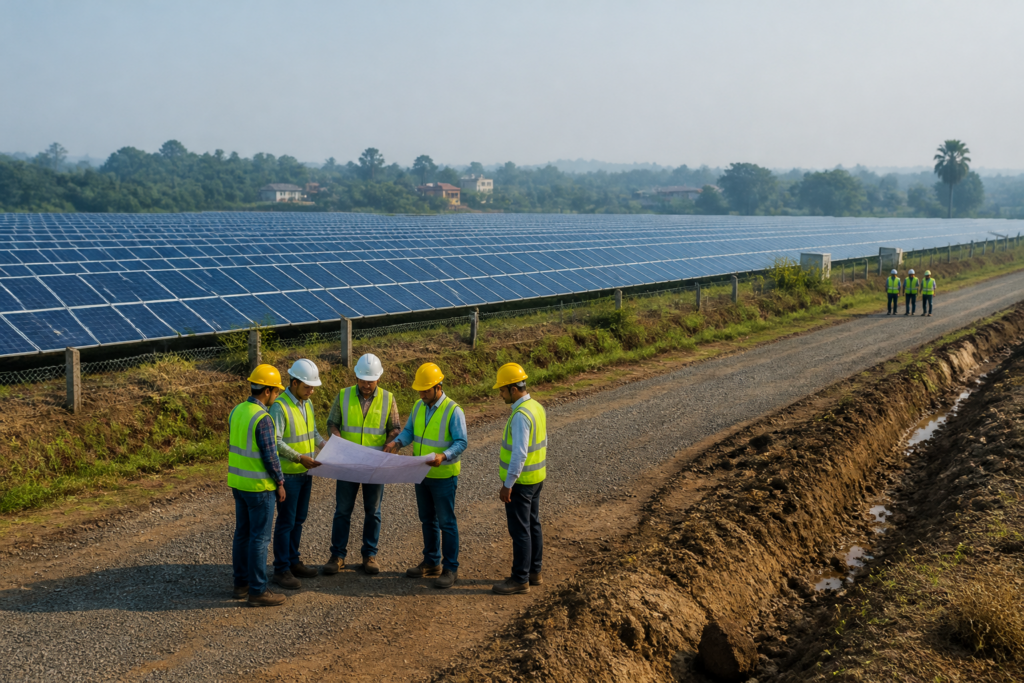
Tata Power is exploring a solar expansion in West Bengal with a combined installed capacity of around 500 MW and a potential investment of approximately ₹2,500 crore, as the company seeks land from the state government for projects across multiple locations.
The proposal remains at a preliminary stage, Tata Power CEO and Managing Director Praveer Sinha told media persons. The company is currently identifying suitable land after the West Bengal government indicated three or four possible locations for assessment.
“We have to go and see the viability of these locations,” Sinha said. He added that securing one large parcel may not be feasible in the state, meaning the proposed capacity could be distributed across several sites. Individual projects could range from 100 MW to 500 MW, depending on the land available at each location.
The proposed investment and capacity are therefore subject to the outcome of site assessments and subsequent project decisions. Tata Power has not announced a final project location, construction schedule or commissioning date for the solar facilities.
Alongside the utility-scale projects, Tata Power said the West Bengal government is showing interest in expanding rooftop solar adoption under the Ghar Ghar Solar initiative. The company has suggested that the state introduce additional incentives for households installing rooftop systems.
Sanjay Banga, CEO and Managing Director of Tata Power Renewable Energy, said West Bengal could consider a state subsidy similar to those available in Odisha, Bihar and Assam. He cited incentives ranging from ₹15,000 to ₹25,000 per project as a possible model for increasing household adoption.
Banga made the remarks at the launch of the Ghar Ghar Solar and storage battery solution in Kolkata ahead of the Durga Puja celebrations. The initiative combines rooftop solar with battery storage, although the company did not provide a target for the number of households or the total rooftop capacity it expects to add in West Bengal.
The proposed approach places two different implementation requirements before the state. Utility-scale projects will depend on land identification, site viability and the ability to assemble capacity across multiple locations. Rooftop deployment will depend on household incentives and the availability of installation and storage solutions.
West Bengal’s possible role would extend beyond providing land for large solar projects. The company’s request for additional rooftop incentives indicates that state-level financial support could influence the pace at which households adopt distributed solar systems. The exact structure, eligibility conditions and funding source of any such subsidy have not been announced.
Banga also said Tata Power Renewable Energy’s expansion plans would continue despite leadership and governance differences between Tata Sons and Tata Trusts. He said the subsidiary is independently managed by the board of the publicly listed Tata Power and that the developments at the promoter-group level would not affect its planned growth.
The next steps are the assessment of the locations identified by the West Bengal government, followed by decisions on project viability, land requirements and the configuration of the proposed solar capacity. The state’s response to the suggested rooftop incentives will determine whether the Ghar Ghar Solar initiative receives additional support beyond existing arrangements.


