

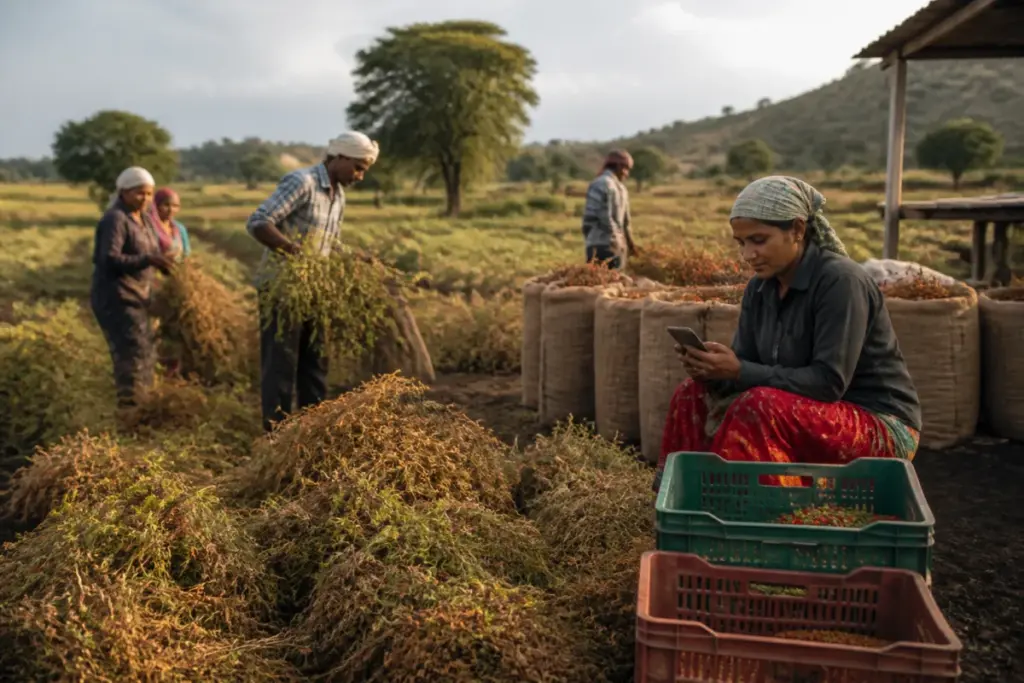
Telangana’s Tandur Red Gram traceability project is being positioned as more than a digital record-keeping exercise. By linking individual farmers, land parcels, harvests and downstream transactions, the system could make the identity of a GI-tagged food product visible across a value chain where authenticity has been difficult to establish. The project also shows how a state-backed digital platform is being used to connect agricultural production with market recognition, farmer bargaining power and consumer trust.
Telangana Technology Services (TGTS) has issued a notification of award to Hyderabad-headquartered TrayamBhu Tech Solutions, or TRST01, to implement traceability for Tandur Red Gram under the National e-Governance Plan in Agriculture scheme for 2025-26. The project is expected to onboard about 65,000 farmers in the designated area of Telangana.
The immediate administrative task is registration. Each farmer will receive a digital identity and profile linked to the person’s land, crop and harvest. The system will also map farm plots and check them against the registered Geographical Indication area of Tandur. This is intended to ensure that produce marketed as Tandur Red Gram actually comes from the area covered by the GI registration.
That geography is central to the project. Tandur Red Gram, popularly known as Tandur Toor Dal, is grown in the rainfed black soils of the Tandur region in Vikarabad district. According to TRST01, the soils contain limestone and attapulgite clay, characteristics associated with the dal’s taste and cooking quality. The company also states that the product has a protein content of 22-24%.
The traceability platform is expected to create a digital record that follows the crop from the farm through aggregation, processing and distribution to the buyer. In practical terms, that means the product’s journey is intended to become a chain of linked records rather than a series of disconnected transactions. The stated objective is to identify the grower behind every lot and preserve that information as the produce moves through the supply chain.
This distinction matters because a GI tag and traceability perform different institutional functions. The GI tag identifies a product associated with a particular geographical origin and set of characteristics. Traceability is the operational system through which that identity can be checked at different stages. As TRST01 founder and chief executive Prabir Mishra said, a GI tag protects the identity of a product, while traceability makes that identity visible and verifiable across the value chain.
The project therefore addresses a weakness that often sits between legal recognition and market enforcement. A GI registration can establish that a product belongs to a recognised geographical category, but the market still needs mechanisms to distinguish genuine produce from goods using the same name without meeting the geographical or production requirements. The project’s plot mapping and registered-area checks are designed to address that gap for Tandur Red Gram and to curb the problem of fake “Tandur Dal”.
The institutional structure behind the initiative is also significant. Yalal Farmers Producers Company holds the GI for Tandur Red Gram and filed the application with support from Professor Jayashankar Telangana State Agricultural University. TGTS has awarded the implementation work to TRST01, while the Department of Agriculture is the department for which the traceability system will be implemented. The arrangement brings together a farmers’ producer organisation, an agricultural university, a state technology services agency, a private technology company and the agriculture department.
That structure places coordination at the centre of the project. A traceability system cannot rely only on a digital interface. Its records must correspond to actual farm plots, registered production areas, harvested lots and movement through aggregation, processing and distribution. The supplied details establish that these functions are part of the project design, but they do not yet establish how frequently records will be updated, who will validate each stage, how disputes will be resolved or what penalties will apply when produce fails the authenticity check.
The planned onboarding of about 65,000 farmers gives the initiative a substantial operational scale. It also creates a test for whether a digital identity can become useful in daily agricultural transactions rather than remain a registration number. The project says the identity will be linked to land, crop and harvest, which could connect the farmer to a specific lot and make production history more visible to buyers. The company has also said that the initiative will strengthen farmers’ bargaining power and promote the inclusion of women farmers in the agricultural ecosystem.
Those benefits remain stated objectives rather than demonstrated outcomes at this stage. The award notification establishes that implementation has been assigned and describes the intended system. It does not provide evidence on how prices will change, whether buyers will pay a premium for verified Tandur Red Gram, how many women farmers will be registered, or whether the platform will reduce disputes over quality and origin. These are the indicators that will determine whether the technology changes the market position of farmers or simply digitises existing records.
The governance question is consequently broader than whether the platform works technically. It is whether the data created by the platform will be trusted and usable by all participants in the chain. Farmers will need to be correctly identified. Land and crop information will need to be accurately recorded. Aggregators and processors will need to maintain the link between physical lots and digital records. Buyers will need access to verification, and the responsible institutions will need to address incorrect or contested entries.
The project’s relevance to the wider built and urban system lies in this chain of institutions and infrastructure. Food reaches towns and cities through networks of farms, collection points, processors, distributors, markets and buyers. The announcement does not provide data on the final urban market, retail pricing or consumer adoption. It does, however, show how a state-supported digital system is being designed to make a regional agricultural product legible beyond its place of origin. That is a governance challenge shared by many products that move from local production zones into wider markets.
It also illustrates a shift in the meaning of infrastructure. Roads, warehouses, processing units and market facilities remain physical parts of a supply chain, but the project adds a digital layer that records who produced the crop and where it came from. Without that layer, the physical movement of a lot may be visible while its origin is difficult to verify. With it, the state and market participants are expected to have a common record connecting production to distribution.
The initiative is being undertaken under the NeGPA 2025-26 scheme, giving it a policy setting beyond a standalone company deployment. The details supplied do not specify the scheme’s total budget, procurement value, implementation deadline or technical standards. They also do not clarify whether the platform will be integrated with other government agricultural databases or whether farmers will access the records directly. Those unanswered questions will be important in assessing the system’s durability and administrative burden.
The first measurable benchmark is likely to be coverage: whether the planned 65,000 farmers are successfully onboarded and whether their records can be matched with the designated Tandur GI area. The next is chain integrity: whether records remain connected as produce passes through aggregation, processing and distribution. A further test is market recognition: whether buyers can use the information to distinguish genuine Tandur Red Gram and whether that distinction improves the position of registered farmers.
The project also raises a question about inclusion. Digital identity can make a farmer visible to institutions and buyers, but visibility depends on accurate registration and continued access to the system. The announcement specifically mentions the inclusion of women farmers, yet provides no breakdown of current participation or the mechanisms that will ensure women cultivators are recorded as producers rather than being lost within household or landholding records. That gap should be monitored as implementation progresses.
What is clear is that Telangana is attempting to turn the GI status of Tandur Red Gram into a verifiable production and distribution system. What remains unestablished is whether the new records will produce stronger enforcement, better bargaining outcomes and measurable inclusion. The project’s significance will ultimately be judged not by the existence of a platform, but by whether the farmer, the lot and the product remain credibly connected from the Tandur region to the final buyer.


