

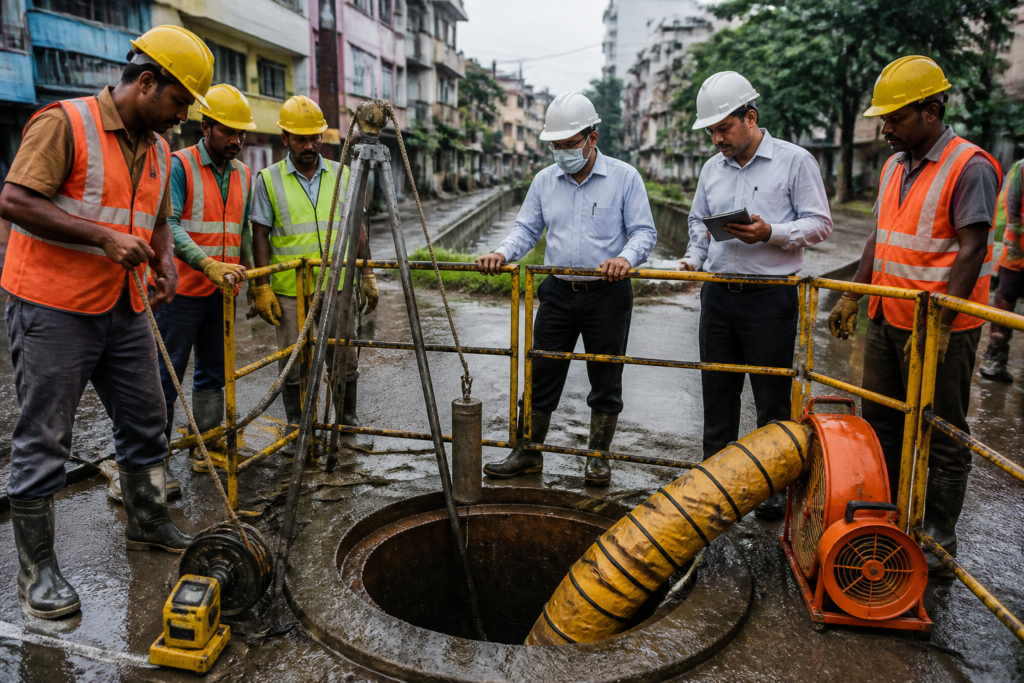
The deaths of six sanitary workers in suspected toxic-gas incidents across Tamil Nadu within 10 days have brought renewed attention to a basic failure in urban sanitation: dangerous work is still being carried out in confined spaces without adequate protection, technical oversight or effective prevention systems. The Tamil Nadu Untouchability Eradication Front (TNUEF) has responded by demanding sanitation engineering departments in higher education institutions, arguing that specialised training and modern technology are necessary to keep workers away from hazardous conditions.
The latest incidents occurred in Chennai on October 12. Two workers, Asmath Basha, 38, from Periya Hasthinapuram in Arcot, Ranipet, and Naveenkumar, 34, from West Tambaram, died after inhaling suspected toxic gas while repairing a faulty electric motor in a 20-foot-deep well constructed for a stormwater drain pump in Kodungaiyur, under the Perambur constituency. Sewage that had entered the rainwater collection structure from nearby drains is suspected to have generated the gas.
The incident illustrates how urban infrastructure can become hazardous when different systems overlap without adequate safeguards. A structure intended for stormwater management had reportedly received sewage from nearby drains. When workers entered the 20-foot-deep well to repair an electrical component, the confined space became a potential site for the accumulation of toxic gases. The available account does not establish the precise gas involved or whether the workers had access to gas detection, ventilation, protective equipment or a safe-entry protocol. Those details are central to understanding how the deaths occurred and whether they could have been prevented.
In a separate incident on Veerasamy Street in Pallikaranai, Kesavan, 29, from Nelli village in Chengalpattu district, died after inhaling suspected toxic gas while cleaning a sewage tank at a private residence. Rajesh, 49, a resident of the same locality who was working with him, was hospitalised. The incident shows that the risk is not confined to large municipal projects. Private properties and local sanitation work can also involve confined spaces where workers may be exposed to toxic gases without the engineering controls used in other hazardous occupations.
Three other workers died on October 2 while constructing a septic tank in Gandhi Nagar, Senthurai. The deceased were identified as Ramachandran from Senthurai in Ariyalur, and Bhaskar and Dinakaran from Tiruvarur. Together, the two reported incidents in Chennai and the earlier incident in Senthurai account for six deaths within the period described by DT Next. The repeated presence of wells, sewage tanks and septic tanks in these cases points to a common hazard: workers entering enclosed spaces where air quality cannot be assumed to be safe.
The issue is not simply the absence of individual caution. Confined-space sanitation work involves risks that cannot be reliably managed through informal experience alone. A worker may not be able to see or smell a dangerous gas before losing consciousness. The depth and design of a structure, the presence of decomposing sewage, electrical equipment, inadequate ventilation and the absence of a safe rescue system can combine to make a routine repair or cleaning task fatal. The supplied report does not provide technical findings from investigations, but the sequence of deaths raises questions about whether these risks are being assessed before workers enter such spaces.
That is the institutional gap highlighted by the TNUEF. Its state president T Chellakannu and general secretary P Sugandhi called for sanitation engineering departments in higher education institutions. Their proposal treats sanitation as an engineering and public-systems discipline rather than as a low-skilled service carried out at the edge of municipal administration. The demand is significant because urban sanitation depends on the design, maintenance and operation of interconnected systems, including stormwater drains, sewage networks, pumping structures, septic tanks and waste-processing facilities.
The proposal also shifts attention from post-incident compensation to prevention. According to the report, TNUEF demanded compensation of Rs 30 lakh for each of the families of the four workers who died in the Pallikaranai and Ariyalur incidents. It also sought government employment for one member of each affected family, citing a Supreme Court ruling. Compensation and employment support address the immediate consequences for families, but they do not by themselves establish whether the worksite was safe, whether legal safeguards were followed or whether responsibility was assigned before the next worker is sent into a similar structure.
The report further states that a case under the appropriate legal provisions was registered only after TNUEF leaders and Communist Party of India (Marxist) leaders protested. This detail places enforcement within the wider question of how sanitation deaths are officially recognised and investigated. A prompt case registration does not itself prove accountability, while delayed action can make it more difficult for families and workers’ organisations to secure answers. The supplied material does not identify the investigating agencies, the sections applied or the status of the cases, leaving those aspects unresolved.
The geography of the incidents is also important. Kodungaiyur and Pallikaranai are urban areas where drainage, sewage and residential infrastructure operate in close proximity. In Kodungaiyur, sewage reportedly entered a stormwater collection structure designed for a drain pump. In Pallikaranai, a worker was cleaning a sewage tank at a private house. These are different kinds of sites, but both demonstrate that sanitation safety depends on how infrastructure is designed and maintained at the local level, not only on the existence of large citywide projects.
The numbers in the report are stark: six deaths in 10 days, three deaths in one earlier septic-tank incident, three workers affected in two separate Chennai accidents on the same day, and one survivor receiving hospital treatment. They do not constitute a complete statewide database of sanitation deaths, and the report does not provide a longer-term trend. But the short period and the similarity of the suspected cause are enough to raise a public-safety concern requiring more than isolated incident reporting.
A sanitation engineering approach could potentially bring together the technical and administrative responsibilities now distributed across different actors. Stormwater and sewer infrastructure may involve municipal bodies, contractors, private property owners and workers hired through informal or semi-formal arrangements. Without clear responsibility for inspection, gas testing, ventilation, protective equipment, training and emergency rescue, the worker at the bottom of the system bears the immediate risk while accountability remains dispersed. The report does not establish how these responsibilities were allocated in the reported cases, but that lack of clarity is itself an important issue for investigation.
The demand for specialised departments also raises questions about what kind of training sanitation workers receive and who is authorised to undertake confined-space work. The TNUEF specifically referred to specialised training and modern technological interventions. The available report does not list the technologies proposed, but the principle is clear: workers should not have to determine atmospheric safety through personal exposure. Any prevention framework would need to clarify how hazardous spaces are identified, who approves entry, how workers are monitored and how rescue is conducted if a worker becomes unconscious.
For city governments, the incidents underline the connection between infrastructure quality and labour safety. A blocked or mixed drainage system is not only a service-delivery problem. It can change the atmosphere inside a pump well or tank and create a lethal work environment. Maintenance decisions, drain connectivity, pumping arrangements and site supervision therefore have consequences for workers whose labour keeps urban systems functioning.
For the affected families, the central questions are more immediate: why the workers entered these spaces, what safeguards were available, whether the work was authorised, and what action will follow. The compensation and employment demands cited by TNUEF indicate the scale of the economic loss faced by families after a worker’s death. The hospitalisation of Rajesh also shows that an incident can produce continuing medical and livelihood consequences even when it does not result in multiple fatalities.
The reported deaths confirm a pattern of repeated exposure to suspected toxic gases in wells, sewage tanks and septic tanks. They do not, on the evidence supplied, establish the final cause of each death, the precise legal violations involved or whether a common agency or contractor was responsible. Those facts require investigation by the relevant authorities. What the incidents already demonstrate is that sanitation work remains a high-risk component of urban infrastructure, while the technical and institutional systems needed to protect workers remain under scrutiny.
The next test will be whether the state response moves beyond compensation and case registration. The TNUEF has called for sanitation engineering departments, specialised training and modern technological intervention. Investigations into the Chennai and Ariyalur incidents, the treatment of the surviving worker and the government’s response to the demands will determine whether these deaths lead to changes in how confined-space sanitation work is designed, supervised and carried out.


