

A report published by Dinamalar has raised questions about the traffic, business and public-cost implications of roadshows attributed to Tamil Nadu Chief Minister Vijay, but the specific claims require documentary verification before they can be treated as established facts.
According to the report, the Chief Minister travels by road from airports to venues for government programmes and uses a campaign vehicle to greet people along the route. It says these roadshows are popular with party functionaries, supporters and sections of the public, but alleges that the arrangements impose a substantial burden on local movement and commerce.
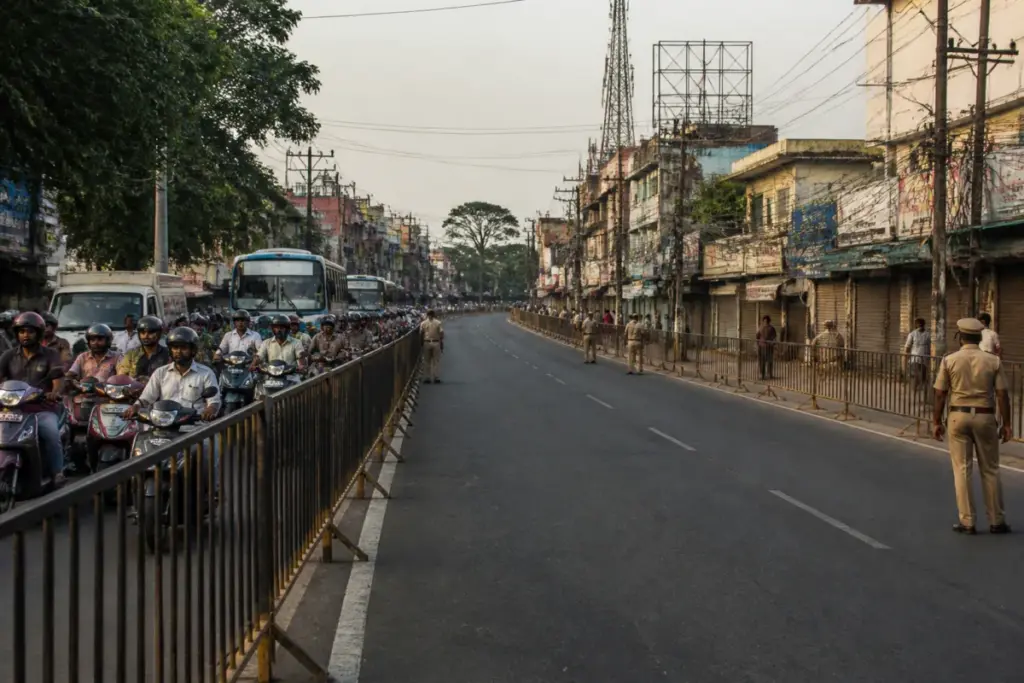
The report claims that police take control of the area one day before the Chief Minister’s visit and suspend traffic to prevent interruptions during the movement. It contrasts the alleged arrangements with the road journeys of former chief ministers Jayalalithaa, Edappadi K. Palaniswami and M.K. Stalin, saying traffic was stopped for up to 30 minutes during their public programmes, while the current arrangements can result in closures lasting between three and six hours.
Dinamalar further reports that shops in affected areas are instructed to close. It says the disruption extends beyond commuters to small businesses and workers, with employees at small enterprises and shops allegedly losing part of their daily wages when operations are interrupted. The report does not identify the affected locations, the number of businesses involved, the number of workers affected or any business association, worker or shopkeeper who has independently confirmed the claim.
The account also says that two barricades are placed on both sides of the route from the airport and along the Chief Minister’s travel path. It estimates that security arrangements can cost as much as Rs 5 crore. No government expenditure document, police deployment order, tender record, budget head or official estimate is cited in the supplied report. The amount therefore remains an unverified figure rather than an established public expenditure.
The urban significance of the issue lies in the way high-security political movement can affect the everyday functioning of a city. Road closures are not limited to the immediate route. They can alter bus movements, delivery schedules, access to commercial streets, school and workplace journeys, emergency response routes and the operating hours of small establishments. However, the report does not provide traffic counts, closure maps, diversion plans, travel-time comparisons or emergency-service records that would show the scale of the impact in any particular city.
The report presents the issue through the views of unnamed supporters who are said to expect the Chief Minister to change the practice. It also says that some ministers are aware of the concern but do not know who can bring it to the Chief Minister’s attention. These statements are not attributed to named individuals, and the report does not include a formal response from the Chief Minister’s office, the police department, the transport department, a district administration or a municipal authority.
That absence matters because traffic management for a protected public figure normally involves several institutions. Police authorities determine security perimeters and route controls, while traffic police manage diversions and public movement. District administrations and municipal bodies may coordinate access to public roads and commercial areas. Transport agencies may have to adjust bus services, and local authorities may communicate temporary restrictions. Without the relevant orders or operational plans, it is not possible to determine which agency authorised the reported closures, whether the restrictions were proportionate to a specific security assessment or whether alternative arrangements were considered.
The report’s comparison with earlier chief ministers also requires a common measurement framework. A meaningful comparison would need the date and location of each event, the length of the route, the duration of the closure, the number of roads affected, the security category involved, the size of the public gathering and the number of police personnel deployed. Comparing a reported three-to-six-hour closure with a previous 30-minute restriction without those details cannot establish whether the arrangements represent a consistent policy change or differences between individual events.
The same problem applies to the cost estimate. Security expenses can include barricading, police deployment, traffic diversions, transport, communication and other operational requirements. A reliable assessment would require event-wise expenditure records and a clear separation between routine security costs and additional costs directly caused by a roadshow. The supplied material provides no such breakdown. It only reports an estimate of up to Rs 5 crore.
The reported impact on workers and small businesses is also an important but undocumented part of the account. Small establishments often have less capacity to absorb a lost trading day than large companies, and a forced closure or reduced footfall can affect daily-wage workers immediately. Establishing this impact would require testimony from affected businesses, local market associations, worker groups or official records showing closure notices and trading interruptions. None of those sources is identified in the supplied report.
The central governance question is therefore not simply whether a Chief Minister should meet people from a roadshow vehicle. It is how public access, security obligations and the uninterrupted functioning of urban streets are balanced. A public road is simultaneously a mobility corridor, a commercial frontage, an emergency route and a space for political communication. When one function takes priority, the authority responsible for the decision should be able to explain the duration, geographic extent, legal basis and public-interest rationale of the restriction.
The available material does not establish whether the reported closures were ordered across Tamil Nadu or occurred only during selected visits. It does not state whether the restrictions were formally notified, whether shops were legally required to close or merely advised to do so, or whether commuters were given advance information about diversions. It also does not establish whether the reported security cost was incurred in one event or represents a broader estimate.
These gaps prevent a verified conclusion about the scale of the alleged disruption. They do not eliminate the public-interest value of examining the issue. Traffic restrictions around senior political leaders are an urban governance matter when they affect access, livelihoods and public spending. But any final account should be built on primary records: police traffic plans, district administration orders, expenditure documents, route closure timings, transport advisories and responses from affected businesses and residents.
Dinamalar’s report has brought forward allegations about roadshow-related disruption and the concerns of unnamed supporters. The next verifiable step would be to establish the specific events involved, obtain official records on traffic and security arrangements, and seek responses from the relevant authorities before determining whether the reported pattern is widespread, how much it costs and how significantly it affects urban life.


