

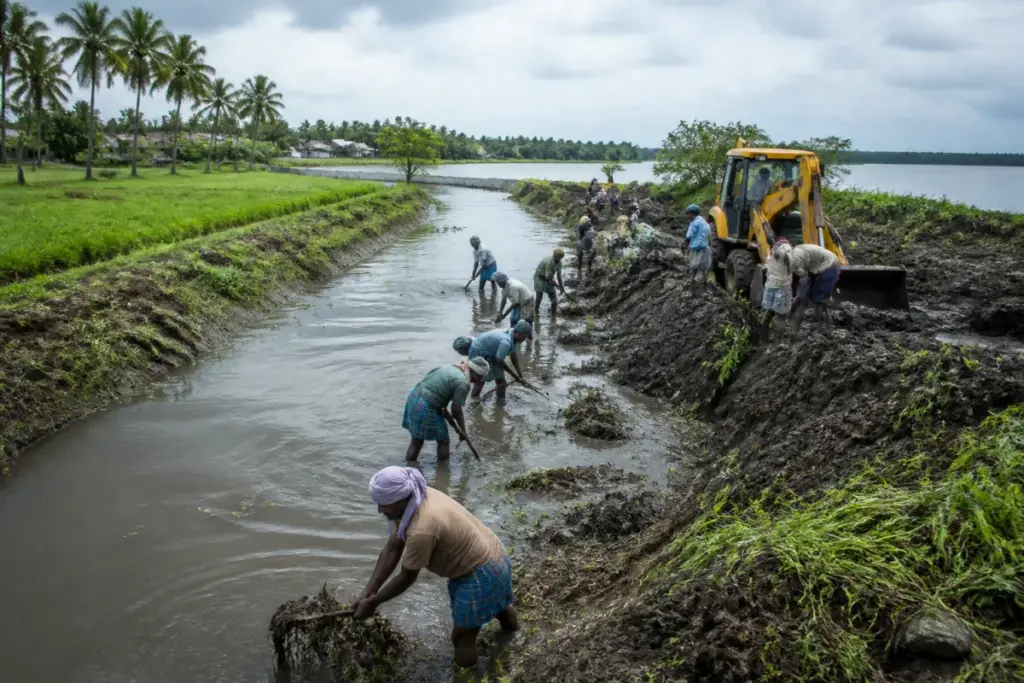
Tamil Nadu’s plan to desilt 10,185 canals and 809 water bodies before the northeast monsoon is more than a rural works programme. It is an attempt to restore a water network that connects catchment areas, lakes, agricultural fields, groundwater reserves and, in places such as Chennai, the management of urban floodwater.
The programme, estimated to cost Rs. 500 crore, follows an expert committee recommendation that critical river basins, agricultural tanks and storm channels should be heavily desilted to accommodate sudden increases in floodwater. The scale of the proposed work shows the extent to which routine maintenance of water infrastructure has become a state-wide concern rather than a local repair issue.
The government has already begun desilting work on the Adyar, Cooum and Kosasthalai rivers in Chennai. These waterways are being treated as part of the city’s flood-management system, with the stated objective of ensuring the free flow of floodwater after heavy rain. The wider programme will cover canals and water bodies across Tamil Nadu and is expected to be completed before the beginning of the northeast monsoon season.
That connection between rural waterways and urban flooding is often missed in public discussions about drainage. A canal that carries water from a catchment area to a tank, or from one water body to another, is part of a larger hydrological chain. When it is blocked by silt, vegetation, garbage or encroachment, the disruption does not remain confined to the location of the blockage. Water may fail to reach a storage structure, spill into agricultural land or move towards residential areas instead.
The reported programme identifies 10,185 canals with different functions. Some bring water from catchment areas to water bodies. Others carry water between water bodies or take water to agricultural fields. Their condition therefore affects both flood movement during intense rainfall and water availability after the rains. A canal system that cannot convey water efficiently can contribute to inundation during the wet season and scarcity during summer.
This dual role is central to understanding the proposal. Desilting is being presented not only as a flood-prevention measure but also as a way to increase the storage capacity of lakes and ponds, improve irrigation and support drinking-water availability. The 809 water bodies listed for desilting and rejuvenation include large and small lakes and ponds. Removing accumulated sand, garbage and plants is expected to improve their ability to hold water.
The arrangement also links water management with the rural employment guarantee system referred to in the report as the VB-G RAM G scheme. The government intends to use the programme to provide jobs and wages to rural residents while carrying out the desilting work. This gives the scheme two immediate objectives: spending on employment is directed towards physical works, and the physical works are intended to repair assets that support rural livelihoods.
The report describes the earlier use of the renamed rural employment guarantee scheme as having produced limited results, particularly in relation to tree planting. It says saplings were planted in unsuitable locations such as roads and areas below electricity cables, while panchayat leaders were focused on accounting for expenditure and providing wages. These claims are presented in the source report and are not independently assessed in the material available here. They nevertheless point to a governance question that is important for the new programme: whether employment spending can be tied to durable public assets through better planning and supervision.
Desilting itself is not a substitute for waterway protection. The source report notes that canals are often left without maintenance and become encroached upon, blocking the movement of water during rainfall. This indicates that the challenge is not simply the removal of accumulated material before one monsoon. It is the continuing management of a distributed network that passes through villages, agricultural land and settled areas.
If a canal has nearly disappeared, restoring its channel may require more than removing silt. The work may involve identifying its original alignment, clearing obstructions, managing waste and preventing renewed encroachment. The supplied report does not provide details of land records, enforcement arrangements, technical standards or post-work maintenance. Those omissions matter because the long-term performance of the programme will depend on what happens after the initial cleaning is complete.
The planned work also reveals how closely agricultural resilience is tied to water infrastructure. During heavy rain, agricultural fields can remain inundated, damaging crops and erasing the labour and money invested by farmers. A functioning canal can help drain excess water from fields while also directing flows towards storage structures. The programme is therefore intended to reduce crop damage during heavy rainfall and improve water access during drier periods.
For cities, the implications are equally significant. Chennai’s Adyar, Cooum and Kosasthalai rivers are named among the waterways being desilted. The report describes the purpose as enabling the free flow of floodwater after heavy rains. But river desilting can only perform that function within a wider drainage system. Storm channels, feeder canals, tanks, river corridors and outfalls must work together. A cleared river cannot fully compensate for blocked feeder channels or water bodies whose storage capacity has been reduced.
The expert committee’s recommendation to include critical river basins, agricultural tanks and storm channels in the desilting effort reflects this network logic. It moves the focus away from isolated water bodies and towards the paths through which water travels. That is particularly relevant in areas where residential development has expanded around former agricultural and drainage landscapes. The report does not quantify the extent of such development or identify specific encroachments, but it states that blocked canals can lead to inundation of residential areas.
The programme’s administrative structure is also important. The work is to be carried out under the VB-G RAM G scheme through the rural development department, while the assets involved perform functions associated with irrigation, flood control, drinking water and groundwater recharge. This creates a coordination requirement across rural local bodies, water-resource agencies and authorities responsible for urban drainage. The supplied material does not specify how these responsibilities will be divided or how progress will be measured.
That coordination will determine whether the programme becomes a durable public-works intervention or a seasonal cleaning exercise. The source report emphasises the need for proper coordination and speedy implementation. It also states that the work is to be taken up across Tamil Nadu at the same time and completed before the northeast monsoon. The timing creates a clear operational deadline, but the material does not state how many sites have been completed, how work quality will be checked or how cleared channels will be monitored later.
The numbers provide a useful indication of the programme’s scale. It covers 10,185 canals and 809 water bodies, with an estimated cost of Rs. 500 crore. Spread across more than 10,000 canals and 809 water bodies, the headline allocation represents a large and geographically dispersed workload, although the source does not provide a site-wise financial breakdown. The absence of such a breakdown makes it difficult to compare the proposed expenditure with the differing technical needs of a major river, a village canal, a large lake or a small pond.
The programme’s stated benefits are similarly broad: flood prevention, water storage, groundwater recharge, improved irrigation, drinking-water support and rural employment. These outcomes are connected, but they are not automatic. Increased storage depends on the actual removal of silt and waste. Better drainage depends on unobstructed downstream channels. Groundwater benefits depend on water reaching and remaining in recharge structures. Employment benefits depend on timely wages and meaningful work. Each outcome therefore requires a different form of monitoring.
The larger urban question is whether Tamil Nadu treats water infrastructure as a continuous public system or as a set of emergency works activated before the monsoon. The reported programme recognises that canals and water bodies have multiple users and multiple functions. It also demonstrates that flood resilience cannot be separated neatly into urban and rural categories. Water moving through a rural catchment can determine whether an agricultural field, a peri-urban settlement or a city neighbourhood is inundated.
The evidence supplied by the report confirms the scale and stated objectives of the proposed desilting drive, as well as its links to employment and flood management. It does not establish the programme’s completion status, the condition of each water body, the extent of encroachment, or the mechanisms for independent measurement of results. Those are the next facts that will determine whether the plan restores Tamil Nadu’s water network or merely prepares it for one monsoon cycle.


