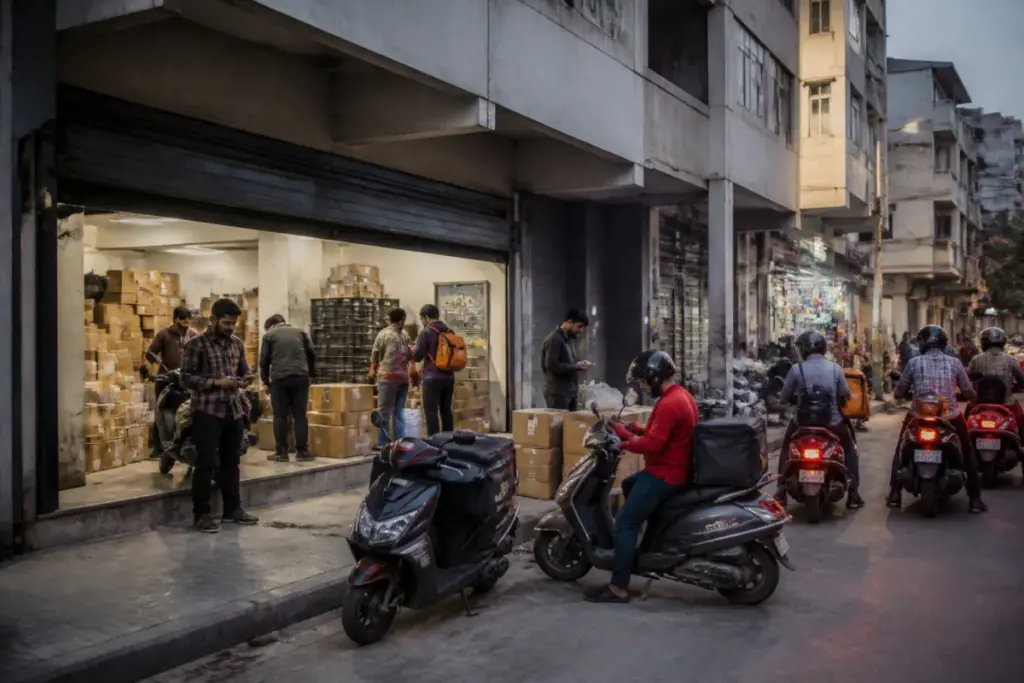
Swiggy’s latest results expose the central tension in India’s quick-commerce expansion: the network is getting larger and reaching more cities, but the cost of building and defending that network is also rising. The company added 69 net dark stores during the quarter ended September 30, taking Instamart’s network to 1,240 outlets across 133 cities, even as its quick-commerce losses widened and its contribution margin deteriorated.
The numbers place dark stores at the centre of Swiggy’s urban strategy. These facilities, designed to serve online orders rather than walk-in shoppers, are the physical infrastructure behind promises of rapid delivery. Their expansion gives a platform greater proximity to customers, but it also creates continuing costs related to pricing, customer acquisition, warehouse expansion and retention. Swiggy’s results show that a larger footprint has not yet translated into an improvement in the economics of the business.
Swiggy reported a consolidated net loss of ₹922 crore for the quarter, narrower than the ₹1,092-crore loss recorded a year earlier but higher than analysts’ expected loss of ₹792 crore, according to LSEG data cited by Reuters. Revenue from operations rose 36.1 per cent year on year to ₹7,571 crore, exceeding the analysts’ estimate of ₹7,281 crore. The combination of strong revenue growth and a larger-than-expected loss underlines the difference between expanding transaction volumes and reaching profitability.
The company’s two main operating businesses moved in different directions. Food delivery reported adjusted core profit of ₹341 crore, up from ₹240 crore a year earlier. Swiggy attributed the improvement to higher advertising revenue and delivery efficiencies. Instamart, however, reported an adjusted core loss of ₹895 crore, compared with ₹849 crore a year earlier. Its net order value rose 34.8 per cent to ₹6,594 crore, but the increase in order value did not prevent the operating loss from widening.
That divergence is important because the quick-commerce business depends on a much denser physical network than a conventional food-delivery operation. A food-delivery platform primarily coordinates restaurants, customers and delivery workers. Quick commerce adds a distributed layer of warehouses positioned close to demand. In urban terms, that means more small-format commercial facilities embedded within neighbourhoods, more inventory held near consumers and greater dependence on the availability and cost of suitable premises.
Swiggy’s 1,240 dark stores across 133 cities represent a substantial operating network, but the supplied results do not establish how each location performs, how quickly individual stores reach viability or what occupancy and operating costs are in different markets. What they do establish is that the network is still being expanded while the business is spending heavily to attract customers, support pricing and retain demand.
The company’s contribution margin in quick commerce deteriorated to negative 1 per cent of gross order value from negative 0.2 per cent in the preceding quarter. This measure indicates that the economics of fulfilling orders before broader corporate costs became less favourable over the period. The deterioration came even as Instamart’s net order value increased, suggesting that higher sales alone did not resolve the cost pressure associated with the service.
The urban significance of this model lies in the relationship between speed, proximity and space. Faster delivery requires inventory to be placed closer to households. That changes the geography of retail distribution from a smaller number of larger facilities towards a more dispersed network of local warehouses. The results show the commercial pressure attached to that shift: companies are adding locations and competing for customer loyalty while accepting weaker margins in the near term.
Swiggy is not pursuing this expansion in isolation. Eternal’s Blinkit added 308 net stores during the September quarter and said it planned to accelerate expansion without a near-term reduction in margins, according to the Reuters report. The contrast in store additions illustrates the intensity of the race. Instamart added 69 net dark stores in the quarter, while Blinkit added more than four times that number. The figures also indicate that competitive positioning is being measured not only through order volumes or revenue, but through the scale and reach of physical networks.
For cities, this creates a new form of logistics infrastructure whose visibility is often lower than that of roads, metro systems or large warehouses. Dark stores can occupy existing commercial premises or other small-format spaces, allowing platforms to build a local distribution network without relying solely on large peripheral fulfilment centres. However, the supplied material does not provide details on zoning permissions, rental costs, delivery traffic, labour conditions or the impact of these facilities on local retail markets. Those questions remain outside what the quarterly results establish.
The available financial data nevertheless show why the model continues to attract investment. Instamart’s net order value grew 34.8 per cent year on year, while Swiggy’s overall operating revenue grew 36.1 per cent. These increases provide evidence of demand and scale. But the widening adjusted core loss, negative contribution margin and continued spending on pricing and customer acquisition show that demand is being pursued through an expensive expansion strategy rather than through an already settled operating model.
The company’s food-delivery performance offers a useful contrast. Its adjusted core profit increased by ₹101 crore year on year to ₹341 crore, supported by advertising revenue and delivery efficiencies. That improvement suggests that a more mature platform activity can benefit from operational efficiencies and additional revenue streams. Instamart, by comparison, remains in a phase in which expansion, customer acquisition and network-building are exerting pressure on margins.
This difference also reflects two distinct urban systems. Food delivery uses an existing restaurant network and organises movement between established commercial locations and homes. Quick commerce seeks to redesign the location of inventory itself. Its promise depends on creating enough neighbourhood-level capacity to make short delivery times commercially attractive. The cost of that promise is visible in the continued need to add stores and spend on customer retention.
The results therefore do not establish that dark stores are either a failed model or a proven success. They show a business with growing revenue and order value, alongside losses and margins that remain under pressure. They also show that the competitive market is still expanding its physical footprint. Any assessment of long-term viability would require information not included in the supplied report, including store-level profitability, delivery economics, property costs, order density and the time required for new locations to mature.
For urban policymakers and property markets, the immediate question is how this network will be accommodated as it spreads across 133 cities. The report confirms the scale of the expansion but does not identify the regulatory or planning frameworks governing individual facilities. It also does not specify whether dark stores are concentrated in dedicated commercial areas, mixed-use neighbourhoods or other types of premises. Those distinctions will determine how the model interacts with existing land use and local commerce.
The broader signal is clearer. Quick commerce is no longer only a digital-service story. It is also a question of distributed warehousing, neighbourhood access, commercial real estate and last-mile movement. Swiggy’s quarterly results show that companies are willing to keep building this physical layer even while its financial returns remain unsettled. Rival expansion reinforces the competitive pressure to maintain or increase network coverage.
What the evidence confirms is a widening gap between scale and profitability at Instamart. The business added stores, expanded its network and increased net order value, but its adjusted core loss widened to ₹895 crore and its contribution margin became more negative. The next important indicators will be whether new stores improve order density and margins, whether spending on pricing and retention moderates, and how the competing networks develop across the cities they serve.