

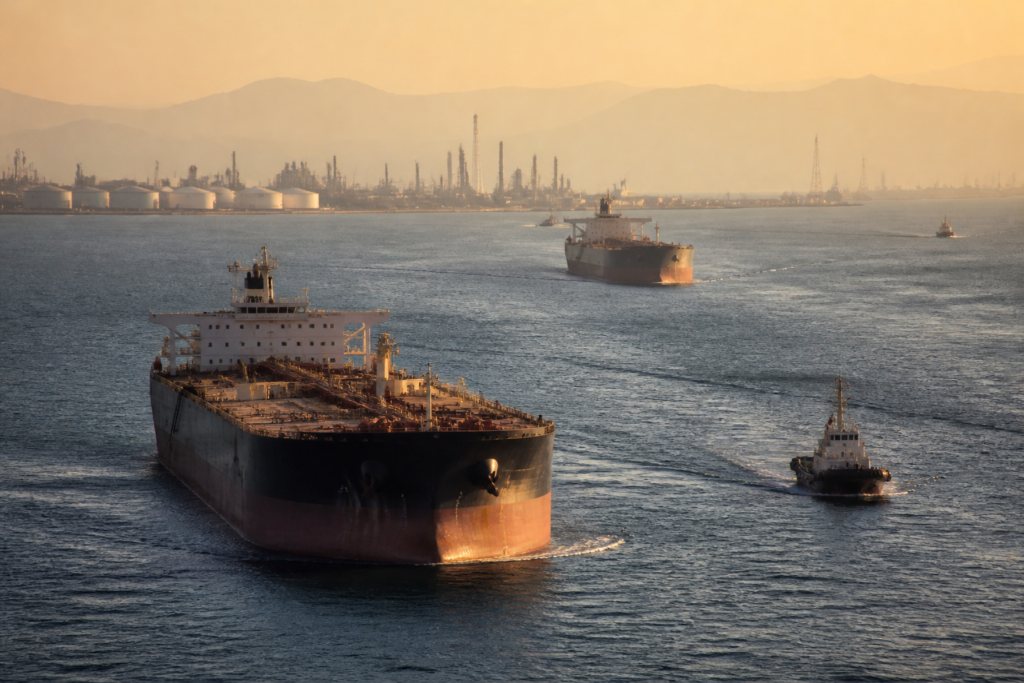
The Strait of Hormuz is moving from a story of physical oil scarcity to one of delivery risk, and that distinction is keeping energy costs elevated for India even as crude flows from the Middle East recover. Tanker-tracking data cited in a Times of India report shows that oil shipments have returned to their highest levels since the US-Iran conflict began, but freight, insurance, security and inventory pressures continue to shape the price of every barrel reaching Asian refiners.
The shift matters because India’s exposure is not limited to the volume of crude it imports. The country also depends substantially on the Middle East for liquefied petroleum gas and liquefied natural gas. A disruption around Hormuz therefore affects transport fuels, cooking gas, industrial energy, electricity generation and the operating costs of refineries and logistics networks. The immediate question is no longer simply whether oil is moving. It is whether shipments can move safely, predictably and at a cost that does not feed through to the wider economy.
The conflict initially produced a sharp interruption. Before the war, around 19 million barrels of crude oil were exported daily from the Middle East, according to the report. Oil shipments through the Strait of Hormuz came to a standstill, crude prices rose and the global market faced a supply crunch. September data from Kpler showed flows recovering to an average of 16 million barrels per day, the highest since the conflict began. Approximately 10 million barrels moved through Hormuz, while another 6 million barrels were routed through pipelines and ports on the Red Sea and Gulf of Oman that bypass the strait.
That recovery, however, does not represent a return to normal conditions. Kpler data cited by the report shows Gulf crude exports rising to 14.1 million barrels per day in September from 9.8 million barrels per day in August. The September figure was about 78% of February’s 18.2 million barrels per day, although it included bypass loadings at Yanbu and Fujairah. Kpler’s crossing data also showed crude flows through Hormuz down 27% from a wartime high to at least 10.1 million barrels per day. A separate tally of laden tanker exits reportedly fell from about 11 million barrels per day during October 1-7 to 6.2 million barrels per day during October 8-12.
The numbers point to a market that is operationally adapting rather than diplomatically stabilising. Kpler’s analysis said that normalisation through Hormuz no longer necessarily depends on a US-Iran agreement. Its base case reflects slower and uneven recovery under continued conflict, with shipping companies, governments and traders adjusting their operations to keep cargo moving. That distinction is important for cities and industries that rely on energy systems designed around regular supply rather than continual risk management.
### Why Strait of Hormuz oil is still expensive
Oil markets price reliability, not just barrels. A cargo loaded today does not guarantee that the next shipment will cross safely or arrive on schedule. The report quotes Kpler senior analyst Naveen Das as saying that unsustainable flows, attack risks and the need to secure crude before freight costs further reduce refinery margins are keeping prices elevated.
The cost of maritime transport illustrates the change. Very large crude carriers loading at Fujairah, Yanbu or Muscat were reportedly fixing at 750-950 Worldscale points, compared with 125-155 for Gulf loadings in February. War-risk premiums reached 3-8% of a vessel’s hull value, against about 0.25% before the conflict. The New York Times analysis cited in the report said that US military air protection, along with higher payments by Saudi Arabia and the UAE, had encouraged more tanker operators to accept the risk. In some cases, fees were reportedly as much as ten times pre-war levels.
These costs alter the economics of supply even when physical volumes improve. A refiner may be able to secure crude, but the delivered price can remain high because the cargo requires expensive insurance, longer or more complex routing, security support and specialised transfer arrangements. Supplier-arranged shuttle movements and ship-to-ship transfers may reduce a buyer’s direct exposure to the riskiest leg, but the allocation of freight, insurance and transit risk depends on the commercial terms of each cargo.
The security situation also remains fluid. The report says Iran continued to attack ships almost daily, while Kpler data recorded the highest number of tanker attacks in a week during the conflict. Only seven commodity vessels crossed on October 6, compared with about 125 a day before the war. At least six vessels were reported hit from September 28, and Saudi Arabia’s East-West pipeline, damaged in attacks on September 10 and 11, was only about half restored.
The result is a supply chain with more barrels but fewer guarantees. The market is therefore pricing the possibility that the next disruption could arrive before inventories and alternative routes are fully restored. The reported recovery in loadings has eased the physical shortage, but it has not removed the underlying delivery risk.
### The inventory and refinery problem
The price question is also connected to products, not only crude. Praveen Rai, director at Grant Thornton Bharat, identified four reasons for continued price pressure: the risk of renewed interruption, expensive logistics, reduced product and inventory buffers, and constraints linked to crude quality and refinery availability.
Industry shipping estimates cited by Rai put Middle East-to-Asia very large crude carrier rates at more than $1.2 million per day, compared with roughly $30,000 in January. Freight accounted for about 27% of the delivered value of a barrel on the observed route, against approximately 3% previously. Such an increase can affect refinery margins and influence which grades refiners choose to buy.
The product market has also lost part of its cushion. The International Energy Agency reportedly estimated that global diesel exports in September were around 700,000 barrels per day below the previous year. A loss of 1.3 million barrels per day from Russia and the Middle East was only partly offset by other suppliers. Global observed oil inventories were 509 million barrels below end-February levels, according to the report.
This means that higher crude exports cannot automatically produce lower prices for diesel or other middle distillates. Crude must be of a suitable grade, reach a refinery, be processed through available capacity and then move through distribution networks. Medium-sour crude availability and refinery operations therefore matter alongside the number of barrels crossing Hormuz.
The urban consequences are indirect but extensive. Fuel prices affect bus and freight operations, construction equipment, delivery networks, airport access and the cost of moving food and building materials. LPG costs affect households and commercial kitchens, while gas availability influences industrial production and electricity systems. The report does not quantify the final impact on Indian inflation, but it identifies the transmission mechanism: higher risk-adjusted landed costs continue to place pressure on the economy even when headline supply volumes recover.
### India’s diversification is helping, but not eliminating route risk
Indian refiners have responded by widening their crude basket. According to Das, India kept total imports at about 5.0-5.3 million barrels per day while changing origins according to the lowest risk-adjusted landed cost. Russia’s supply rose from 1.08 million barrels per day in February to a peak of 2.73 million barrels per day in July before easing to 1.87 million barrels per day in September. The Gulf-origin share fell from about 59% in February to around 18% in June, then recovered to approximately 37% in September.
Iraq and Kuwait together increased from 0.32 million barrels per day in August to 0.86 million barrels per day in September. Venezuela also became a new supplier, contributing between 0.2 million and 0.35 million barrels per day from April. These movements show that Indian procurement has remained flexible rather than relying on a single origin.
That flexibility gives refiners options when routes or suppliers become more expensive. Improved Gulf availability also gives Indian refiners greater access to medium-sour grades suited to producing diesel and other middle distillates, Rai said. But diversification of suppliers is not the same as diversification of routes. Several Gulf suppliers remain dependent on the same chokepoint, meaning that a wider list of sellers cannot fully protect India from a disruption around Hormuz.
This is the central strategic limitation. India can switch the origin of a cargo, but it cannot instantly remove the geographic risks embedded in the global oil system. Alternative suppliers may have different transport requirements, quality profiles, payment conditions and geopolitical complications. The cheapest barrel on paper may not be the cheapest barrel once insurance, freight, route security, refinery compatibility and delivery timing are included.
The evidence therefore points to a partial stabilisation rather than a resolution. Oil flows have recovered from the wartime trough, and Indian refiners have demonstrated the ability to substitute suppliers. Yet tanker attacks, incomplete pipeline restoration, lower inventories and sharply higher logistics costs continue to keep the market on alert.
For India’s cities and economy, the Strait of Hormuz crisis reveals how distant maritime infrastructure can shape everyday urban costs. The exposure is not confined to oil companies or foreign policy institutions. It runs through public transport, construction supply chains, household energy, manufacturing and food distribution. A barrel that moves through the system is not necessarily a barrel that arrives cheaply or reliably.
The next indicators to watch are the durability of tanker crossings, the restoration of damaged energy infrastructure, the level of freight and war-risk premiums, refinery access to suitable crude and the rebuilding of global inventories. Until those conditions improve together, recovering oil volumes alone are unlikely to deliver durable price relief for India.


