

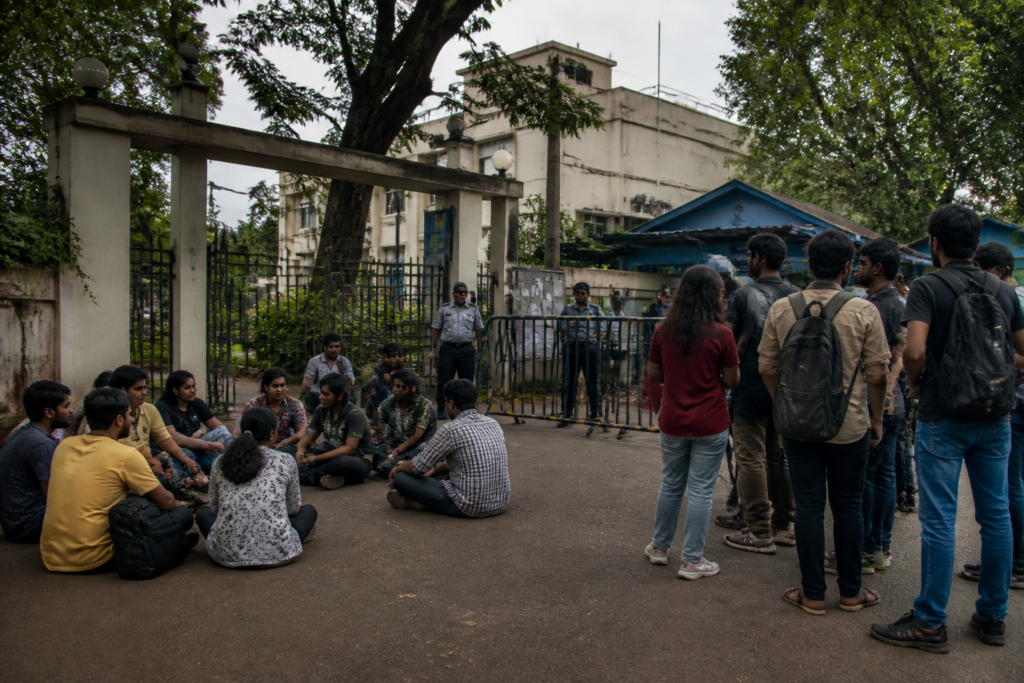
The SRFTI student protest in Kolkata has moved beyond a dispute over the resignation of Vice-Chancellor Santosh Ajmera. With classes suspended since September 28, a sit-in continuing into its fourth day, allegations of attacks and intimidation on both sides, and disciplinary notices issued to protesting students, the standoff now exposes a wider breakdown in campus governance at one of India’s premier public film institutions.
The immediate trigger for the latest escalation was an alleged confrontation involving Ajmera and students, following damage to the Vice-Chancellor’s office. The Satyajit Ray Film and Television Institute said stones were thrown at the office windows during the night between Wednesday and Thursday, damaging glass panes, furniture, water lines and air-conditioning lines. The institute also alleged that a student manhandled Ajmera as faculty members and officials were leaving a meeting held to condemn the vandalism.
Ajmera, who took charge around 15 days before the incident, described the alleged attack as “unacceptable and intimidating” and called for strict action against those found guilty. The institute said students had disrupted peace, order and normal academic activity, and had intimidated others into avoiding classes. According to the administration, some students left the campus and returned home during the disruption.
The students’ account is substantially different. In a letter dated October 14, the SRFTI Students’ Union appealed to chairman Suresh Goel to intervene, saying its “academic halt and indefinite sit-in” would continue until its demands were addressed. The union has demanded the Vice-Chancellor’s resignation, independent inquiries into alleged attacks on students, and withdrawal of disciplinary and show-cause notices.
This conflict over competing accounts is central to the crisis. The administration has alleged vandalism, abusive behaviour and an assault on the Vice-Chancellor and security personnel. Students have alleged that the administration failed to protect them during incidents outside the institute and later used disciplinary proceedings to silence dissent. An SRFTI official denied that staff members or security personnel had assaulted students. The supplied report does not establish an independent finding on any of these allegations.
The dispute also reaches back to September 27 and October 4. The students’ union alleged that members of the Akhil Bharatiya Grahak Panchayat, described in the report as an RSS-affiliated consumer awareness group, attacked students during incidents linked to a rally by the Bangiya Hindu Jagran Manch near the institute gate. The union said several students were injured and accused the administration of failing to ensure their safety or take adequate action.
Students have sought independent inquiries into those incidents as well as allegations that institute staff intimidated, harassed or manhandled protesters on October 6 and 7. They claimed that staff members attempted to forcibly remove protesters from the Vice-Chancellor’s office during the sit-in. The administration has rejected the allegation of assault by staff or security personnel. Without an independent inquiry, the institutional dispute remains locked in mutually opposed narratives.
The disciplinary process has added another layer to the standoff. An institute official said show-cause notices had been served on eight protesting students for alleged violations including objectionable graffiti, posters placed in breach of campus discipline, failure to comply with the Vice-Chancellor’s appeal to resume classes, and assaulting security personnel in his room the previous week. The students have described the notices as an attempt to intimidate those questioning the administration’s handling of the crisis.
The disagreement is not simply about whether disciplinary action is permissible. It is also about whether disciplinary mechanisms can be trusted while the institution is simultaneously dealing with allegations of violence and a breakdown in communication. The students have asked for all disciplinary and show-cause notices issued during the protests to be withdrawn. Union spokesperson Sudip Chakraborty said students were consulting lawyers about possible legal steps concerning the notices.
For an institution built around collaborative production, the suspension of academic work has consequences beyond missed lectures. The students said they wanted to return to classes, shoots and workshops and complete their films. Their demand for the unconditional rescheduling of classes missed since September 28 points to the operational difficulty of restoring an academic calendar in a film and television institute, where practical sessions, screenings and production work depend on access to equipment, studios, workshops and coordinated schedules.
The crisis also reveals that student welfare is part of the governance question. The union said SRFTI faces a shortage of about 100 hostel beds and sought temporary accommodation, including vacant staff quarters, until a proposed new hostel is built. According to the students, the hostel proposal has been pending for three years. Many students are living off campus, making the availability of accommodation directly relevant to their ability to attend classes, remain on campus and participate in shoots and workshops.
Medical assistance has become another point of contention. The union alleged that injured students were told medical help would be provided only if they remained in Kolkata, even when their families wanted to arrange treatment in their home states. The report does not provide an independent assessment of the medical arrangements or the injuries. But the allegation indicates how quickly a campus protest can become a test of institutional responsibility for students’ physical and emotional safety.
The chairman’s intervention is significant because the students are not seeking only a change in the Vice-Chancellor’s office. Their letter asks the institute authorities and the Centre to initiate dialogue and resolve the impasse. They also said repeated requests for accountability and dialogue with the chairman, Vice-Chancellor and Information and Broadcasting Minister Ashwini Vaishnaw had not produced satisfactory responses.
That escalation from campus authorities to the governing board and the Union government reflects the institutional structure of the dispute. The chairman is being asked to act as an intermediary while the students question the Vice-Chancellor’s conduct and the administration’s response to earlier incidents. At the same time, the involvement of the Centre is being sought because the institute is central government-run. The unresolved issue is therefore not only who leads the campus, but which authority is responsible for investigating allegations, protecting students and restoring academic functioning.
The sequence described in the report suggests a failure of early resolution. Alleged attacks on September 27 and October 4 were followed by further allegations involving staff and protesters on October 6 and 7. Classes then remained suspended from September 28, while the sit-in and demands for resignation continued. By the time the Vice-Chancellor’s office was allegedly vandalised and the later confrontation took place, the dispute had already developed into a prolonged institutional standoff.
The timeline matters because every additional stage raises the cost of settlement. A protest that begins with a demand for accountability can become harder to resolve once property damage, alleged physical confrontations and disciplinary notices enter the dispute. Each side then has reasons to insist that the other must first answer for alleged wrongdoing. The result is an administrative deadlock in which dialogue becomes more difficult precisely when it is most necessary.
The student union’s demands connect three issues that are often treated separately: safety, academic continuity and accountability. They want independent investigations into alleged attacks, protection from intimidation, access to campus facilities, rescheduling of missed classes and withdrawal of disciplinary notices. Their demand that the institute have a head who respects freedom of expression and maintains open dialogue also shows that the leadership dispute is rooted in confidence, not merely personality.
The administration’s position rests on a different institutional priority: restoring order, protecting officials and enforcing campus discipline. Its allegations of vandalism, intimidation, objectionable graffiti and assaults on security personnel cannot be dismissed simply because they arise during a protest. But the legitimacy of disciplinary enforcement depends on transparent procedures, clear evidence and confidence that complaints by students are being examined with equal seriousness.
The supplied material does not establish whether any inquiry has begun, whether the alleged attacks have been referred to an external authority, or when classes will resume. It also does not establish the status of the proposed hostel, the availability of vacant staff quarters or the mechanism through which missed academic work will be rescheduled. These unresolved administrative details are now as important to the future of the institute as the competing demands for resignation and disciplinary action.
The SRFTI crisis therefore represents a broader campus governance problem: when safety complaints, leadership disputes and disciplinary proceedings overlap, an institution needs a credible process that can separate facts from allegations and restore ordinary academic life. The immediate priority identified by the competing accounts is dialogue, but the evidence supplied shows that dialogue will have to address the entire chain of events—from the September incidents and the suspended classes to the alleged vandalism, the confrontation involving the Vice-Chancellor, the show-cause notices and the unmet accommodation and medical concerns.
For now, the confirmed position is that classes have remained suspended since September 28, the students’ sit-in is continuing, the administration and students dispute the allegations of violence, and eight students have received show-cause notices according to an institute official. The next decisive development will be whether chairman Suresh Goel and the relevant authorities establish a process capable of independently examining the allegations and creating conditions for classes, shoots and workshops to resume.


