

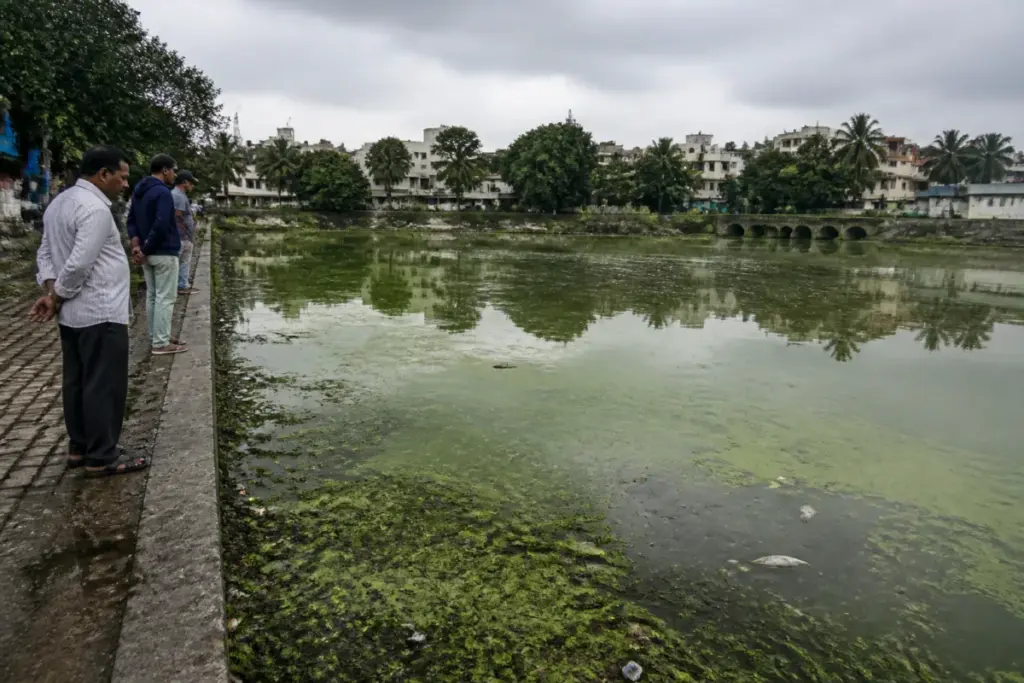
The fish deaths at Siddapura Lake in Bengaluru are more than an isolated pollution incident. They show how quickly an urban lake can move from being a civic amenity to becoming a public-health and ecological concern when water quality is not tested regularly and pollution sources are not identified early.
Hundreds of dead fish were found floating in Siddapura Lake, while extensive algal growth turned the water green, according to a report by Bangalore Mirror. Residents alleged that sewage from nearby neighbourhoods was entering the lake. They also reported a strong smell, worsening pollution after recent rains and the beginning of mosquito breeding around the waterbody.
The exact cause of the fish deaths has not yet been established. That distinction matters. The visible combination of green water and dead fish is consistent with serious ecological stress, but it cannot by itself prove that sewage caused the deaths. Scientific testing is needed to determine the water’s quality, identify possible pollutants and establish whether oxygen depletion or another factor was responsible.
That uncertainty is not a reason to minimise the incident. It is the central governance problem exposed by it. When a lake is monitored only after fish begin dying, authorities are responding to a visible failure rather than preventing the conditions that produced it. The calls from residents and lake conservation advocates for immediate sampling, regular monitoring and corrective action point to a system that remains reactive.
The ecological mechanism described by experts is straightforward. Sewage entering a lake can increase its nutrient load. Those nutrients can encourage excessive algal growth, a process commonly associated with eutrophication. When the algae die and decompose, the decomposition process consumes dissolved oxygen in the water. If oxygen levels fall sharply, fish and other aquatic organisms may be unable to survive.
At Siddapura Lake, the green colour of the water and the fish deaths therefore provide warning signs, but not a complete diagnosis. The water needs to be assessed rather than judged only by appearance. Testing should establish the relevant water-quality conditions and help authorities determine whether the lake is receiving sewage, stormwater carrying pollutants or another form of contamination. The supplied report does not include laboratory results, so the present condition should be treated as a serious reported deterioration awaiting scientific confirmation.
This is where the institutional responsibilities become important. Residents have called for intervention by the Greater Bengaluru Authority and the Karnataka State Pollution Control Board. The GBA has been urged to identify the pollution source and take measures to prevent further deterioration, while the KSPCB has been asked to ensure quarterly water-quality monitoring of lakes and timely corrective action.
The distinction between these roles is significant even when the public experiences them as one failure. A city authority is responsible for managing local urban conditions and responding to pollution pathways affecting a lake. A pollution control regulator has a broader role in assessing environmental quality and enforcing standards within its mandate. Without coordination between the bodies responsible for lake management, drainage, sewage and pollution monitoring, responsibility can become fragmented while the waterbody continues to deteriorate.
Siddapura Lake’s reported condition also raises questions about what happens when the management of urban lakes shifts away from the communities that have historically watched them closely. Madhuri Subbarao, co-founder of Friends of Lakes, said the lake had been in better condition more than 15 years ago, when local communities were organically involved in its care. She also said recent citizen-led greening efforts had created hope for revival.
Subbarao argued that the transfer of responsibility to government agencies had weakened the connection between citizens and lake welfare activities. Her concern is not simply about volunteering. Local residents are often the first to notice changes in smell, colour, waste accumulation, fish behaviour and the movement of wastewater. Their observations cannot replace laboratory testing or official enforcement, but excluding them can remove an important early-warning layer from lake management.
Her warning against introducing aquatic life into lakes before scientific assessments establish that water quality is suitable is equally important. Fish stocking or the addition of aquatic species can appear to signal restoration, but it does not address the pollution or oxygen conditions that determine whether those organisms can survive. At Siddapura, the reported fish deaths underline the need to establish the ecological condition of the waterbody before any such intervention is considered.
The residents’ account adds a ground-level dimension to the incident. Sathyam, a local resident, said pollution that had earlier affected one side of the lake appeared to have spread across the waterbody after recent rains. He described the lake as stinking and said walking around it had become difficult. He also linked the deteriorating condition to mosquito breeding and called for a water-quality analysis and a permanent solution.
The reference to recent rains is relevant because rainfall can change how pollutants move through an urban area. However, the supplied report does not establish whether rain directly caused the fish deaths or merely coincided with the visible deterioration. That is another reason the response must examine the lake’s inflow and drainage connections rather than rely on assumptions. If sewage or contaminated runoff is entering through a drain, cleaning the visible surface without addressing the inflow would leave the underlying problem intact.
The incident also challenges the idea that lake restoration can be measured mainly through landscaping or visible beautification. Siddapura Lake had reportedly seen citizen-led greening efforts, yet residents now describe dead fish, green water, odour and mosquito breeding. These signs suggest that the health of an urban waterbody cannot be assessed through its edges, paths or planted areas alone. Water quality, aquatic biodiversity and the lake’s connection with surrounding drainage systems are equally central to restoration.
The broader concern is that Bengaluru’s lakes are functioning within a dense and changing urban system. They are not isolated ponds. Their condition is shaped by neighbourhood sewage, stormwater flows, waste disposal, maintenance practices and the institutions responsible for monitoring and enforcement. When one of these connections fails, the impact becomes visible inside the lake, even if the source lies outside its boundary.
The Siddapura episode therefore presents a test of whether lake governance can move from incident response to routine prevention. A quarterly monitoring system, as proposed by Subbarao, would not by itself solve pollution if the results are not made actionable. Monitoring must be linked to timely identification of pollution sources, corrective measures and public accountability. The report does not establish whether such a system is currently operating effectively at Siddapura or across Bengaluru’s lakes.
What is confirmed so far is the reported presence of extensive algal growth, green water and hundreds of dead fish, along with residents’ allegations of sewage inflow and concerns about odour and mosquitoes. What remains unresolved is the precise cause of the deaths, the quality of the water and the source of any contamination. Those questions require scientific testing and an official response from the relevant authorities.
The next step is therefore not another symbolic intervention but a documented assessment of the lake. The GBA and KSPCB have been urged to test the water, trace possible pollution sources and take corrective action. Until those findings are available, Siddapura Lake remains a visible warning that urban lake conservation depends on continuous monitoring, institutional coordination and meaningful citizen participation—not only on restoration activity after ecological damage has already become impossible to miss.


