

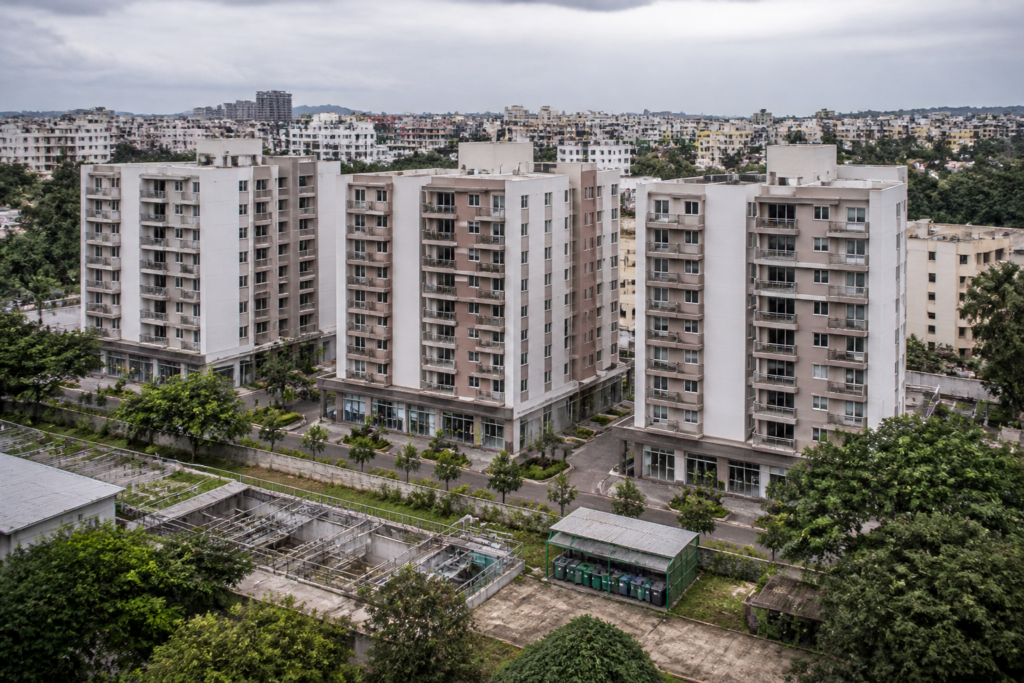
The National Green Tribunal’s cancellation of the environmental clearance for Pune’s Shubh Gateway project has exposed a serious gap between regulatory approval and construction on the ground. The Viman Nagar residential and commercial development had already been substantially built, occupied and put into commercial use when the tribunal found that the environmental impact assessment submitted for its clearance did not address the mandatory conditions set out in its terms of reference.
The order does not merely reopen the question of whether the project should receive environmental clearance. It also places the functioning of Maharashtra’s environmental appraisal system under scrutiny. The Maharashtra State-Level Environment Impact Assessment Authority has been directed to reconsider the developer’s application and take a fresh decision within two months from the date on which the judgment was uploaded. For residents and shopkeepers already using the project, the decision creates a difficult administrative situation: the buildings exist and are occupied, but the clearance supporting the project has been set aside.
The case arose from an appeal filed by Pune environmental activist Tanaji Balasaheb Gambhir. The Western Zone Bench of the NGT, comprising judicial member Justice Dinesh Kumar Singh and expert member Dr Sujit Kumar Bajpayee, delivered the decision on 8 October. The project was developed by Shubh Landmarks at Survey Nos. 227/1 to 17, Plot Nos. 1 and 2, in Viman Nagar.
The central issue was not simply the size or location of the development. It was the quality and completeness of the environmental assessment on which the approval rested. According to the report on the tribunal’s decision, the project’s 28-page EIA did not provide point-by-point responses to the conditions and requirements included in the approved terms of reference. The NGT observed that environmental impact assessment cannot be treated as a formal exercise. The competent authority must be able to verify whether every condition in the terms of reference has been addressed.
That observation goes to the heart of how environmental regulation is meant to operate in expanding urban areas. An EIA is intended to create an evidence base for decision-making before, or while, a project is assessed for its environmental consequences. If the report does not systematically answer the questions set by the regulator, the authority’s ability to evaluate water, waste, pollution, traffic, natural-resource and restoration impacts is weakened. In this case, the tribunal held that the deficiencies affected the foundation of the clearance decision itself.
The project’s regulatory history makes the matter more complicated. An environmental clearance had earlier been granted on 26 March 2019 for a built-up area of 45,141.56 square metres. The report says that SEIAA later found that construction had been carried out differently from the plan described in the earlier approval. The proposal was therefore treated as a violation case under the Environment Impact Assessment Notification, 2006.
The developer applied in January 2023 for terms of reference under the violation category. SEIAA finalised the terms of reference in April 2023. The developer subsequently submitted an EIA report, an environmental management plan, an environmental damage assessment and a remediation plan as part of its application for environmental clearance. The February 9, 2024 clearance was then granted, but the NGT concluded that it could not survive judicial scrutiny because the assessment on which it relied was inadequate.
This sequence shows why the case matters beyond one project. The approval process was not dealing with an undeveloped site awaiting permission. It was dealing with a project where the regulator had already identified construction that differed from the earlier sanctioned plan. That placed greater importance on a complete assessment of the actual environmental damage, the remedial obligations and the conditions required for continued occupation and operation.
The NGT specifically noted that the cost of environmental damage and the natural-resource augmentation plan recorded in the proceedings of the State Expert Appraisal Committee were not included in the EIA report. These omissions meant that the report did not fully incorporate material information already identified during the appraisal process. The tribunal consequently found that the approval granted in February 2024 was based on an insufficient assessment.
The project’s physical status adds a significant citizen-impact dimension. A Maharashtra Pollution Control Board inspection conducted on 5 September 2025 found that Buildings A, B, C and D had been completed. Each building had a basement, a ground floor and 12 floors above it. Residents were living in the buildings, the clubhouse had been completed and commercial shops were operating.
The inspection also recorded environmental infrastructure at the site. A sewage treatment plant with a capacity of 220 cubic metres per day was operational, as was an organic waste-processing machine with a capacity of 550 kilograms per day. These facilities indicate that the project had moved into an operating phase rather than remaining a proposal on paper. However, the presence of functioning infrastructure does not resolve the tribunal’s concern about whether the project was properly assessed and whether the environmental damage and restoration obligations were adequately calculated.
This distinction is important in urban governance. Compliance equipment can show that a project has installed particular systems, but it does not by itself establish that the project’s total environmental impacts were assessed correctly. A sewage treatment plant addresses one part of urban environmental management. It does not automatically answer questions about the original deviation from the approved plan, cumulative construction impacts, resource use, site conditions or the cost of restoration. The tribunal’s decision, as reported, centres on the adequacy of the assessment that should have brought these issues together for regulatory scrutiny.
The case also illustrates the tension created when enforcement follows construction instead of preceding it. Once homes are occupied and shops are open, regulatory action affects people who may not have been involved in the original approval or construction decisions. Residents may have purchased or occupied units believing that the required permissions were in place. Commercial occupants may have begun operations. At the same time, regulators and courts cannot treat occupancy as a substitute for lawful environmental appraisal.
That tension is visible in the tribunal’s remedy. The clearance has been cancelled, but the authority has not been directed simply to ignore the project’s existing condition. Instead, SEIAA must reconsider the application and issue a fresh decision within a defined period. The renewed process will have to address the defects identified in the judgment, including the failure to respond point by point to the terms of reference and the absence of the environmental-damage cost and natural-resource augmentation plan in the EIA report.
The institutional chain involved in the case is equally significant. SEIAA granted the clearance, the State Expert Appraisal Committee’s proceedings contained findings relevant to environmental damage and resource augmentation, the Maharashtra Pollution Control Board inspected the completed project, and the NGT reviewed the legality of the clearance after an appeal by an environmental activist. Each institution dealt with a different part of the project’s regulatory life cycle. The case shows how weaknesses at one stage can become difficult to correct once construction and occupation have advanced.
For urban residents, environmental clearance is often experienced as an abstract approval attached to a large project. In practice, it is part of the system that is expected to connect construction activity with public infrastructure and environmental safeguards. A mixed-use development adds pressure through residents, workers, visitors, sewage generation, solid waste and traffic. The reported capacities of the STP and organic-waste plant provide operational details, but the tribunal’s findings indicate that such details must be assessed within a complete and transparent environmental framework.
The Shubh Gateway matter therefore raises a broader question about the credibility of violation-case assessments. When a project is found to differ from an earlier approval, the subsequent assessment must do more than regularise a completed structure. It must establish what changed, identify the resulting environmental consequences, quantify damage where required, and specify how remediation and future compliance will be enforced. The NGT’s reasoning, as reported, suggests that a short report without a point-by-point response cannot provide that foundation.
The evidence currently available establishes three connected facts: the project had an earlier clearance for a specified built-up area; SEIAA later treated the changed construction as a violation case; and the NGT cancelled the subsequent clearance because the EIA did not adequately address the mandatory terms of reference and related environmental findings. It also establishes that the project was completed and occupied by the time of the MPCB inspection. The future legal and operational position of the residents, shops and developer will depend on SEIAA’s fresh decision and on how the identified deficiencies are addressed.
The next test is therefore administrative, not rhetorical. SEIAA must reconsider the application within the tribunal’s stipulated two-month period. That process will determine whether a complete assessment can now be produced, whether the project’s environmental damage and restoration obligations are properly accounted for, and whether the development can secure a renewed clearance. Until then, the Shubh Gateway case remains a pointed example of how weak documentation can undermine an approval even after a city project has moved from paper to lived reality.


