

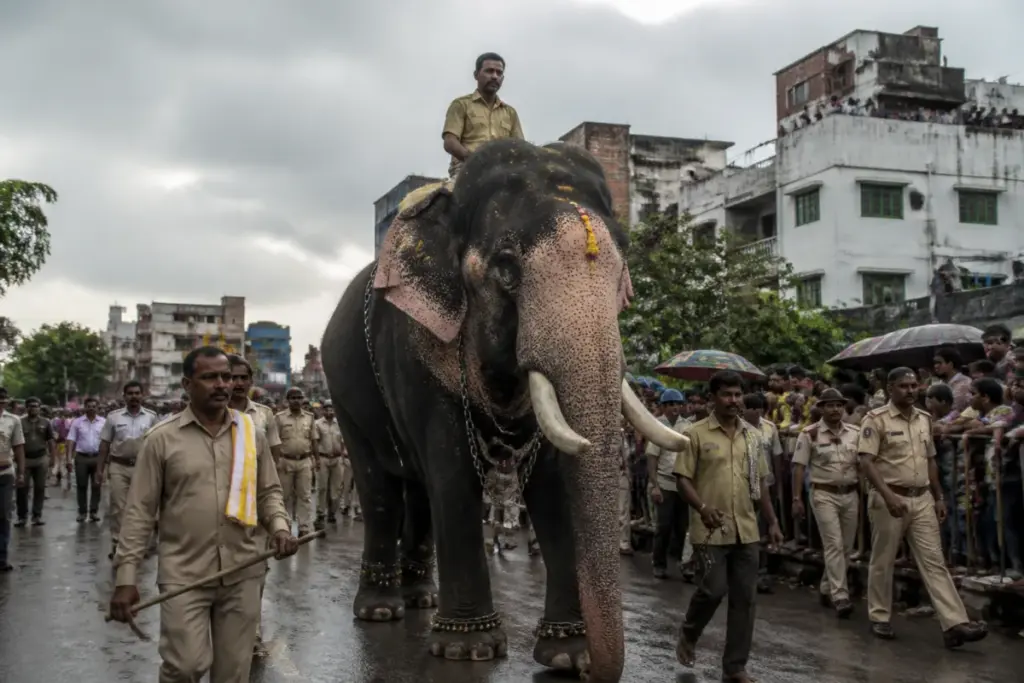
The Shivamogga Dasara elephant incident has turned a ceremonial procession into a test of how cities manage public spectacles involving large captive animals. Somanna, a 36-year-old elephant carrying the idol of Goddess Chamundeshwari, bolted minutes after the Jamboo Savari began on Kote Road, damaging a car and two two-wheelers before forest officials and mahouts brought him under control. No person was injured, but the event exposed a gap between the scale of the procession and the preparation reported to have preceded it.
The incident took place after Somanna had walked about 750 metres and reached Vithal Mandir. Residents cited in the report said the elephant began running backwards, while the silver howdah tied to his back slipped off and broke into pieces. Shivamogga Circle Chief Conservator of Forests Hanumantappa K T said the road widened at that point, with a large crowd and significant noise. The official said it appeared that Somanna panicked and returned along the same route.
The immediate response was operational rather than preventive. Forest officials and mahouts controlled the elephant, after which officials tranquillised him and led him to the premises of the Kote Anjaneya Swamy Temple. The absence of human injuries limited the immediate consequences, but the damaged vehicles and the howdah showed how quickly a ceremonial route can become a public-safety risk when a large animal reacts unpredictably in a dense urban setting.
## A week of training for a first-time role
The most important institutional detail is that Somanna was making his debut as the elephant carrying the howdah. Officials said Somanna, Bahadur and Sagar had recently been brought from Sakrebailu Elephant Camp and had practised for the event for about a week. Sagar had carried the howdah in earlier years, but officials said he was not comfortable carrying its weight during training. An expert committee comprising mahouts, forest officials and other experts then selected Somanna.
That decision is central to understanding the incident. Somanna was not simply participating in a familiar route; he was being introduced to a new role in a noisy public procession. The official account said everything was new to him and that he appeared to have been frightened. The same account acknowledged that the training period was not sufficient for the elephants to understand the conditions of the event.
The comparison with Mysuru Dasara, made by a forest official, is revealing. Officials said elephants for that procession arrive at least two months before practice, while preparation in Shivamogga takes place for about a week. The comparison does not establish that a longer training period would have guaranteed safety. It does, however, show that the administration itself recognises a difference in preparation between an established event and the Shivamogga procession.
## Replicating a spectacle without replicating its preparation
Shivamogga has held the Jamboo Savari for more than eight years, according to the chief conservator. The event therefore has institutional continuity, but continuity alone does not make every edition equally prepared. The decision to use a different elephant for the howdah-bearing role changed the risk profile of the procession, even though the broader ceremony may have followed an established format.
This is the structural question raised by the episode: can a city reproduce the visible form of a major cultural procession without reproducing the preparation, route management and animal-handling systems required for it? A ceremonial event may appear routine to spectators and organisers, but the conditions experienced by an elephant can change with the animal, the load, the route, the crowd and the noise.
The report does not provide details of the event’s crowd-control plan, route barricading, emergency evacuation arrangements or the criteria used to assess Somanna’s readiness. It also does not establish whether alternative arrangements were available if the selected elephant could not safely carry the howdah. These gaps do not prove that such measures were absent. They show, instead, that the public account remains focused on the incident after it occurred rather than on the systems that were meant to prevent it.
For urban governance, this distinction matters. Safety is not limited to the moment when officials regain control of an animal. It includes the selection process, rehearsal conditions, route design, crowd separation, traffic management and a clear decision on whether the procession should proceed when preparation is limited. The reported damage to vehicles suggests that the route remained exposed to surrounding traffic and property when the elephant panicked.
## The city-level responsibility
The episode also illustrates how responsibility for public events is distributed across institutions. Forest officials, mahouts, an expert committee and local event authorities were all involved in bringing the elephants to the procession and selecting the animal for the howdah. The report identifies the expert committee’s composition, but it does not describe its written assessment, safety threshold or accountability if conditions changed during the event.
That institutional chain is significant because large public events are rarely governed by one decision alone. An elephant may be selected by specialists, placed on a route managed by local authorities and watched by a crowd whose size and behaviour can alter conditions. If an incident occurs, the public sees the result, but the underlying decisions are spread across departments and operational teams.
The Shivamogga incident therefore raises a governance issue without requiring a conclusion about individual culpability. A committee can make a decision that appears reasonable during training and still face a different reality once the procession begins. The question for future events is whether the system allows officials to stop, alter or redesign the procession when the animal’s behaviour or crowd conditions indicate that the original plan is no longer safe.
The report also records public criticism of using elephants in crowded urban events. Some users on X called for an end to the practice and argued that captive elephants are subjected to abuse. Another post said that parading elephants in crowded towns placed both animals and the public at risk. These views are allegations and opinions from social media users, not an independent finding about Somanna’s treatment. They nevertheless show that the incident has widened the debate from one frightened elephant to the legitimacy and safety of the event format itself.
## What the available evidence confirms
The available evidence establishes several facts. Somanna carried the howdah during the opening of the Jamboo Savari, panicked after about 750 metres, moved backwards, and caused the howdah to fall apart. A car and two two-wheelers were damaged, no injuries were reported, and officials later tranquillised and secured the elephant. Somanna was new to the role, and the elephants had trained for about a week.
The evidence also records an official explanation linking the panic to a widened road, a large crowd and noise. It does not establish whether one factor alone caused the reaction. Nor does it provide an independent veterinary assessment of Somanna’s condition after the incident, a full account of the crowd-management system or a formal review of the committee’s decision.
That limitation should shape the next stage of reporting. The event is not only about whether an animal was eventually brought under control. It is about whether the city’s planning and administrative systems were designed around the possibility that control could be lost in a crowded public space.
The reported comparison with Mysuru offers a possible benchmark for preparation, but it should not be treated as proof that one city’s model can simply be transferred to another. Shivamogga’s event has its own route, crowd conditions, institutional arrangements and history. What the episode makes clear is that an established tradition still requires event-specific assessment whenever the animal, role or operating conditions change.
The immediate next step should be a documented review of the incident, including the selection of Somanna, the adequacy of the training period, the route conditions at Vithal Mandir, the crowd and traffic arrangements, and the animal’s post-incident health. Until those details are made available, the Shivamogga Dasara elephant incident remains both a narrow operational failure and a wider warning about how urban celebrations manage risk when cultural spectacle, public space and animal welfare meet.


