

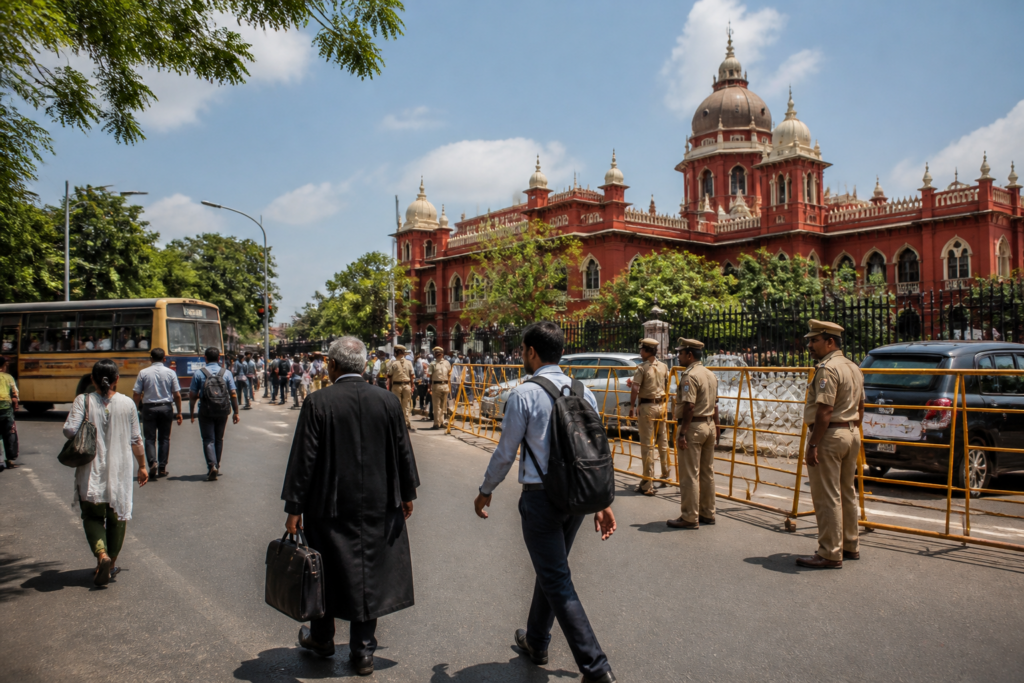
The High Court in Chennai has questioned the Tamil Nadu government’s repeated refusal to permit RSS processions across the state, asking whether holding a procession could be treated as an anti-national act and urging both sides to seek a practical settlement.
The observations came during a hearing on a petition filed on behalf of RSS state secretary Jagadeesan. The petition seeks directions allowing the organisation to conduct processions across Tamil Nadu. The matter was heard by Justice Lakshmi Narayanan on October 14, according to Dinamalar – Tamil Nadu.
During the hearing, the judge questioned why permission was being denied in Tamil Nadu when RSS processions are permitted even in Jammu and Kashmir, which the court referred to as an area with a strong presence of terrorist groups. The judge also observed that the organisation has had to approach the courts each time it seeks permission, regardless of which political party is in power in the state.
The court’s remarks, as reported by the source, extended beyond the RSS petition. The judge said that permission was denied not only to the RSS but also to other parties or organisations seeking to conduct processions. The observation places the dispute within a wider question about how public authorities regulate assemblies and processions on public roads.
Tamil Nadu government counsel Vijay Narayanan told the court that permission had been refused because processions during festival periods could cause inconvenience to members of the public. The government’s position therefore centred on managing disruption and protecting ordinary public movement during periods when roads and public spaces may already face additional pressure.
The judge did not accept that explanation at this stage and questioned whether conducting a procession could amount to an anti-national activity. The court also observed that denying permission could lead to unnecessary litigation and create negative publicity for the police. The comments were made during the hearing and do not amount to a final ruling on the petition.
The court directed representatives of the RSS and the government to hold discussions and attempt to reach an amicable solution. That direction leaves the immediate administrative question—whether, where and under what conditions the proposed processions can be held—to discussions between the organisation and the state authorities.
The case has been adjourned to the following day. The next hearing is expected to indicate whether the parties have reached a settlement or whether the court will issue further directions on the permissions sought by the RSS.


