

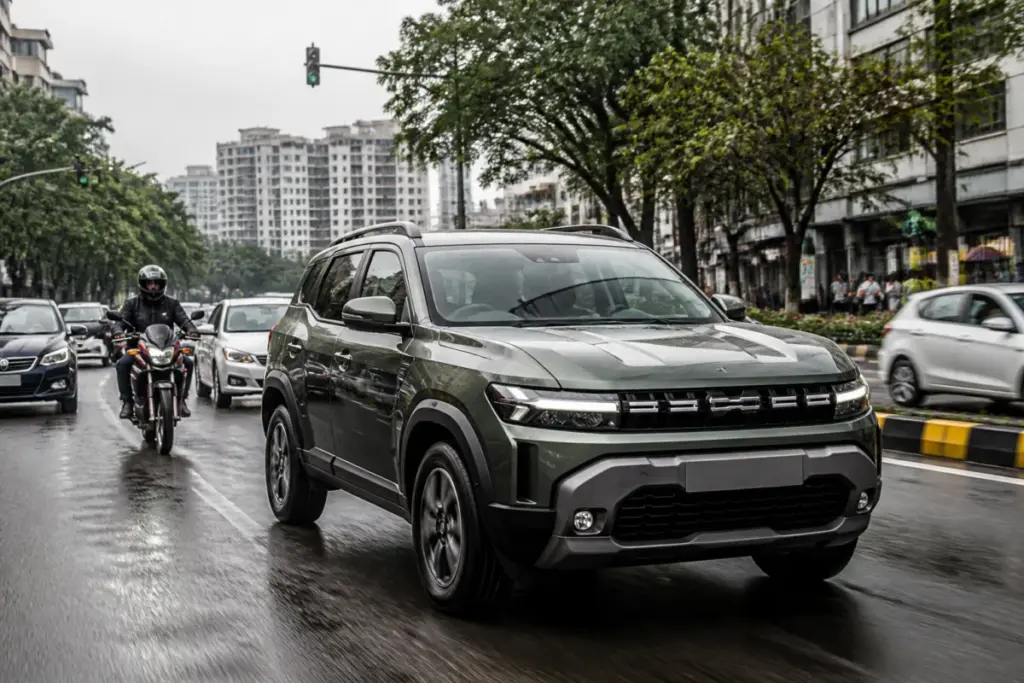
Renault’s Duster Strong Hybrid E-Tech 160 has entered India at a moment when urban car buyers are being asked to move away from diesel without necessarily being ready for a fully electric vehicle. Priced from ₹16.99 lakh and carrying a claimed mileage of 29 km/l, the hybrid SUV is Renault’s attempt to occupy the increasingly important middle ground between conventional internal-combustion vehicles and battery-electric cars.
That positioning gives the launch significance beyond one model. India’s strong-hybrid passenger-vehicle market is estimated at 1.23 lakh units in FY26, while registrations rose 9.5 per cent to 86,403 units during January–September 2026 from 78,881 in the same period a year earlier, according to vehicle-registration data cited in the report. The category remains small within the overall passenger-vehicle market, but its growth shows that fuel efficiency is becoming a more visible factor in urban vehicle purchasing.
The Duster’s challenge is to turn that interest into sustained demand. Renault’s retail market share remains below 1 per cent, leaving the company to compete against Toyota and Maruti Suzuki, whose hybrid SUVs have stronger dealership networks and established customer loyalty. The Duster therefore arrives with a technical proposition that is stronger on paper than its market position suggests, but with a retail and service infrastructure that the company itself acknowledges needs improvement.
## The price-efficiency equation
The Duster Strong Hybrid begins at ₹16.99 lakh, placing it ₹31,000 above the entry-level Maruti Suzuki Grand Vitara Strong Hybrid, priced at ₹16.68 lakh. It is also broadly aligned with Toyota’s Urban Cruiser Hyryder Strong Hybrid, which is priced at approximately ₹16.81 lakh to ₹17.18 lakh. This puts Renault directly into a comparison set that already has established products and consumer recognition.
Renault’s answer is performance and claimed efficiency. The Duster uses a 1.8-litre petrol engine and a dual-motor system producing 160 PS. The 1.5-litre hybrid systems in the Grand Vitara and Urban Cruiser Hyryder produce 116 PS. Renault also claims mileage of 29 km/l, compared with 27.97 km/l for the two rival models cited in the report.
The Duster’s 1.4-kWh battery is designed to support electric-only operation for up to 80 per cent of city driving time, depending on conditions. That feature is particularly relevant to urban users, whose driving often involves repeated braking, short trips and congested traffic. However, the stated operating share is conditional, and the supplied information does not establish how the vehicle will perform across different traffic conditions, driving styles or road environments.
This distinction matters because urban fuel economy is not determined only by the powertrain. It is shaped by congestion, trip length, driving patterns, road quality and the availability of reliable service. The Duster’s technical specifications may improve its appeal, but the final purchase decision will also depend on whether buyers trust the technology and can maintain it without excessive cost or inconvenience.
## The post-diesel transition
Renault Group India Chief Executive Officer Stéphane Deblaise said after the launch that the hybrid would expand the Duster’s customer base beyond its petrol variants and enable the company to compete more directly for diesel SUV buyers. The company is positioning the strong hybrid as an alternative for consumers who continue to value fuel efficiency but may not be ready to shift immediately to battery-electric vehicles.
That argument reflects a practical transition problem in urban mobility. Consumers do not change vehicle technologies overnight, particularly when the replacement technology requires new ownership habits, different service capabilities or greater confidence in charging access. The supplied report quotes Deblaise as saying that consumers could not move overnight from internal-combustion vehicles to battery-electric cars. Renault is therefore treating hybrids as an intermediate technology rather than as a final destination for the passenger-vehicle market.
The approach also aligns with the structure of India’s existing vehicle market. Petrol, CNG, strong-hybrid, diesel and electric vehicles are competing simultaneously, with different products serving different combinations of price, range, operating cost and infrastructure access. Renault’s seven-model roadmap through 2030 spans petrol, CNG, strong-hybrid and electric vehicles across two platforms, indicating that the company is not relying on a single technology to rebuild its position.
The roadmap includes the sub-four-metre Bridger SUV, expected in late 2027, followed by an electric model expected in 2028. At the same time, Renault has clarified that it has no immediate plans to introduce the Duster’s hybrid system in smaller models such as the Kwid, Triber and Kiger. According to Deblaise, adapting the technology to those vehicles would require significant engineering and packaging changes.
## Infrastructure is part of the product
For urban consumers, the ownership proposition does not end at the showroom. Hybrid maintenance, battery reliability, spare-parts pricing and service accessibility can influence adoption as much as claimed mileage. These concerns are especially important for a manufacturer with a smaller retail footprint, because customers may judge the technology through the reliability and reach of the service network supporting it.
Deblaise acknowledged gaps in Renault’s service infrastructure and parts pricing during the post-launch interaction. The company is examining additional localisation opportunities while strengthening existing facilities and dealer training. This acknowledgement gives the launch a second institutional dimension: Renault is not only introducing a new powertrain, but also attempting to build the operational system needed to support it.
Localisation is central to that effort. Renault is targeting up to 90 per cent localisation across future product programmes to improve cost competitiveness. The company has also outlined an ambition of €2 billion in annual exports by 2030, covering vehicles, components and engineering services. These targets connect the Duster launch to a broader manufacturing and supply-chain strategy rather than treating the vehicle as an isolated product introduction.
However, the information supplied does not establish how quickly localisation will reduce spare-parts costs or expand service coverage. Nor does it provide comparative data on maintenance expenses between the Duster and competing hybrids. Those remain practical questions for buyers and for Renault’s ability to convert technical claims into long-term confidence.
## A small category with strategic importance
The strong-hybrid market’s estimated size of 1.23 lakh units in FY26 and the 9.5 per cent rise in registrations during the first nine months of 2026 indicate growth, but not mass adoption. The category remains a small part of India’s passenger-vehicle market. That creates a difficult operating environment for manufacturers: the technology must be visible and differentiated, yet volumes may not immediately justify the same scale of ecosystem investment as more established powertrains.
Toyota and Maruti Suzuki have an advantage because their hybrid SUVs already provide a reference point for buyers. Their products also benefit from stronger dealership networks and customer familiarity. Renault’s Duster must therefore compete on more than price. Its 160 PS output, 29 km/l claimed mileage and electric-only city-driving capability provide measurable points of distinction, but those features must be supported by confidence in service, parts and resale value.
The Duster’s arrival could also widen the definition of what urban SUV buyers consider an alternative to diesel. Instead of choosing only between petrol and diesel, buyers increasingly face a range of powertrain options, each linked to different expectations about running costs, environmental performance and convenience. Strong hybrids are attempting to capture consumers who want improved efficiency without depending entirely on charging infrastructure.
That does not resolve the larger urban mobility questions. A more efficient SUV can reduce fuel use relative to a less efficient vehicle, but the supplied material does not quantify the Duster’s lifecycle emissions, total cost of ownership or effect on congestion and road demand. The launch should therefore be understood as a market and technology shift, not as a complete solution to the challenges created by car-dependent urban growth.
## The test Renault must pass
Renault’s immediate test is whether the Duster can overcome the gap between product capability and institutional reach. Its pricing is close to established hybrid competitors, while its claimed efficiency and power output are stronger on paper. But the company enters with less than 1 per cent retail market share and has identified service infrastructure, parts pricing and dealer training as areas requiring attention.
The outcome will depend on whether urban buyers treat the Duster’s hybrid system as a credible ownership proposition rather than simply an attractive specification sheet. The next signals to monitor are sustained sales, the expansion of service capacity, progress on localisation and Renault’s ability to execute the wider seven-model roadmap. The launch confirms that strong hybrids are gaining a larger role in India’s transition debate; it does not yet establish whether they can move beyond a growing niche into mainstream urban mobility.


