

An Income Tax Appellate Tribunal ruling in Mumbai has highlighted a significant tax question for homeowners whose flats are replaced through society redevelopment: whether the holding period begins when the new flat is formally allotted or continues from the date the original property rights were acquired. In the case reported by the Times of India, the tribunal treated the redeveloped flat as a continuation of the homeowner’s original ownership rights and allowed relief against a Rs 80.14 lakh tax addition.
The dispute arose after a Mumbai resident sold a redeveloped flat for Rs 1.95 crore, eight days after signing an Agreement for Permanent Alternate Accommodation in 2018. The homeowner had originally purchased a 510-square-foot flat in a housing society during financial year 2006-07 and lived there with his wife. Several years later, the society entered into a redevelopment agreement with a builder, under which he was allotted a replacement flat in the same society.
The replacement home had 30% more carpet area than the original flat. The redevelopment arrangement also included 185 square feet transferred by the homeowner’s mother and another 55 square feet purchased from the developer for Rs 6 lakh. The homeowner subsequently sold the redeveloped flat and invested the entire Rs 1.95 crore sale consideration in another residential flat at a different location.
He classified the gain as long-term capital gains and claimed exemption under Section 54F of the Income Tax Act. The Assessing Officer rejected that treatment. The tax department viewed the transfer of rights in the original flat to the developer and the allotment of the redeveloped flat as separate transactions. On that reasoning, the redeveloped flat was treated as a new asset acquired when the Permanent Alternate Accommodation Agreement was signed.
Because the flat was sold eight days after that agreement, the resulting gain was classified as short-term capital gains. The Assessing Officer also denied indexation and added Rs 80.14 lakh to the homeowner’s taxable income, representing his 50% share of the short-term capital gains. The Commissioner of Appeals upheld the assessment before the matter reached ITAT Mumbai.
The tribunal ruled in the homeowner’s favour on July 16, 2026. According to the account published by the Times of India, ITAT Mumbai held that redevelopment does not generally terminate an existing owner’s property rights and replace them with ownership of an entirely new capital asset. Instead, the rights can continue through the redevelopment process and be substituted from the old premises to the newly constructed one.
This distinction is important because the execution of a Permanent Alternate Accommodation Agreement can appear, on paper, to be the moment when a new flat is formally identified. The tribunal’s reasoning, as described in the report, was that the agreement recorded and specified permanent alternate accommodation to which the homeowner was already entitled under the redevelopment arrangement. It did not necessarily create ownership rights for the first time.
Chartered Accountant Suresh Surana, cited by the Times of India, said the holding period should be calculated from the date on which the taxpayer acquired enforceable rights over the property, rather than automatically from the date of the Permanent Alternate Accommodation Agreement or a later conveyance document. In this case, those rights originated in 2006 and continued during the redevelopment process.
The tribunal also considered an alternative calculation based on the development agreement dated February 15, 2013. Even under that approach, the homeowner had held the property for nearly five years before selling it on January 20, 2018. The report states that this was longer than the applicable 24-month period for long-term treatment of the asset.
The case demonstrates why redevelopment taxation cannot be understood only by looking at the date printed on the final agreement for the replacement flat. A society redevelopment project involves several legal and administrative stages: the original purchase, the society’s development agreement with a builder, the owner’s continuing rights during construction, the allotment of permanent alternate accommodation and, eventually, possession or transfer documentation.
Each stage can carry a different meaning. The tax department’s original position focused on the formal replacement of the old flat with a new property. The tribunal instead examined the continuity of the ownership rights behind the transaction. That approach placed greater weight on the redevelopment arrangement and the enforceable rights created under it, rather than treating the replacement flat as an asset acquired only when the Permanent Alternate Accommodation Agreement was executed.
The details of the additional area were also relevant. The homeowner received 30% additional carpet area without cost, 185 square feet transferred by his mother and 55 square feet purchased from the developer for Rs 6 lakh. Despite these different components, the tribunal ruled that the portions of the redeveloped flat could not automatically be treated as separate capital assets merely because the owner received extra space or purchased additional area as part of the redevelopment arrangement.
The ruling also dealt with the relationship between redevelopment and Section 56(2)(x). The Assessing Officer had accepted that this provision did not apply to the transaction because the homeowner received the redeveloped flat under the redevelopment arrangement. However, the tax assessment still treated the replacement flat as a newly acquired asset for the purpose of calculating capital gains. The tribunal rejected that separation in its treatment of the holding period.
For homeowners, the institutional lesson is that tax outcomes may depend on the documentary chain establishing when property rights arose and how those rights continued through redevelopment. The original purchase documents, society resolutions, development agreement, allotment terms, Permanent Alternate Accommodation Agreement and records relating to additional area can all become relevant to the characterisation of the transaction.
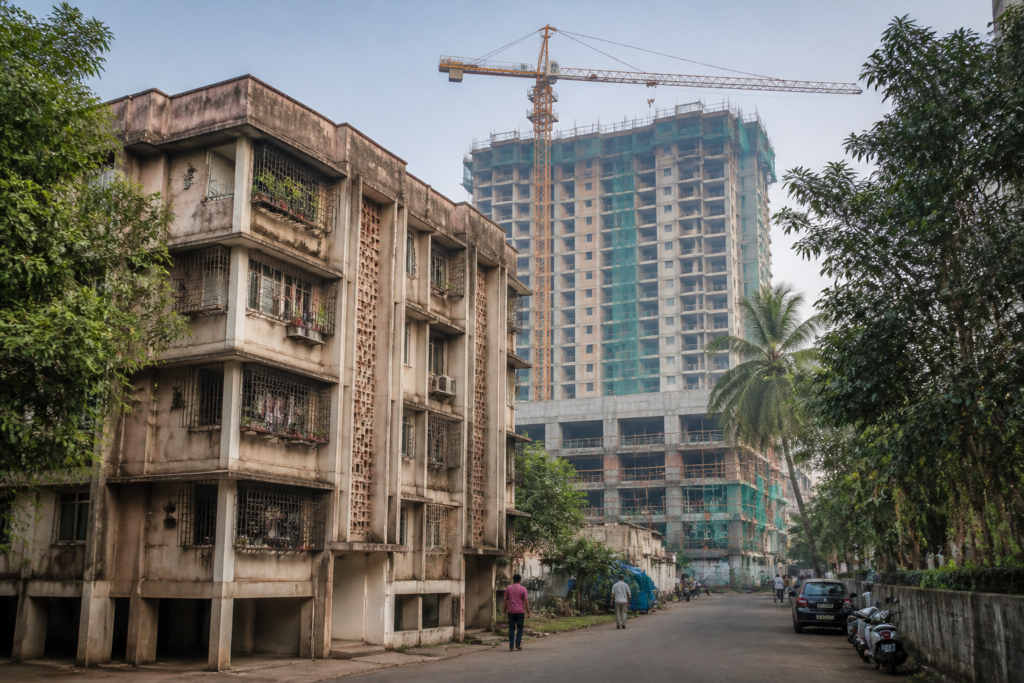
The case also reflects a wider feature of urban redevelopment in Mumbai and other Indian cities. Redevelopment is not simply a construction exercise in which one structure is demolished and another is built. It is a legal and financial transition in which existing residents exchange occupation of an old building for rights in a future building. The replacement home may have a different area, a different configuration and a later possession date, while the underlying ownership relationship with the society continues through the project.
That institutional structure creates recurring questions about taxation, documentation and the timing of rights. A homeowner may remain connected to the original property for years while construction is delayed, agreements are revised or possession is postponed. A formal document signed near the end of that process may not, by itself, capture the entire history of the ownership relationship.
ITAT Mumbai ultimately treated the Rs 1.95 crore gain as long-term capital gains, allowed relief under Section 54/54F and set aside the Rs 80.14 lakh addition. The ruling, as reported, does not mean that every sale of a redeveloped flat will automatically qualify for the same treatment. Its reasoning turned on the facts of the case, including the original purchase, the redevelopment arrangement, the continuity of enforceable rights and the tribunal’s interpretation of the additional area.
The immediate significance of the decision is therefore narrower but important: a replacement flat created through society redevelopment may be treated as a continuation or substitution of existing ownership rights rather than an entirely new capital asset acquired on the date of a permanent alternate accommodation agreement. The precise documents and facts of each redevelopment transaction will remain central to determining its tax treatment.


