

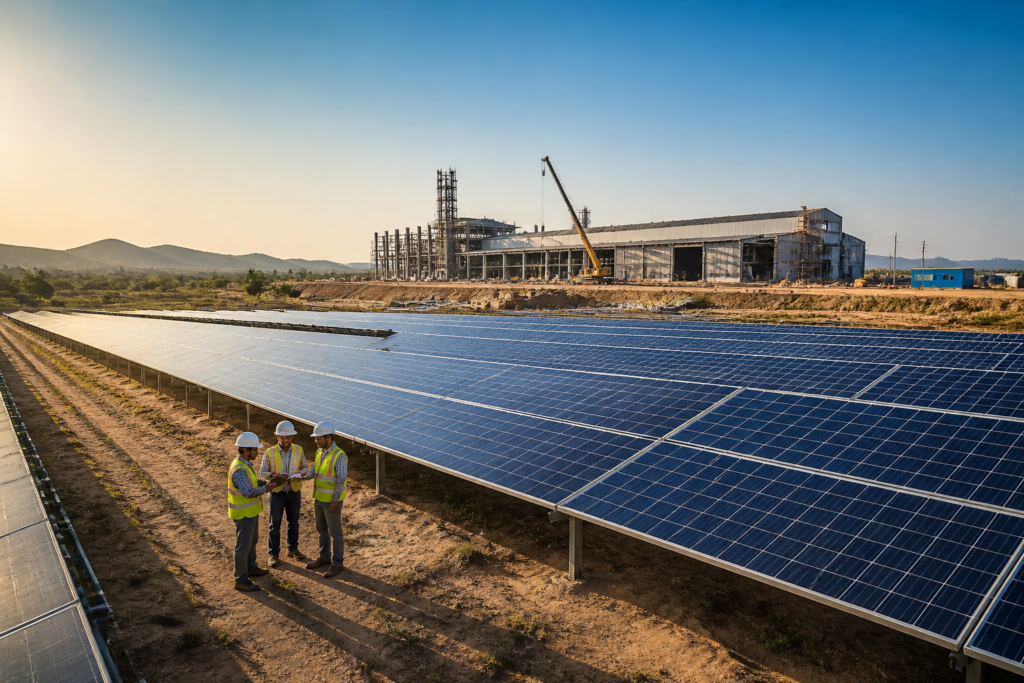
Rajasthan’s industrial growth is gaining momentum in solar energy, garments, education and technology, business leaders said at the Panchayat Aaj Tak Rajasthan programme, pointing to rising investment, local hiring and improving policy support across the state.
Ravi Verma, senior executive vice-president at Avaada Group, said the company had commissioned 2,000 megawatts of capacity in Rajasthan and that work on another 2,000 megawatts was progressing. He said the company’s workforce was largely young and that solar projects in rural areas were creating employment for local residents.
According to Verma, Rajasthan’s expanding education ecosystem, improving policies and growing industrial activity could make the state a stronger destination for companies in the coming years. His comments placed renewable energy at the centre of the state’s emerging industrial opportunity, particularly in rural areas where large solar plants are being developed.
Puneet Talesara, founder and chief executive officer of ONEPWS Private Limited, said entrepreneurs needed to learn from failed ideas rather than treat failure as a reason to stop. He said Rajasthan now had the facilities required for businesses and that government support could assist companies, but could not run their businesses for them.
Talesara also argued that digital connectivity had reduced the importance of location for some businesses, making it possible for companies to operate from different parts of the country. He identified tourism, Bhilwara’s industrial base and Kota’s education sector as established strengths for Rajasthan, while noting that solar panels were also being manufactured in the state.
Garment manufacturing was another area highlighted during the discussion. Mudeet Samdariya, director of Surya Jyoti Cotex, said Ahmedabad and Surat were facing worker shortages, while Rajasthan had a larger available workforce. He said factories could train people locally and provide employment closer to their homes, reducing the need for workers to migrate for jobs.
Samdariya said textile activity was gradually expanding across several districts and that the Rajasthan government was offering incentives to the sector. He added that greater cooperation between the government and private companies could make industrial targets easier to achieve.
Gaurav Kumar, founder and chief executive officer of LeadRx Technologies, said Rajasthan had become a more attractive business location compared with earlier decades. He said people who had moved out of the state had largely done so around 50 years ago, while new factories were now being established within Rajasthan.
Kumar also said industrial growth would be influenced by the state’s population, which he put at around 8.5 crore. He described the industrial environment as one that was changing gradually and said Rajasthan should develop cities such as Alwar along the lines of Jaipur.
The business leaders said policy announcements alone would not be sufficient to sustain industrial expansion. They stressed that companies would also assess how quickly administrative problems were resolved and whether the local business environment provided reliable facilities and support. The discussion placed the speed of grievance resolution and implementation alongside incentives, workforce availability and infrastructure as key conditions for Rajasthan’s next phase of industrial growth.


