

Rajasthan’s voter registration drive has added 2,40,534 names to the electoral rolls from 7,78,147 applications submitted between October 1 and October 20. The figures show both the reach of the Election Commission of India’s special campaign and the scale of the administrative challenge that followed the deletion of 31.3 lakh names during the state’s Special Intensive Revision, or SIR, process earlier this year.
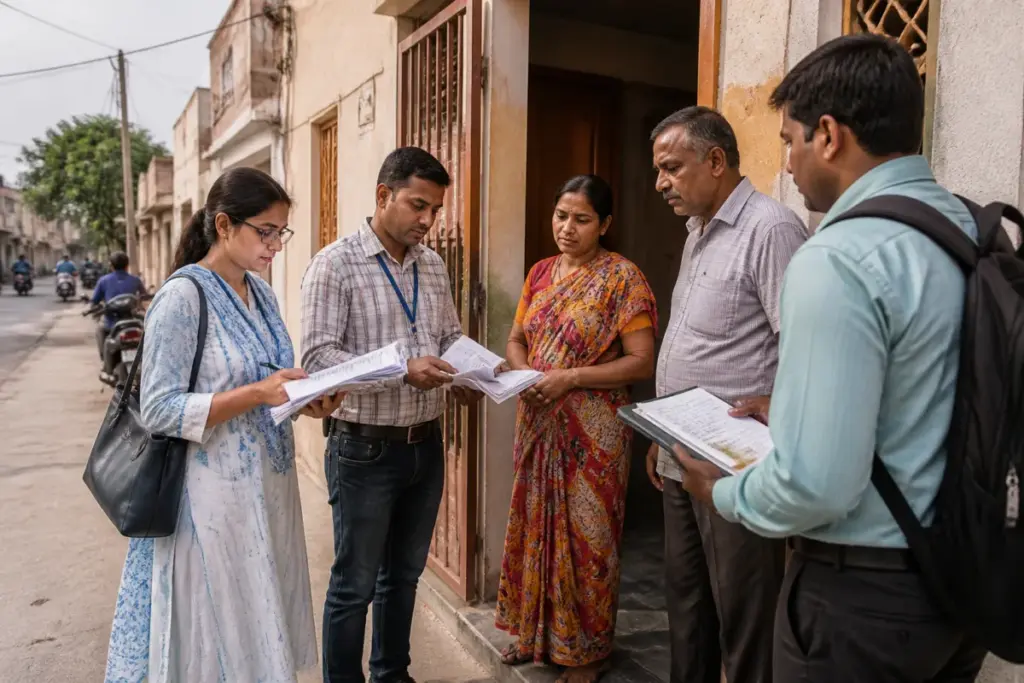
The campaign is aimed at two groups: first-time voters aged 18 and 19, and eligible citizens aged 20 and above whose names were not present on the rolls. According to figures reported by the Times of India, applications from both groups are being processed through a campaign that includes door-to-door visits by Booth Level Officers, or BLOs. The exercise will continue until October 31, although eligible citizens will be able to apply after the special campaign ends.
The numbers are important because they show that voter registration is not only an annual exercise involving young people reaching voting age. It is also a continuing administrative process in which existing citizens can disappear from, and later seek restoration to, the electoral system. Rajasthan’s current campaign is therefore functioning as both a new-enrolment drive and a correction mechanism after the SIR exercise.
The figures also show a substantial gap between applications received and names added. Of the 7,78,147 Form-6 applications received during the first 20 days, 2,40,534 names had been added to the rolls. That means the reported additions represented roughly 31 per cent of applications received in that period. The difference does not, by itself, establish how many applications were rejected, remained under examination, required further documentation or were pending processing. The source report does not provide a district-wise breakdown of these categories.
That distinction matters for understanding administrative performance. A high number of applications indicates demand for enrolment, but it does not automatically translate into a high number of verified voters. Similarly, a large number of deletions during a revision does not, by itself, establish how many removed names belonged to ineligible, duplicate or deceased voters and how many represented eligible citizens who were subsequently left out. The available figures establish the scale of movement in the rolls, but not the reasons for every deletion or the final outcome of every application.
The first-time voter category accounted for 4,30,701 applications between October 1 and October 20. Of these, 1,39,972 names were added. This represents about one-third of applications in the 18–19 age group. The campaign’s focus on this category reflects a predictable demographic requirement: citizens who have recently reached voting age must enter the electoral system before they can participate in elections.
The second category produced a different and more consequential signal. Citizens aged 20 years and above submitted 3,47,446 applications, of which 1,00,562 names were added. These applicants were not simply new 18-year-old voters. They were eligible citizens whose names were absent from the rolls, including people who officials said had been left out during the SIR process.
The addition of names in the 20-years-and-above category suggests that the campaign is addressing a broader problem than first-time enrolment. It is also providing a route for citizens to seek re-entry or inclusion after a large-scale revision. Chief Electoral Officer Naveen Mahajan told the Times of India that the campaign covered both first-time voters and eligible citizens who were not on the rolls. That two-track design is central to understanding the campaign’s institutional purpose.
In practical terms, the campaign places the BLO at the point where electoral administration meets the household. Door-to-door visits can help identify residents who may not have applied independently, particularly those unfamiliar with the process or unaware that their names were missing. At the same time, the reported figures show that household-level outreach must be matched by the capacity to process applications and verify claims within the campaign period.
The role of BLOs is therefore not limited to collecting forms. They are part of a chain involving identification of eligible residents, receipt of Form-6 applications, scrutiny, decision-making and updating of the electoral roll. The supplied report does not provide information on staffing levels, processing timelines, rejection rates or the number of pending cases. Without those details, it is not possible to determine whether the gap between applications and additions reflects normal verification procedures or a capacity constraint.
The district-level pattern adds another layer to the story. Bundi, Bharatpur, Dholpur, Karauli, Alwar, Tonk, Balotra, Churu, Kotputli-Behror and Sawai Madhopur were identified among the leading districts by the percentage of applications processed in the first-time voter category. The report does not provide the underlying district totals or explain whether “processed” means applications disposed of, names added, or applications handled at another stage. The comparison therefore indicates variation in progress but does not allow a complete ranking of district performance.
This is significant for a state with a reported electorate of 5.1 crore. Even a relatively small percentage change in the rolls can affect a large number of residents because the administrative system operates at statewide scale. The 31.3 lakh deletions during the SIR process were equivalent to roughly 6 per cent of the electorate cited in the report. The 2.4 lakh additions recorded during the special campaign amount to less than 1 per cent of that electorate, although the two figures are not directly comparable because the additions are still being processed and may include different categories of voters.
The comparison nevertheless establishes the central institutional question: how does a voter-roll revision protect the integrity of the list while ensuring that eligible citizens are not excluded? The campaign is an attempt to answer that question after the revision by creating a targeted enrolment window. Its effectiveness will depend not only on the number of names added before October 31, but also on how transparently pending and rejected applications are handled and whether eligible residents continue to have accessible routes for correction.
The reported process also illustrates why electoral administration is a form of civic infrastructure. Roads, water systems and public transport are usually understood through physical networks, but democratic participation also depends on an administrative network that identifies residents, records eligibility and maintains reliable public registers. When that network works well, enrolment is routine and largely invisible. When names are deleted or remain absent, the administrative gap becomes a direct barrier between residents and a public institution.
Rajasthan’s campaign shows that inclusion has at least two timeframes. The first is the immediate campaign period, during which officials are visiting households and processing applications. The second is the continuing system after October 31, when eligible residents can still seek enrolment. The existence of a post-campaign route is important because a fixed deadline cannot fully capture population movement, changes in eligibility, documentation delays or citizens who learn about missing names later.
The available evidence does not establish whether the deletions during the SIR were concentrated in particular districts, neighbourhoods or demographic groups. It also does not explain whether applicants face different processing outcomes depending on age, location or documentation. Those unanswered questions limit what can be concluded from the statewide totals. The numbers demonstrate a large administrative response, but they do not yet provide a complete assessment of who was excluded, who has been restored and who remains outside the rolls.
What the figures do confirm is that voter registration demand continued well beyond the conventional first-time enrolment category. Of the 7,78,147 applications received, 3,47,446 came from citizens aged 20 and above. That is nearly 45 per cent of all applications reported during the period. The scale of this group means that electoral-roll management cannot be treated only as a transition for young citizens turning 18. It also requires durable correction systems for adults whose names are missing.
The next administrative milestones are clear. The special campaign will continue until October 31, and the Election Commission’s field machinery will continue processing applications during that period. Citizens eligible to enrol will retain the ability to apply after the campaign concludes. The evidence currently available confirms the size of the application and addition exercise, but a fuller evaluation will require final campaign figures, district-wise outcomes, pending and rejected application data, and an explanation of the deletions recorded during the SIR process.


