

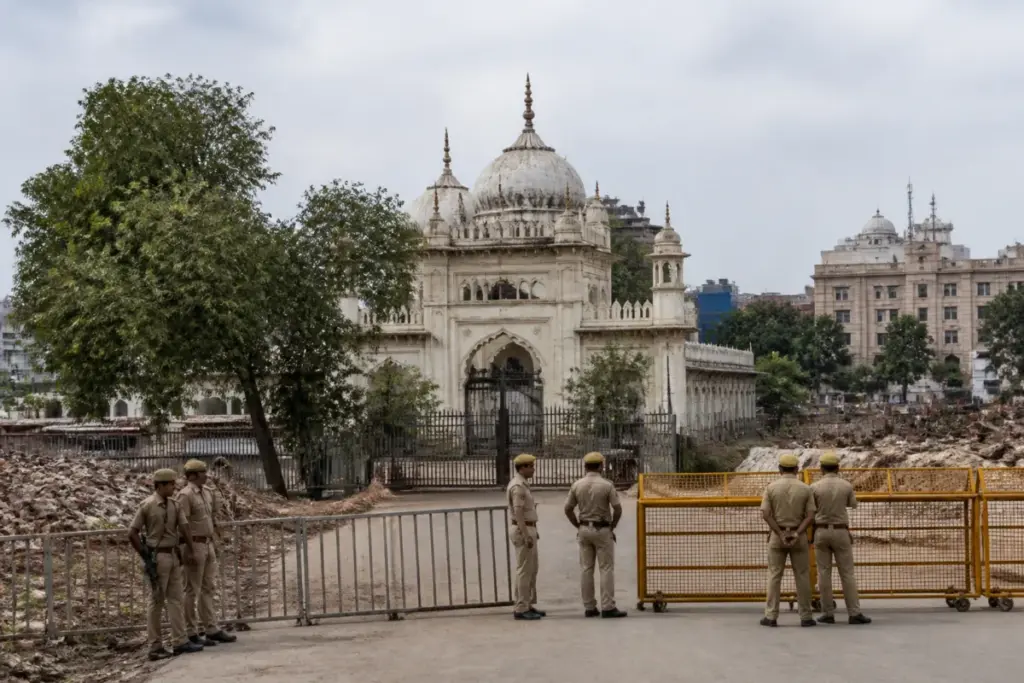
The dispute over the Race Course mosque in central Delhi has brought an important urban governance problem into view: what happens to recognised religious and heritage properties when government agencies clear surrounding settlements from public land. The nearly 300-year-old mosque, according to the Delhi Waqf Board, was left without electricity and water during a demolition drive on October 7, while access to the site was later restricted. The competing accounts around the disconnection, the land’s ownership and the mosque’s future show how quickly a clearance operation can become an institutional dispute.
The Delhi Waqf Board’s concern is not limited to a utility connection. In a letter sent on October 19 to the ministries of minority affairs and home affairs, as well as the divisional commissioner and the New Delhi district magistrate, its chief executive officer, Tanvir Ahmad, sought protection for the mosque and the adjoining qabristan. The board said the two properties together cover two bighas and were notified as waqf properties under a Delhi administration gazette notification dated September 8, 1977.
The board also stated that the mosque was under its direct management and control, with an imam appointed to conduct five daily prayers. It said the mosque had a lawful electricity connection since 1976 and was included at number 22 on the New Delhi Municipal Council’s heritage list. The property has also been registered on the UMEED portal, according to the letter.
These details matter because the site sits inside a much larger government land and redevelopment framework. The 53.2 acres around the location belongs to the Land and Development Office and has been handed over to the Central Public Works Department for maintenance and development. The area was also occupied by jhuggi clusters, including Bhai Ram Camp, Masjid Camp and DID Camp, whose residents were directed to vacate government land and relocate to a Delhi Urban Shelter Improvement Board colony in Savda Ghevra.
The clearance of those settlements is therefore not an isolated demolition action. It is part of a sequence involving land ownership, removal of unauthorised occupation, rehabilitation eligibility and the management of public land by multiple agencies. A joint survey by the L&DO and the Delhi Development Authority in January 2024 examined the rehabilitation of the affected jhuggi-jhopri clusters. A notice issued in October 2025 said residents considered eligible under DUSIB policy had been identified for relocation.
The mosque’s position within that process is the central unresolved issue. The Waqf Board says the electricity and water links were disconnected during the removal of the jhuggis without prior notice or an apparent valid reason. It also alleged that individuals identifying themselves as L&DO officers visited the mosque on October 17 and told the imam to vacate within three days, after which the structure would be removed. Ahmad further confirmed that no demolition order had been served on the mosque, according to the report.
The account from authorities, however, is incomplete rather than definitive. Sources in the Ministry of Housing and Urban Affairs said the L&DO had not issued any notice to the mosque. The NDMC did not respond to questions about the disconnection of power and water. A source cited in the report said the connections were in the imam’s name rather than the Waqf Board’s name, while also stating that entry had been restricted to prevent encroachers from returning after the demolition.
That distinction between the name on a utility connection and the legal or administrative status of a property is significant. In a dense city, electricity and water are not only household services. They are also indicators of whether an institution can continue to function. For a place of worship where an imam conducts five daily prayers, the interruption of basic services can affect routine use even if the structure itself is not demolished.
The reported restrictions on entry add another layer. Maulana MM Haroon Rahi, associated with the mosque, said people were not being allowed to enter the area to offer prayers. During a visit, Times of India found entry restricted and police personnel deployed around the site. Debris from the demolished jhuggis remained near the closed gate. The reported presence of debris and security measures suggests that the immediate operational priority was controlling access to the cleared area, but the available account does not establish how long the restrictions were intended to continue or under whose formal order they were imposed.
This is where Delhi’s fragmented land administration becomes visible. The L&DO controls the land, the CPWD is responsible for maintenance and development, DUSIB is connected to the relocation of eligible residents, the NDMC maintains a heritage list, and the Waqf Board claims management of the mosque and qabristan. The ministries and district administration were also included in the Waqf Board’s request for intervention. Each institution has a defined responsibility, but the episode raises a practical question: which agency must coordinate the protection of a recognised property when another agency is clearing adjacent land?
The source material does not establish that the mosque was demolished or that a formal order for its removal exists. It does establish that the Waqf Board sought urgent protection, that it alleged utilities had been disconnected, that access was restricted according to a mosque representative, and that ministry sources said the L&DO had not issued a notice. These distinctions are essential in a dispute where the status of the structure, the legality of the action and the authority behind it are being contested.
The heritage listing also complicates the public-land clearance question. Inclusion in the NDMC heritage list does not, by itself, resolve land ownership or determine the outcome of a competing claim. But it does indicate that the mosque has been identified within an institutional heritage framework. The Waqf Board’s reference to the 1977 gazette notification and the UMEED registration similarly points to documentary claims that require agencies to establish the property’s status before taking irreversible action.
There is also a wider rehabilitation issue. The notices to residents of the surrounding camps were linked to a policy process under which eligible occupants could be relocated to Savda Ghevra. The source does not provide the number of residents relocated, the number awaiting rehabilitation or the status of the resettlement colony. It does, however, show that the clearance was connected to a long-running land and rehabilitation process rather than a single day’s enforcement activity. The mosque became entangled in that process because it remained within or near the cleared government land.
For cities, the institutional lesson is straightforward but difficult to implement: clearance cannot be treated only as the removal of structures deemed unauthorised. It also requires an inventory of legally recognised, religious, heritage and service-connected properties in the affected area. It requires clear notice procedures, a documented chain of authority and a public explanation of who is responsible for utilities and access while work is under way.
The Race Course episode does not, on the evidence supplied, settle whether the disconnection was authorised, whether the mosque was legally at risk of removal or whether access restrictions were temporary security measures. It does show that these questions remained unclear after the demolition of nearby jhuggis. The Waqf Board has asked for restoration of electricity and water and for urgent examination of the matter. The next decisive development will be the authorities’ documented response on the mosque’s status, utility connections, access and protection from any further action.


