

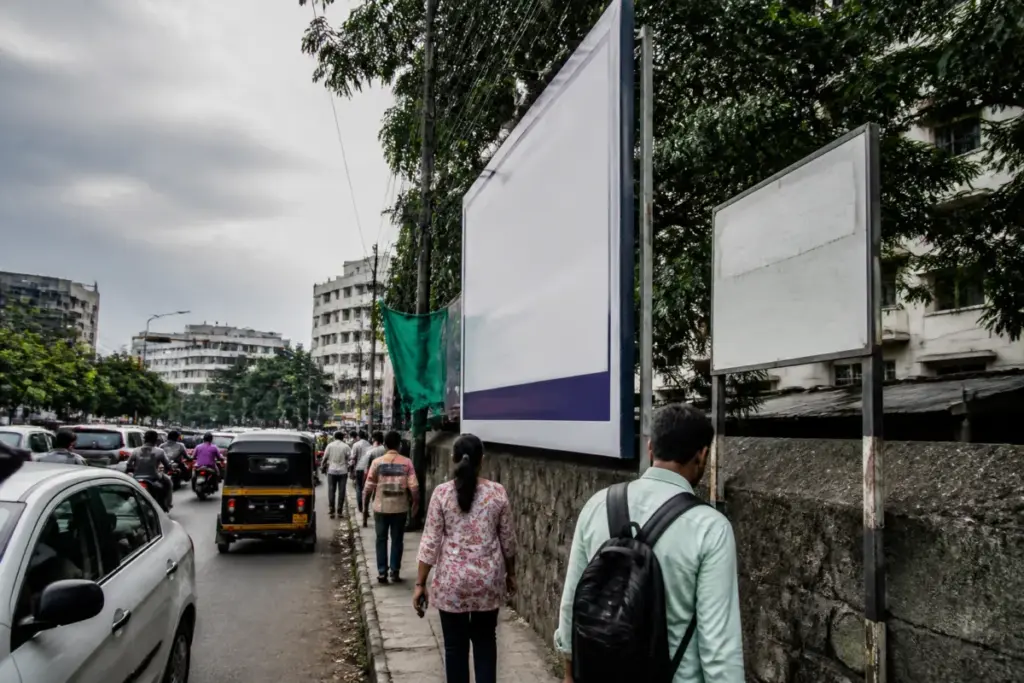
Pune’s illegal flex boards are no longer only a visual nuisance. Their spread across junctions, roads and footpaths, including displays featuring the names and photographs of police officers, shows how weak enforcement can allow private publicity to occupy public space and undermine the authority of the rules meant to regulate it.
The immediate issue reported along Sinhagad Road and near Rajaram Bridge involved flex boards announcing the inauguration of a hotel. One board prominently featured the name and a large photograph of a Deputy Commissioner of Police-rank officer as the inaugurator. Another was installed beside a Pune Municipal Corporation warning sign stating that cases would be registered against those putting up illegal hoardings.
The contrast is significant. A civic warning sign represents the formal regulatory position of the municipal corporation. The flex board beside it represents the practical reality on the street: a public footpath or junction can still be used for unauthorised publicity, even when the prohibition is visibly displayed. The question is not simply why one board was installed, but why the enforcement system did not prevent it or remove it immediately.
According to the report, unauthorised boards were placed along Sinhagad Road between Pu La Deshpande Garden and Dhayari Phata. Another flex board was installed on the footpath along the Anandnagar–Vitthalwadi road. Similar boards were reported at several points along Sinhagad Road, while flex boards and advertisements were also being installed on the footpath opposite Matoshree Old Age Home in the DP Road area of Karvenagar.
The locations matter because these are not vacant advertising plots. They include busy junctions, pedestrian paths and road edges, where even a temporary structure can interfere with movement and visibility. The report describes boards tied to trees at such a low height that pedestrians are forced to bend while passing underneath them. That turns an advertising practice into a direct public-space and safety problem.
The issue also exposes a conflict between two systems of authority. The PMC’s Sky Sign Department and encroachment machinery are responsible for acting against unauthorised displays, while police personnel and officers are associated with law enforcement and public order. When a board uses the identity of a police officer to promote an event, it creates a public impression of official association, regardless of whether the officer authorised the display.
Pune Times Mirror quoted Sandeep Kadam, Deputy Commissioner of the PMC’s Sky Sign Department, as saying that immediate action would be initiated against those responsible. “This is a serious issue. I am directing the assistant commissioners to take immediate action. Legal action will be taken against those responsible,” he said.
The reported sequence, however, suggests that removal often follows citizen intervention rather than routine inspection. In an earlier incident involving boards near Rajaram Bridge, a vigilant citizen informed the authorities and shared photographs. The boards were removed two days later. The fact that photographic evidence and a citizen complaint were needed to trigger action points to a reactive enforcement model.
That model is particularly weak when unauthorised displays are numerous and temporary. Flex boards can be printed and installed quickly, used for a limited event, and removed before formal proceedings gather momentum. If responsibility for printing and installation is difficult to establish, the regulatory burden shifts towards continuous monitoring. Without that capacity, enforcement becomes dependent on residents noticing violations and reporting them.
The report also identifies the commercial and political ecosystem supporting the practice. Flex-printing businesses operate across the city, and the same businesses are responsible for installing many of the boards. The displays are used by political workers seeking publicity at little or no cost, as well as for commercial advertising and event announcements. Boards feature current and former corporators, political workers and office-bearers, and are often placed in the areas where those individuals are active.
This creates a low-cost publicity network built on public land and municipal infrastructure. The expense of the campaign may be small for the person commissioning the board, but the collective cost is borne by pedestrians, road users and the city’s public realm. Footpaths become advertising supports, trees become mounting points and junctions become informal display zones. The municipal corporation is then left to spend time and resources clearing installations that should not have been permitted in the first place.
The use of police identities adds another layer. The report states that police officers are permitted to participate in social and cultural events, but that the police manual does not permit advertisements featuring the names and photographs of officers or personnel to be displayed in public places. Despite this rule, such displays are routinely used.
The earlier example cited in the report involved a police officer known as an “encounter specialist”. After the officer was posted to a particular location, a notorious criminal put up a congratulatory flex board. The board was removed and destroyed after the officer learnt about it. The example demonstrates how the public display of an officer’s identity can be used to create an association that may not reflect official approval.
The institutional problem is therefore larger than unauthorised advertising. The PMC has a regulatory role over sky signs and encroachments, while the police have internal rules governing the public use of officers’ names and photographs. Yet the boards occupy a space between these responsibilities. Municipal action is required because the display is unauthorised, while police rules become relevant because official identities are being used. If the two systems do not act together, responsibility can become fragmented.
The reported response from the Sky Sign Department indicates that the PMC recognises the seriousness of the matter. But a statement promising immediate action does not establish how the person who commissioned the board will be identified, whether the printer or installer will face action, or whether similar displays will be tracked across the city. Those operational details are central to whether removal produces compliance or merely clears one location temporarily.
The pattern described in the report also follows a predictable seasonal and political rhythm. Flex boards increase around celebrations connected to national leaders and during festive periods. They are also used for anniversaries, inaugurations and local political publicity. This means the problem is not limited to isolated violations. It is a recurring form of urban communication that has become embedded in neighbourhood-level political and commercial activity.
Because the boards are distributed across many streets, enforcement cannot rely only on occasional drives. The source material does not establish whether the PMC maintains a public register of complaints, publishes removal data, or records repeat offenders. It does, however, show that boards continue to appear at multiple locations even after warnings and previous removals. That gap between the existence of rules and visible compliance is the central governance issue.
The pedestrian consequences are also easy to overlook because each board may appear temporary. A board tied to a tree, placed at a low height or installed on a footpath reduces the usable width of a walking route. At a junction, it can add visual clutter near signs and traffic movement. For older people, children and residents with limited mobility, an obstruction that requires bending, stepping onto the road or changing direction is not a minor inconvenience.
The Pune case illustrates how the quality of a city’s public realm depends on routine enforcement as much as on major infrastructure projects. Footpaths, road margins and junctions are managed spaces, even when they lack the visibility of a bridge or a metro corridor. When rules are not applied consistently, public land becomes available to whoever can print and install a board fastest.
What the evidence confirms is a recurring enforcement failure involving illegal flex boards across Sinhagad Road, Rajaram Bridge, Anandnagar–Vitthalwadi and Karvenagar. It also confirms that PMC officials have directed immediate action and that the reported displays featuring police officers’ names and photographs conflict with the police manual described in the report. What remains unclear is whether enforcement will extend beyond removal to the organisers, printers and installers responsible for the wider network. That is the next test for Pune’s civic and police administration.


