

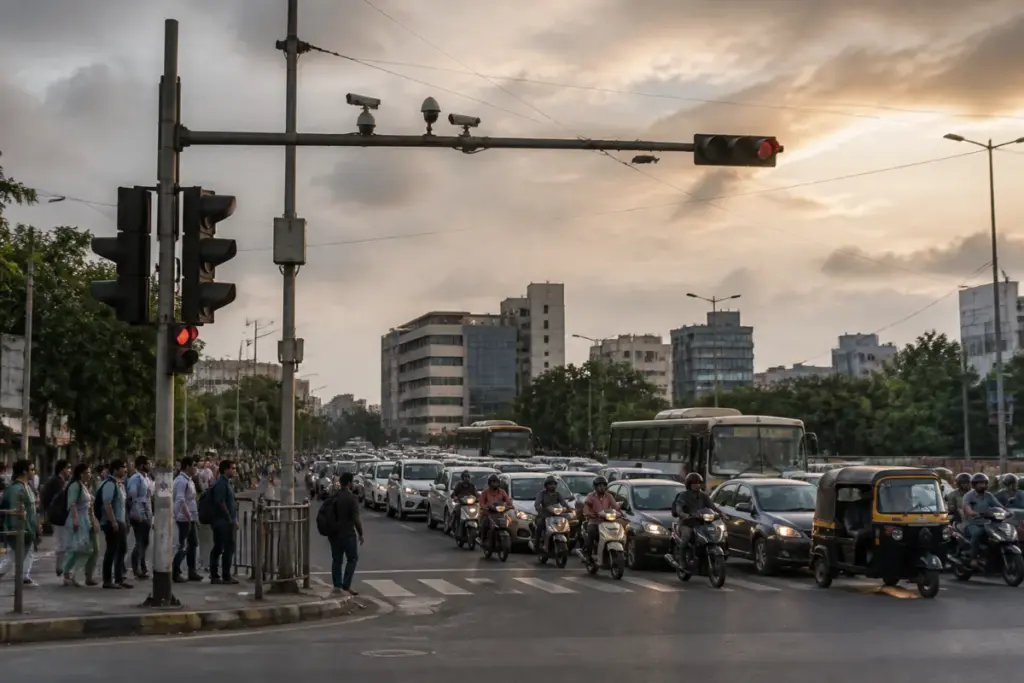
Pune’s Adaptive Traffic Management System (ATMS), introduced in 2023 at a reported cost of ₹102 crore, is facing a basic urban test: whether it has reduced waiting times and made journeys through the city’s busiest junctions more predictable. The system was designed to alter signal timings according to vehicle queues, but observations cited by Civic Mirror found long lines on all four sides of junctions during peak periods. The gap between automated signals and visible traffic relief has now opened a larger question about how Pune evaluates technology-led transport projects.
ATMS is intended to respond dynamically to changing traffic conditions. Cameras monitor vehicle queues, allowing signal time to be adjusted so that a less congested approach receives less green time while a busier approach receives more. The stated objective is to reduce waiting and coordinate signals across major junctions. In principle, this moves signal management away from fixed or manually controlled timings and towards a system that reacts to traffic conditions.
The Pune traffic police maintain that the system has produced an improvement. Additional Commissioner of Police for the western division and traffic, Manoj Patil, told Civic Mirror that ATMS has helped keep traffic moving and achieve better coordination between signals. He said signals were previously controlled manually and that a positive difference could now be seen in traffic management.
That claim, however, has not been matched in the material supplied by a publicly available before-and-after assessment. Harshad Abhyankar, director of Save Pune Traffic Movement, said he had not observed a major improvement. He also clarified that his view was based on personal observation and not on a formal comparative study of traffic conditions before and after the system began operating. His position is therefore not an independent measurement of the project’s performance, but it points to the absence of a clearly established public evidence base in the report.
This distinction matters because Pune’s traffic has continued to change while the system has been in operation. Abhyankar said the city’s vehicle population was increasing by around 7 to 8 per cent each year. On that account, a small improvement in signal performance could be absorbed by the arrival of more vehicles on the road. Without comparable data from before and after ATMS, it is difficult to determine whether the system has reduced congestion, slowed its deterioration or simply managed individual junctions without changing the overall travel experience.
The technology’s operating logic also places limits on what adaptive signals can achieve. If a camera detects a long queue, the system can give that direction a few additional seconds of green time. Abhyankar argued that such an adjustment could provide some relief but would not transform a journey that previously took one hour and 20 minutes into a one-hour trip. The point is not that signal optimisation has no value. It is that the scale of the intervention must be matched against the scale of the congestion problem being measured.
Signal coordination raises another question: whose movement is being optimised? Abhyankar said it was necessary to clarify the speed assumed when designing a sequence of green signals. A progression designed around private vehicles may not work equally well for buses, which operate within mixed traffic and serve passengers who stop and board along the route. If coordination is judged mainly by the movement of cars and two-wheelers, the system may improve one measure of traffic flow without improving the reliability of public transport.
The same concern extends beyond vehicles. Architect and urban designer Aditya Chavande, a project associate at Parisar, argued that ATMS should be assessed through pedestrian safety and access to public transport as well as vehicle speed. He said an arrangement could not be considered inclusive if vehicle traffic improved while pedestrians continued to struggle to cross roads.
For pedestrians, the relevant signal is not the length of a vehicle queue but whether there is sufficient time to cross safely. Chavande said the assessment should include pedestrian crossing time, accessibility for persons with disabilities, and safe walking routes to bus stops and metro stations. These are not secondary concerns in a city where traffic junctions are also transfer points between walking, buses, two-wheelers, cars and rail-based public transport.
The commuter experience described in the report reinforces this broader definition of performance. Amol Zende, who regularly travels through congested junctions, said vehicle queues often moved very little even after several signal cycles during peak hours. Reena Chaudhari said that although the signals changed automatically, the benefit was not apparent when all approaches were already full of vehicles. Their accounts do not establish citywide performance, but they identify the everyday indicators by which users judge the system: waiting time, queue movement and journey predictability.
Pune’s present signal network also shows that ATMS is not operating across every signal. The traffic department said the city has 302 traffic signals, of which 281 are operational. ATMS controls 125 of those operational signals. This means the system covers a substantial but limited part of the functioning signal network. The department is also planning to increase the total number of signals to 450, according to the report.
Expansion creates an institutional question alongside a technical one. Adding more signals and extending automated control may improve coordination only if the underlying network, junction design, enforcement and traffic data are reliable. The report does not establish whether all 125 ATMS-controlled signals are functioning continuously, whether camera data are available at the same quality across junctions, or how frequently signal plans are reviewed. Those details are important because the existence of an automated system does not by itself demonstrate that the system is accurately sensing conditions or producing the intended response.
The traffic administration has proposed an Intelligent Traffic Management System, or ITMS, as the next step. According to Patil, the proposed system would use advance information such as road width and the number of vehicles using each road to plan traffic management. This would represent a shift from responding to observed queues towards using a wider set of network information in planning.
That proposed shift also makes measurement more important, not less. A system that uses road characteristics and traffic volumes needs a clear account of what it is trying to improve. Possible measures identified in the report include waiting time, journey duration, queue length, signal coordination, public transport speed, pedestrian crossing time and access to bus stops and metro stations. The report does not provide a formal dashboard or comparative dataset for these indicators, so the relative success of ATMS remains unresolved.
The institutional disagreement is therefore not simply between supporters and critics of traffic technology. The police say the system has made a positive difference compared with manual control. Mobility activists say a major improvement has not been evident and should be demonstrated through data. Urban-design voices argue that vehicle movement alone is too narrow a measure. Commuters describe persistent delays at the point where the system is expected to make a visible difference.
Pune’s experience illustrates a recurring challenge in urban infrastructure: deployment is easier to count than outcomes. The city can report the ₹102-crore project, the number of operational signals and the number under ATMS control. Those figures establish the scale of the intervention, but they do not answer whether residents are spending less time in traffic or whether public transport and walking have become more reliable and safer.
The next stage of Pune’s traffic management will depend on how the proposed ITMS is defined and evaluated. The immediate evidence confirms that ATMS is functioning across 125 signals and that the traffic police see benefits from automated coordination. It also confirms that commuters and mobility observers continue to report congestion and that no formal before-and-after comparison is presented in the supplied report. Until such evidence is published, Pune cannot clearly distinguish between technology that has reduced congestion and technology that has merely helped the network cope with a growing vehicle load.


