

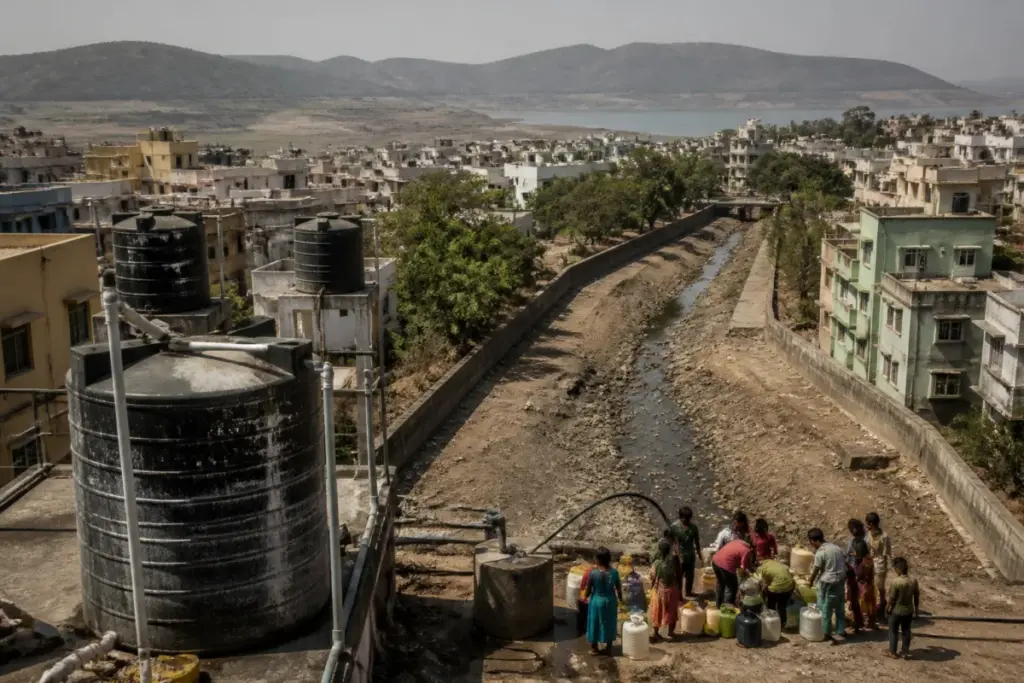
Pune’s water cuts are being presented as a response to deficient rainfall and shrinking dam reserves, but the city’s emerging crisis is also a test of how urban water is allocated, measured and reused. The Pune Municipal Corporation has already implemented a 10 per cent reduction in supply, including a weekly closure every Thursday, while a 20 per cent cut is under discussion. Behind that immediate measure lies a more complicated system: a growing population, a disputed municipal quota, substantial distribution losses, incomplete metering, delayed infrastructure and treated sewage that is not being used at the scale planned.
The civic administration has asked the Water Resources Department to reserve 21.34 thousand million cubic feet, or TMC, of water to meet Pune’s requirements until the next monsoon. The department has allocated 14.61 TMC for the PMC for the year, even though the civic body says it has been drawing slightly more than 22 TMC annually for the past two years and expects demand to rise further. The gap between the formal allocation and actual withdrawals is central to the dispute because it places the city’s drinking-water security within a wider contest over reservoir stocks and competing regional requirements.
The four reservoirs of the Khadakwasla system—Khadakwasla, Panshet, Varasgaon and Temghar—are Pune’s principal water source. According to the report, these dams reached capacity in July, after which there was no further rainfall. Their combined storage was reported at 26.22 TMC, or 80 per cent of total capacity, but this level was lower than at the same time last year. Water is also released through canals to meet rural requirements, and the report says there is a possibility that water could be diverted to other parts of Maharashtra for basic drinking-water needs.
This means that Pune’s water problem cannot be understood only through the percentage of storage remaining in the reservoirs. The usable stock depends on how water is divided between urban and rural areas, how much is reserved for drinking water, how much is released through canals, and how much is lost before reaching households. A reservoir figure is therefore only one part of the city’s water balance. The administrative decisions governing those releases are equally important.
The pressure has increased as Pune’s municipal boundaries have expanded. Eleven villages were merged into the civic body in 2017 and another 23 in 2021. These additions increased the population whose water demand must be met by the PMC, while the formal allocation cited by the Water Resources Department did not match the quantity the civic body says it needs. The report also states that water consumption in the city is estimated at 260 litres per person per day against an allocated norm of 140 litres per person per day.
Those figures point to two different challenges. One is the difficulty of supplying a larger urban area through a system designed around older boundaries and allocations. The other is the need to establish how much water is actually consumed, where it is consumed and how much disappears through leakage or unauthorised use. The PMC claims that 40 per cent of supplied water is lost in leakage, while another estimate in the report puts leakage in the supply system at around 35 per cent. Even with the difference between these figures, both indicate that a substantial share of treated water may not reach paying consumers.
The municipal commissioner, Naval Kishore Ram, said the PMC had begun implementing the 10 per cent cut in accordance with the state government’s directions. He said the administration was reviewing the dam situation and considering whether the reduction should be increased to 20 per cent. A deeper cut would mean closures on more days, but Ram also pointed to technical concerns: some areas could receive very little or no water, and the distribution plan would have to avoid placing a disproportionate burden on neighbourhoods that already receive less water.
That qualification is significant because a citywide percentage reduction does not create a uniform experience. The same reduction can be manageable for a household with storage tanks, regular pressure and reliable supply timings, but disruptive for households in areas with intermittent or low-pressure networks. The PMC’s proposed approach, as described by the commissioner, is to reduce supply less in areas that already receive less water. The report does not provide the neighbourhood-level data needed to assess how such a formula would work, but it establishes that the impact of a water cut will depend on the distribution network rather than only on the headline percentage.
The PMC’s long-delayed 24-by-7 water-supply project is intended to address some of these structural weaknesses. The project includes water metering, new and extended transmission and distribution networks, overhead reservoirs and measures to reduce leakage. The civic body says the project in the old city area is nearing completion, although some tanks have not yet been commissioned because connecting pipelines are incomplete.
The scale of the planned network illustrates why the project matters to the current crisis. The transmission and distribution network is listed at 2,544.09 kilometres, with an additional 1,618.44 kilometres—including replacement of 218.23 kilometres—being undertaken to take the overall network to 4,162.53 kilometres. The PMC is also required to install 2,55,541 automated meter-reading water meters. A total of 82 reservoirs are being constructed as part of the project.
These investments are not simply a service-improvement programme. They are an attempt to create the measurement and control systems needed for reliable water management in a growing city. Without meters, the PMC has limited visibility over consumption. Without reservoirs and pressure management, a scheduled supply can remain uneven. Without network replacement, additional treatment capacity can continue to be undermined by leakage. The project’s effectiveness will therefore depend not only on physical completion but also on commissioning, connections and actual operation.
Pune’s stated future demand makes the issue more urgent. The PMC estimates water consumption at 1,479 million litres per day by 2032 and 1,907 MLD by 2047. Its present water-treatment capacity is 1,651 MLD through treatment plants at seven locations. These numbers suggest that treatment capacity is not the same as assured supply: a city may have plants capable of processing water while still facing shortages because raw-water allocations, reservoir levels, network losses and distribution arrangements constrain what reaches residents.
The most consequential evidence in the report concerns treated sewage. The PMC is described as the first and only municipal corporation in the country to treat 650 MLD of sewage generated in the city every day and release it through a canal to Daund for agriculture. A facility at Mundhwa Jackwell, built at a cost of Rs 100 crore, was intended to support this reuse system. However, the Water Resources Department lifted only 1.5 MLD of purified sewage per day during the three weeks from September 25 to October 14, against the reported treatment capacity of 650 MLD per day.
The difference between planned treatment and actual uptake exposes a coordination failure between urban sanitation and regional water management. If treated sewage is not collected for its intended agricultural use, the city’s investment in purification does not deliver the full water-saving benefit. At the same time, drinking water from the canal may continue to be released for agriculture, according to civic activist Vivek Velankar, whose criticism was cited in the report. His claim is presented as an allegation about the department’s use of available water; the report does not include a response from the Water Resources Department.
The report says that full use of the purified sewage over the three-week period could have prevented at least one TMC of dam water from being released for agriculture, potentially preserving that quantity for Pune’s drinking-water needs. This estimate is attributed to the civic activist’s assessment and should not be treated as an independently established saving. Even with that limitation, the reported 1.5 MLD uptake shows that the reuse system is operating far below its stated scale.
The state government’s response has been to require local self-government bodies to reduce water consumption by at least 10 per cent. A government decision issued through the Water Resources Department on October 5 said water resources would have to be managed to secure drinking-water requirements until August 31, 2027. The report attributes the reduction in rainfall to the effect of El Nino and says the cut could be increased in line with available supply.
This policy places the immediate burden of scarcity management on municipal supply systems and residents. But the evidence in Pune also shows why demand reduction cannot be separated from institutional coordination. The PMC controls distribution within the city, while the Water Resources Department controls important decisions about allocation, canal releases and the movement of water for agricultural use. The city’s water security therefore depends on both local network performance and decisions taken beyond the municipal boundary.
Pune’s weekly closure is consequently more than a temporary scheduling change. It is the visible outcome of a water system where urban growth has outpaced formal allocation, where a large quantity of treated water is reportedly lost through leakage, and where a major sewage-reuse facility is not being used at capacity. The immediate facts are clear: the PMC has implemented a 10 per cent cut, a 20 per cent reduction remains under discussion, and the administration is reviewing reservoir availability. What remains unresolved is how the competing claims on dam water will be reconciled, when the delayed network and metering works will become fully operational, and why treated sewage is not being lifted at the scale required to reduce pressure on drinking-water supplies.


