

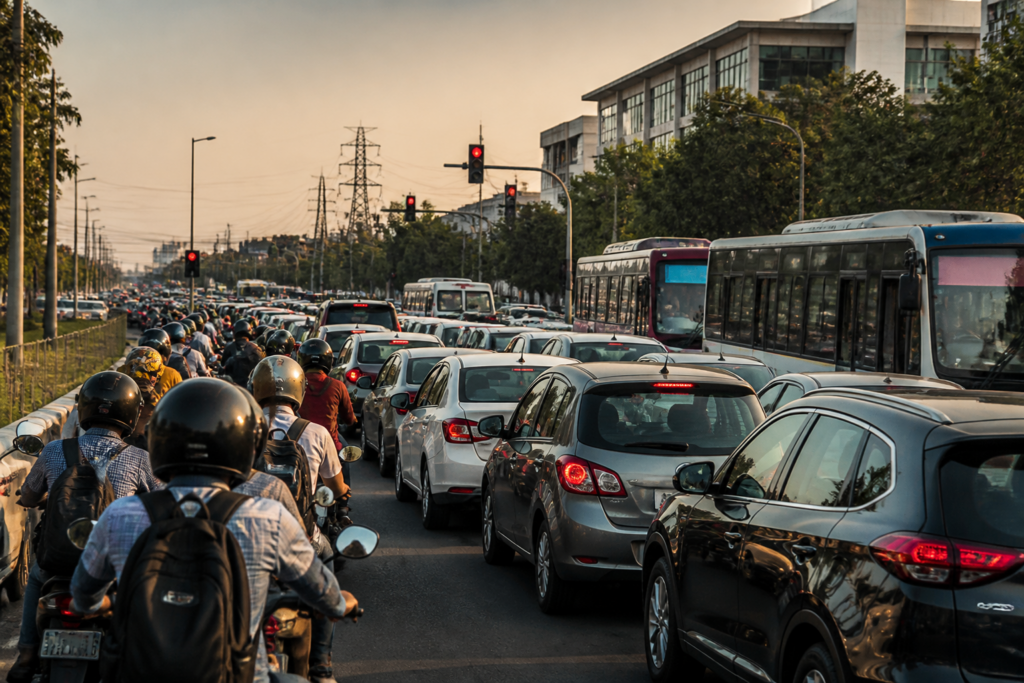
Pune’s traffic congestion is set to undergo a metropolitan-scale review, with IIM Mumbai preparing a study of the city’s transport system and recommending long-term solutions for roads, signals, public transport and the Metro network.
The initiative was taken after Union Minister of State for Cooperation and Civil Aviation Murlidhar Mohol, who represents Pune in the Lok Sabha, approached IIM Mumbai to examine Pune’s traffic infrastructure as an integrated system rather than as a collection of separate projects. Preliminary discussions have begun between institute experts and officials from departments involved in transport management.
The study will cover Pune city and the wider Pune metropolitan region. It will examine the causes of congestion on major roads, improvements required in traffic signal systems and management, and coordination between the Metro, Pune Mahanagar Parivahan Mahamandal Limited (PMPML) and other transport services.
Mohol said traffic congestion was directly affecting citizens’ daily lives and that the city’s rapid expansion and rising vehicle numbers made long-term planning necessary alongside temporary measures. The objective, he said, was to coordinate different transport mechanisms to make journeys safer, easier and faster.
The proposed review will also assess the long-term impact of population growth and increasing vehicle ownership. According to figures cited by Mohol, the Pune metropolitan region has a population of about one crore and is expected to double over the next three decades. The number of registered vehicles in the city has increased from 52 lakh in 2018 to 81 lakh in 2026, with more than 1,300 vehicles being added every day.
These figures place the study within a wider institutional challenge: Pune’s transport system is managed through multiple agencies and modes, while congestion is experienced continuously across their boundaries. Roads, traffic signals, public buses, Metro services and the proposed ring road therefore need to be assessed together, rather than only through individual project timelines.
Traffic police and the municipal corporation are already implementing measures including improved signal coordination and the use of artificial intelligence for traffic analysis. Mohol said these interventions would need to be supported by long-term planning and a clearer assessment of gaps in the existing system.
IIM Mumbai’s expertise includes operations research, transport management and logistics. Its experts will examine shortcomings in Pune’s current transport arrangements and recommend measures based on existing infrastructure and future requirements. The institute and Pune officials are currently determining the scope of the study and identifying the region’s key transport challenges.


