

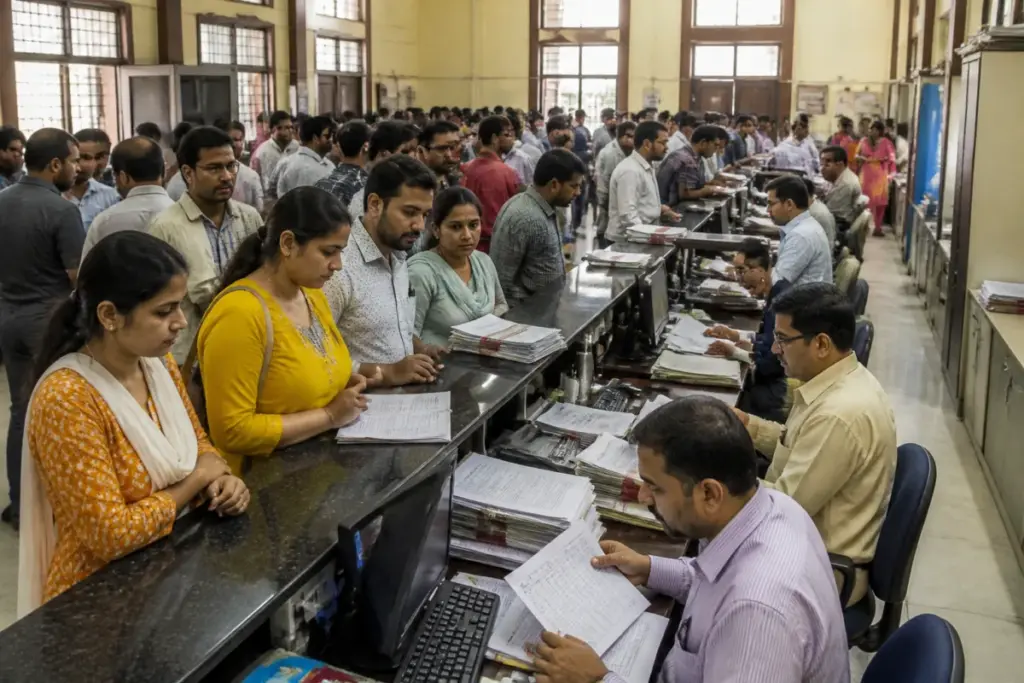
Pune property registrations rose sharply during the Navratri period, with 7,169 documents recorded across the city’s 28 sub-registrar offices between October 11 and 18, generating Rs 269.43 crore in stamp duty and registration revenue. The figures show how a concentrated festive buying window can bring a large volume of housing and property transactions into the formal registration system within just eight days.
The surge was led by buyers choosing the Navratri and Dussehra period to purchase flats, plots and other properties. Lokmat reported that Dattatray Gurav, who moved to Pune from Kolhapur district for work, bought a home after waiting for 10 years. His purchase illustrates the personal timeline that can sit behind a registration statistic: a transaction recorded in one day may represent years of income, saving and decisions about staying in the city.
The registration numbers therefore capture more than a seasonal preference. They bring together household demand, property supply and the administrative process required to make ownership legally effective. Every registered document also creates a direct fiscal transaction for the state through stamp duty and registration charges. During the eight-day period, stamp duty accounted for Rs 256.96 crore, while registration fees contributed Rs 12.48 crore.
The numbers were not distributed evenly across Pune’s registration network. Haveli number 10 recorded the highest volume, with 403 documents. It was followed by Haveli number 25 with 380, Haveli number 7 with 369 and Haveli number 26 with 348. Haveli numbers 24 and 18 recorded 333 and 332 documents respectively.
These office-level figures matter because registration offices are where the city’s property market becomes visible through official transactions. Sales activity may be discussed through prices, launches or buyer sentiment, but the registration system records completed documentation and the charges collected by the government. The concentration of transactions in particular offices also indicates where formal property activity was most intense during the period, although the supplied report does not identify the specific neighbourhoods or property types behind each office’s total.
The comparison with the previous year provides a useful but limited measure of the festive effect. During the previous year’s 10-day Navratri and Dussehra period, 11,234 documents were registered and the department collected Rs 407.12 crore in revenue. The current year’s eight-day total is lower in absolute terms, but the periods are not identical. A direct year-on-year conclusion cannot be drawn without matching the number of days and the corresponding dates.
A separate comparison cited in the report offers another indication of the seasonal increase. Between September 23 and 26 last year, 6,446 documents were registered in Pune over four days. This year’s eight-day Navratri window produced 7,169 registrations. The two periods differ in duration, so they should not be treated as like-for-like annual comparisons. They nevertheless show that the registration department experienced a substantial concentration of activity during the current festive window.
According to Mangesh Khamkar, in-charge joint district registrar, property document registrations, particularly home purchases, increase during this period and the effect is visible in government revenue. He said that on ordinary days around 800 to 1,000 documents are registered, while registrations during Navratri rise by roughly one-and-a-half times.
That observation places the festive period in the context of the city’s normal administrative workload. The reported eight-day total works out to an average of nearly 896 documents a day across the 28 offices. This sits within the ordinary daily range cited by the official, although the available figures do not show how registrations were distributed from day to day or whether some days recorded a sharper peak than others.
The revenue calculation also reveals the fiscal scale of property transactions in the city. The average revenue collected per registered document during the eight-day period was approximately Rs 3.76 lakh, based on the total of Rs 269.43 crore and 7,169 documents. This is an aggregate indicator, not the charge associated with a typical property, because the amount of stamp duty and registration fee varies according to the transaction and property details. The report does not provide the value of the properties registered or a breakdown by flats, plots and other assets.
The difference between stamp duty and registration fees is also significant. Stamp duty generated almost 21 times the revenue collected through registration fees during the period. This means the state’s earnings were driven overwhelmingly by the transaction-linked stamp duty component, while registration fees formed a smaller but separate contribution. Together, the two streams make property registration an important point at which private real estate activity produces public revenue.
For buyers, the registration process is the formal bridge between an agreement to purchase and the government record of the transaction. The report does not state whether the festive registrations were concentrated among newly launched housing, resale homes, plots or commercial properties. That missing breakdown limits what can be concluded about the precise nature of demand. The available data establish the volume of documentation and revenue, but not the income profile of buyers, the size of homes purchased, the locations involved or the financing used.
The story also shows why aggregate registration data must be read alongside the longer housing journey. Gurav’s 10-year wait reflects the gap that can exist between arriving in a city for work and acquiring a home there. Pune’s property market is connected to the city’s role as an employment destination, but the supplied figures do not quantify migration, household incomes, prices or affordability. It would therefore be inaccurate to treat the registration surge alone as evidence that housing has become more accessible.
What the data do establish is that the timing of purchase remains important for many Pune households. A festival creates a recognised moment for completing a transaction, while the registration department must absorb the resulting increase in demand. The administrative system handled 7,169 documents across 28 offices in eight days, with some offices recording more than 400 documents. The scale highlights the operational importance of registration capacity during predictable seasonal peaks.
The figures also offer a reminder that Pune’s real estate cycle has a public-administration dimension. Property transactions are not only private exchanges between buyers and sellers; they require government documentation and generate revenue through statutory charges. When activity rises, the effect is visible simultaneously in household decisions, sub-registrar office workloads and state receipts.
The evidence remains narrower than a complete assessment of Pune’s housing market. It does not establish whether registrations increased because of rising sales, delayed transactions being completed during the festival, changes in property prices or the availability of particular projects. It also does not identify the total value of registered property or compare the current period with an equivalent eight-day window from the previous year.
The clearest conclusion is more specific: Pune recorded a strong concentration of property registrations during October 11-18, with 7,169 documents producing Rs 269.43 crore in stamp duty and registration revenue. The next useful layer of evidence would be a like-for-like annual comparison, an office-wise location map and a breakdown by property type and transaction value. Until those details are available, the registration data confirm the strength of the festive transaction window, but not the broader condition of affordability or the direction of Pune’s housing market.


