

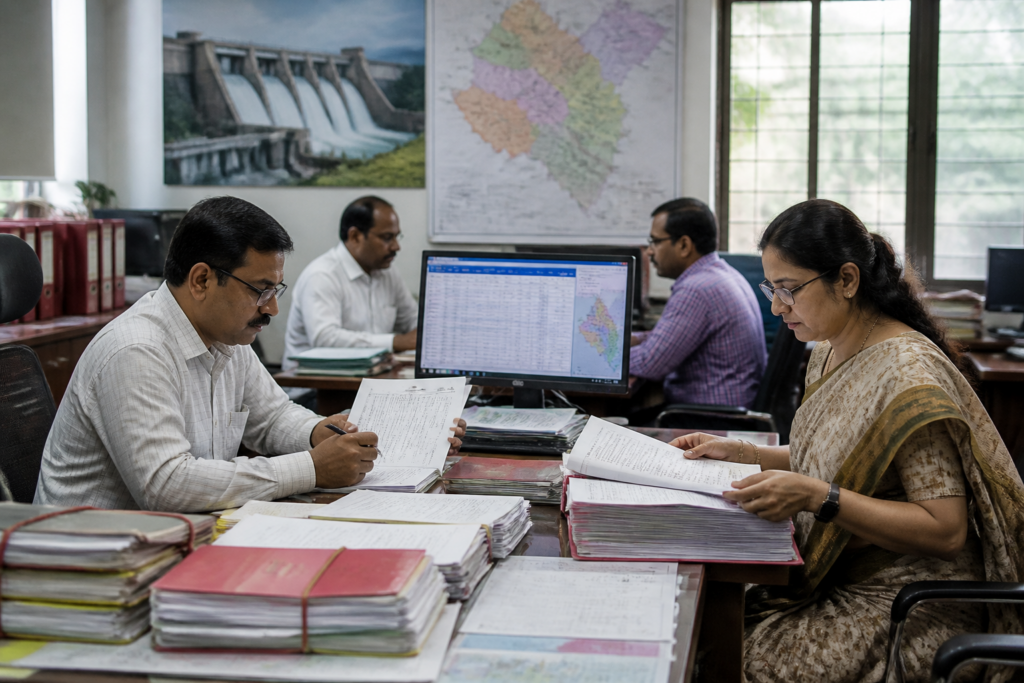
The Pune district administration has begun consolidating land-allotment records for farmers affected by 25 dam and irrigation projects on a single digital dashboard, in a move aimed at identifying eligible beneficiaries and investigating suspected duplicate rehabilitation benefits.
The exercise covers 36,096 hectares acquired for the projects and records 22,976 project-affected people, according to information reported by Lokmat – Pune. Existing digital records show that 6,045 farmers have received allotments covering 13,783 hectares. The administration has identified 1,563 cases requiring scrutiny for possible duplicate allotment.
Initial field-level checks have confirmed 16 cases of actual duplicate allotment, while the remaining cases will undergo detailed verification. The administration plans to match digital entries with original land records, field reports and rehabilitation documents before determining whether the allotments were made in accordance with the applicable rules.
The exercise is also intended to resolve a gap in beneficiary records. Orders for land allotment are estimated to cover around 10,000 beneficiaries, while only about 6,045 names currently appear in the digital records. Officials are examining the succession links between the remaining estimated 4,000 beneficiaries and the original landholders so that the records can be updated.
Information entered by village-level revenue officials is being examined by tehsildars and sub-divisional officers. Each page of the records is being certified with signatures and official seals, according to the report. This verification process is intended to establish a reliable beneficiary database rather than rely solely on incomplete or inconsistent historical entries.
Eligibility for alternative land will depend on the rehabilitation laws applicable when each project acquired land. For projects established before 1976, the rules provided for 100 per cent alternative land after acquisition. In some later projects, affected landholders were allowed to choose between cash compensation and alternative land. Those seeking alternative land were required to deposit 65 per cent, and in some cases 75 per cent, of the land-acquisition compensation with the government.
The administration will examine whether landholders who accepted the full cash compensation without depositing the prescribed amount remain eligible for alternative land under the relevant law. Land-acquisition officers have been asked to provide original receipts and beneficiary lists. These documents will be used to determine the exact number of people eligible for land allotment.
The review covers projects including Ujani, Veer, Panshet, Varasgaon, Pavana, Chaskaman, Dimbhe, Yedgaon, Chilhewadi, Pimpalgaon Joga, Wadaj, Manikdoh, Vadivale, Pimpalwadi, Bhorgaon Raita, Andra Valley, Temghar, Bhama Askhed, Arala, Kalmodi, Malavandi, Jadhavwadi, Gunjavani, Kasarsai and Nira Deoghar. The administration said the digital records would be cross-checked with original documents and field inspections to remove inconsistencies in land distribution.
If duplicate benefits are established under the applicable rules, action will be taken regarding the additional land. The immediate administrative milestone is the completion of document and field verification, after which the district administration is expected to finalise the list of eligible project-affected beneficiaries and determine the status of disputed allotments.


