

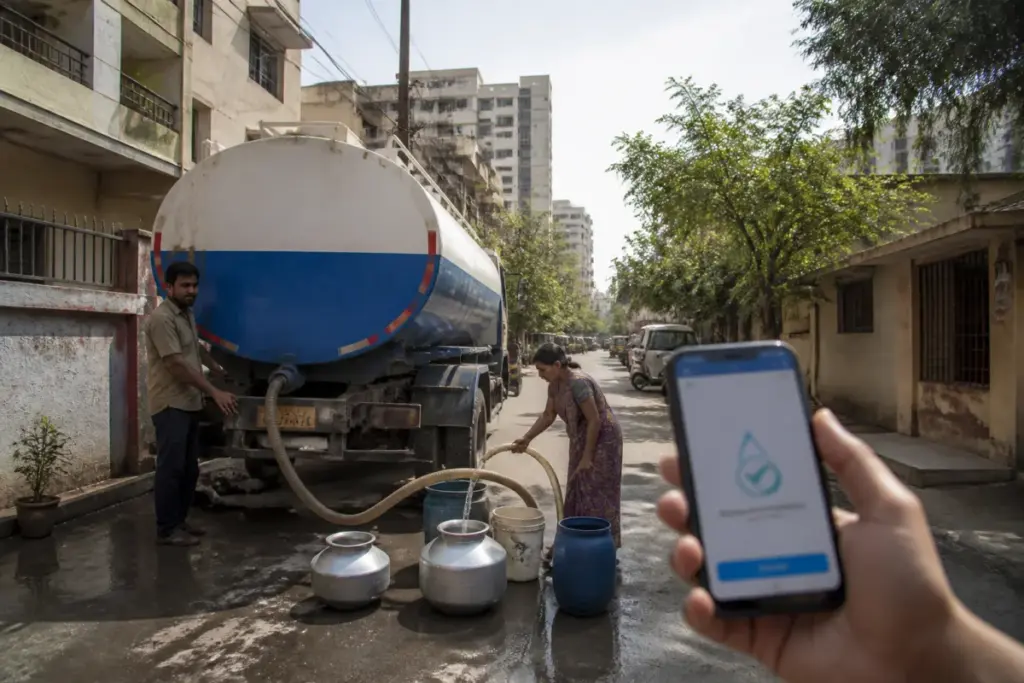
Pune’s OTP water tanker system was announced as a digital answer to bogus tanker trips, water diversion and possible overcharging, but the system remains largely unimplemented six months later. The Pune Municipal Corporation now says it will begin the tender process after the model code of conduct ends, leaving residents dependent on tankers without the promised mechanism for tracking orders and confirming delivery.
The delay matters because a tanker is not simply a private convenience in Pune’s water network. For households facing water shortages, it can become the practical link between the municipal system and daily life. When that link is managed through records that are difficult for residents to verify, the difference between a completed delivery and a recorded delivery can become significant. The proposed OTP system was intended to close that gap through a digital trail from booking to receipt.
According to the report by Pudhari, the system has not started across most of the city, except in the Sus and Mhalunge areas. The claim was made by Sajag Nagrik Manch president Vivek Velankar, who questioned why implementation had not begun even after the corporation had announced the system six months earlier. The Pune civic administration has acknowledged that the system is yet to be implemented.
The proposed process is straightforward. A resident would book a tanker through an application. The tanker’s movement would then be recorded from the filling point to the requested delivery location. Once the water reached the destination, the resident would receive a one-time password on a mobile phone and use it to confirm delivery. The intended result is a record that links a request, a vehicle journey and a customer confirmation.
That design addresses several points at which accountability can weaken. A tanker trip may be shown as completed even if water has not reached the requester. Water loaded at a filling point may not be easy for a resident to trace once the vehicle leaves. A customer may also have limited evidence if the quantity or delivery itself is disputed. The OTP is meant to make the final step dependent on confirmation from the person who requested the water rather than solely on an internal municipal entry.
Pune Municipal Corporation water-supply department chief Nandkishor Jagtap told Pudhari that the system had not yet been applied. He said the tender process would be undertaken after the model code of conduct ended and that the system would then be started quickly. Jagtap described the proposed arrangement as working in a manner similar to Ola and Uber, with digital records for tanker booking, delivery and confirmation of receipt.
The reference to app-based transport platforms is important because it indicates the administration’s intended operating model: a service request, a traceable journey and a digitally recorded endpoint. But the comparison also highlights the difference between a platform feature and a functioning public service. A digital interface can record a booking only after the institution has established the operational rules behind it. The corporation must still determine how tankers are assigned, how filling points are recorded, how delivery locations are authenticated and what happens when a tanker cannot complete a trip.
The source report does not establish the size of Pune’s tanker fleet, the number of daily tanker requests, the cost of the proposed system or the tender timeline. It also does not provide city-wide data on alleged bogus trips, water diversion or overcharging. Those limits are important. The proposed system is being justified as a response to these risks, but the available evidence does not quantify their scale.
What is established is the implementation gap. The corporation announced a mechanism intended to improve transparency; six months later, it had not been deployed across most areas. The administration’s stated next step is not operation but procurement. That means the announcement and the service residents were expected to use belong to different stages of the process. The public-facing promise arrived before the technology and operating arrangement were in place.
This distinction is central to understanding digital governance in cities. A municipal technology project is not complete when its features are announced. It becomes meaningful only when residents can use it consistently, when officials act on the information it generates and when the records can be examined if a dispute arises. In the tanker case, the proposed application and OTP may produce more data, but their public value will depend on whether that data is connected to enforcement and service standards.
The system’s limited presence in Sus and Mhalunge also raises a question about pilot-to-scale execution. The report does not say whether the two areas are formal pilot locations, whether the system is fully operational there or why other parts of Pune have not received it. Without those details, it is not possible to determine whether the delay reflects a technical problem, a procurement issue, an administrative decision or a broader change in the water-supply plan. The corporation’s tender process may clarify that institutional sequence.
The timing becomes more consequential if water cuts increase tanker demand. Pudhari reports that demand could rise in the coming period if water restrictions are imposed. In such a situation, a system that is announced but unavailable cannot perform its intended role. Residents may continue to depend on informal or difficult-to-verify arrangements at precisely the time when the volume of requests and the pressure on supply are higher. Velankar has therefore called for the system to be started across the city without delay.
There is also a question of who bears responsibility when a digital record is incomplete. If a tanker leaves a filling centre but does not reach the destination, the proposed journey record could show the interruption. If the resident does not receive the water, the absence of an OTP confirmation could become evidence of non-delivery. But the source material does not explain the response mechanism: whether payment would be withheld, whether the request would be reassigned, whether an official inquiry would begin or whether a resident could lodge a complaint through the application.
These unanswered operational questions are not peripheral. They determine whether the system functions as a monitoring tool or merely as an electronic register. A platform that records delivery without a defined remedy may improve visibility without improving service. Conversely, a system linked to clear accountability could help the corporation identify repeated failures, compare tanker routes and establish whether supply is reaching the locations for which it was requested. The supplied report confirms the intended digital tracking, but not the enforcement framework around it.
The proposed technology also places a practical requirement on residents: access to a mobile phone and the ability to use the application and OTP process. The report does not examine whether all tanker-dependent households can use a smartphone-based booking system or what alternative channel would be available to people who cannot. That is a relevant implementation issue, but the available material does not establish how the corporation plans to address it.
For Pune, the larger urban question is not whether an OTP can be sent after a tanker arrives. It is whether the municipal administration can turn an emergency-oriented supply arrangement into a service that is traceable, equitable and answerable to residents. Tankers operate at the edge of the formal water network, where shortages, private payments and administrative records meet. That makes them a test of the corporation’s capacity to govern a fragmented delivery chain.
The evidence currently supports three conclusions. The OTP-based tanker management system was proposed to prevent bogus trips, water diversion and possible financial exploitation; it remains largely unimplemented six months after its announcement; and the administration says procurement will begin after the model code of conduct ends. What remains unclear is the tender schedule, the cost, the city-wide rollout plan, the status of the Sus and Mhalunge implementation and the safeguards available when a recorded delivery does not match what a resident receives. Those details will determine whether Pune’s tanker digitisation becomes a functioning public-service system or another delayed municipal promise.


