

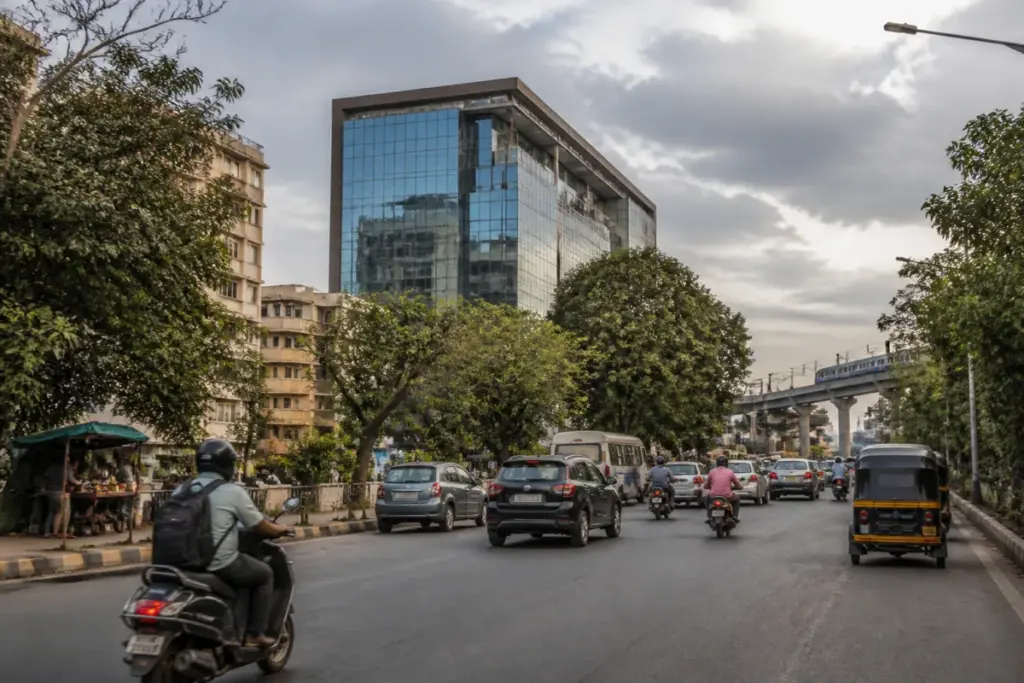
Pune’s office market is entering a phase in which the next major employment hub may not be defined only by large peripheral developments. The growing importance of commute infrastructure, combined with demand for quality office space and access to skilled workers, is opening a wider question: can established neighbourhoods such as Kothrud and other parts of western Pune accommodate modern workplaces closer to where professionals live?
The question is not simply about finding vacant land for offices. It is about whether Pune can distribute employment more evenly across the city without overwhelming residential areas, roads and public transport. The answer will depend on how commercial development is connected to planning regulations, building capacity, metro access, bus services and last-mile mobility.
The scale of demand is significant. According to Colliers, Pune recorded 3.2 million square feet of Grade A office absorption in the third quarter of 2026. The total for January to September reached 6.9 million square feet, 6% higher than during the corresponding period last year. Cushman & Wakefield recorded gross office leasing of 1.99 million square feet in the city during the same quarter, with global capability centres, or GCCs, accounting for about 65% of leasing activity.
Banking, financial services and insurance was the largest contributing sector in the leasing activity recorded by Cushman & Wakefield. It was followed by engineering and manufacturing, IT-BPM and flexible workspaces. These sectors require reliable access to skilled employees, suitable buildings and transport networks, making office location a workforce and operational decision rather than only a real estate choice.
The commute is becoming a more visible part of that decision. CBRE’s 2026 India Office Occupier Survey found that 70% of occupiers prioritise commute infrastructure when selecting office locations. Long and unpredictable journeys can affect punctuality, attendance and employee experience. They can also influence an organisation’s ability to attract and retain talent, particularly when employees have alternatives in other parts of the city or can work from locations closer to home.
This changes the meaning of Pune’s traditional office geography. Hinjawadi, Kharadi, Baner and Balewadi are established commercial districts and are expected to remain important employment centres. However, the continued concentration of jobs in a limited number of corridors can create pressure on travel networks and lengthen daily journeys for workers living elsewhere. The emergence of additional office hubs could complement, rather than replace, these established districts.
Market data already indicates that companies are examining locations beyond core commercial areas. CBRE’s Q3 2026 India Office Figures noted a shift in transactions towards non-core corridors, citing limited availability in core micro-markets and fresh supply in emerging locations. About 51% of GCCs establishing new offices during the quarter selected secondary micro-markets, while Grade A+ buildings accounted for approximately 60% of GCC leasing.
These figures suggest that secondary locations are not necessarily being considered only because they are cheaper or more available. Building quality, connectivity and access to talent are becoming important alongside a location’s established commercial identity. For Pune, that creates a possible opening for neighbourhoods that already possess social infrastructure but have comparatively limited institutional-quality office space.
Cushman & Wakefield places Erandwane, Karve Nagar, Paud Road and Kothrud in its SBD West office submarket, along with Aundh, Baner and Pashan. At the end of the third quarter of 2026, vacancy in this submarket stood at 3.9%, compared with a citywide vacancy rate of 13.88%. The submarket had approximately 11.77 million square feet of planned and under-construction Grade A office supply through 2028.
The low vacancy recorded in the submarket, alongside the planned pipeline, points to an active market. It does not, however, establish that every neighbourhood can absorb large commercial projects. A market opportunity and an urban planning opportunity are not the same thing. The ability of Kothrud or other established areas to accommodate offices will depend on suitable properties, applicable planning rules, building specifications and the capacity of surrounding transport systems.
Kothrud illustrates the potential and the constraints. The neighbourhood is traditionally associated with housing and educational institutions, but it also has healthcare facilities, retail, restaurants and other everyday services. That mature urban setting could support office development without requiring the creation of an entirely new social ecosystem around a peripheral business district.
The same characteristics also make the planning question more complex. An established residential area has existing streets, buildings, services and travel patterns. Introducing institutional-quality offices can bring jobs and activity closer to residents, but it can also alter demand for road space, parking, public transport, water, waste management and public amenities. The supplied market assessment identifies the opportunity but does not establish how much additional development local infrastructure can support.
The principal urban advantage would be a closer relationship between housing and employment. If some workers can access offices within or nearer to their residential catchments, the need for long daily journeys could reduce for those employees. A local workforce pool could also help companies recruit and retain staff. However, these outcomes are not automatic. They depend on the actual distribution of jobs, the affordability and location of housing, working patterns, public transport access and the quality of the office stock.
Metro connectivity strengthens the case for western Pune. The Vanaz–Ramwadi corridor includes Vanaz, Anand Nagar, Ideal Colony and Nal Stop, connecting western Pune with Deccan, central Pune and the eastern corridor. These stations can improve access for nearby employees and for workers travelling from other parts of the city.
The proposed Line 4A extension from Nal Stop towards Warje and Manik Baug could further strengthen connections across western and south-western Pune, subject to implementation. That qualification is important: a proposed extension cannot be treated as existing capacity. The commercial case for offices in western Pune will therefore need to be assessed against transport infrastructure that is available today as well as projects that may be implemented in the future.
Metro access alone will not resolve the last-mile problem. Employees need reliable connections between stations, workplaces and homes. Bus services, interchange facilities, pedestrian access and other forms of local connectivity will determine whether a station is genuinely useful to an office district. A workplace located near a metro line but poorly connected to the station can still impose difficult daily journeys.
The data also shows why employment distribution matters for Pune’s wider urban system. The city recorded strong office absorption in the first nine months of 2026, while GCCs formed a large share of quarterly leasing. This points to continuing demand for modern workplaces, but it also raises questions about where that demand should be accommodated. If new supply is concentrated only in a few high-demand corridors, pressure on those corridors may persist even as citywide vacancy remains available elsewhere.
The distinction between citywide vacancy and neighbourhood-level capacity is therefore central. Pune’s reported citywide vacancy rate of 13.88% was substantially higher than the 3.9% recorded in the SBD West submarket. Such variation indicates that a single citywide measure cannot explain where occupiers can find suitable buildings or where infrastructure is under pressure. Office planning needs to consider the location, quality and accessibility of supply, not only its total volume.
For policymakers, the challenge is to align commercial growth with the systems that make offices functional. Planning regulations determine where and how development can occur. Transport agencies influence the usefulness of metro and bus connections. Municipal services determine whether established neighbourhoods can support additional intensity. Developers and occupiers, meanwhile, determine the type and scale of buildings entering the market.
This makes the potential growth of Kothrud and western Pune an institutional coordination issue as much as a real estate opportunity. A new office building can be approved through a property-level process, but its effects are experienced across streets, junctions, public transport routes and surrounding neighbourhoods. The wider question is whether planning decisions evaluate these connections together or treat each project as an isolated development.
Pune does not need to choose between its established office districts and emerging neighbourhood hubs. The market evidence indicates that demand can expand beyond core corridors, while the city’s transport and residential geography creates a case for more distributed employment. But decentralisation will only improve the urban system if office growth is matched by suitable buildings, effective public transport and infrastructure capacity.
What the available evidence confirms is that commute infrastructure is now a major factor in office location decisions, secondary micro-markets are attracting a significant share of new GCC activity, and western Pune has both an existing urban catchment and a future Grade A supply pipeline. What remains unresolved is how much commercial intensity individual neighbourhoods can absorb and whether transport, municipal services and planning controls will keep pace. Those questions will determine whether bringing workplaces closer to home becomes a practical shift in Pune’s urban structure or remains primarily a real estate proposition.


